A frisbee is one of the simplest toys ever made, and one of the easiest to buy badly. A good disc flies straight and true, floats gently at the end of its flight, and lands softly in the hand without stinging the fingers. A bad one wobbles out of the hand, dives into the ground after ten metres, and turns a relaxed game in the park into a chase after a piece of plastic that refuses to fly. The best frisbees of 2026 are not the most expensive discs on the shelf, and they are not the ones with the flashiest colours. They are the discs that fly well in a light breeze, feel comfortable to throw and catch, and survive being stepped on and dropped on concrete.
What Makes a Frisbee Good
The first thing to judge is how the disc flies. A good frisbee leaves the hand flat, holds a straight line, and glides for a long way before it starts to drop. That flight comes from the shape of the rim and the curve of the top: a well-designed disc catches the air underneath it and rides on it, while a poorly shaped one tumbles as soon as it meets a breeze. When you throw a good disc, it feels almost effortless, and the catch at the other end is a soft meeting of plastic and palm rather than a sting.
The second thing is the feel of the plastic. A disc that is too hard hurts the hand on a fast catch and cracks when it hits a wall. A disc that is too soft folds in the wind and never flies straight. The best discs use a firm but slightly flexible plastic that grips the fingers well, even when hands are a little sweaty, and springs back to shape after a hard landing. The rim should be smooth and rounded, with no sharp edge, because a sharp rim is what turns a fun catch into a sore finger.
The Main Types of Frisbee
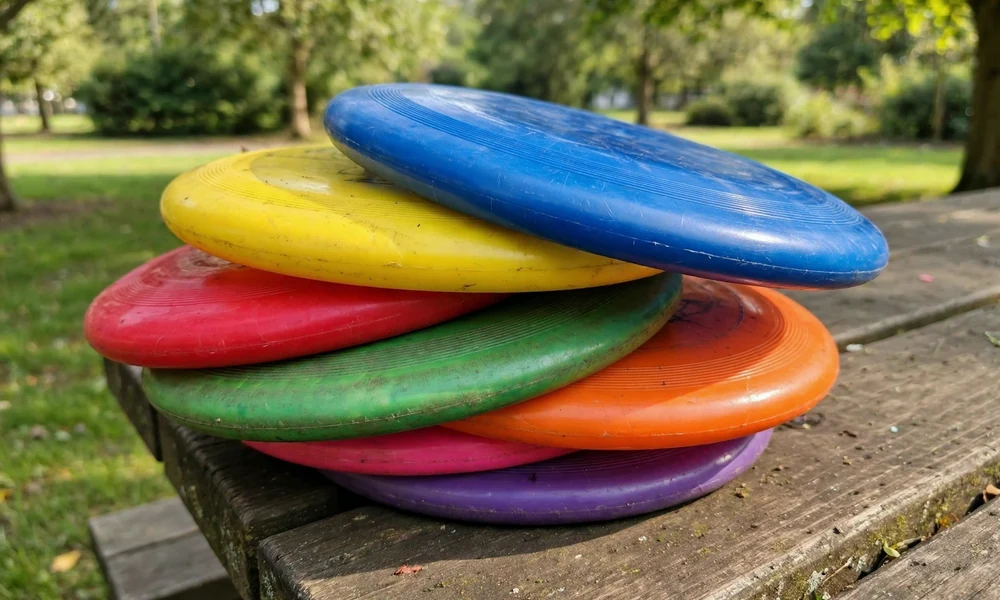
Classic recreational discs are the ones most people grew up with. They are light, usually between 100 and 140 grams, with a wide, rounded rim that is easy to grip and gentle to catch. They fly well over short and medium distances, which makes them perfect for a casual game in the park, on the beach, or in the back garden. They are cheap, cheerful, and forgiving of a sloppy throw.
Ultimate frisbees are the serious players of the disc world. At 175 grams, they are heavier and more stable than a beach disc, and they are built to fly far and straight in a proper game of ultimate, where players sprint, cut, and throw with real pace. The extra weight keeps them steady in the wind, and the shape is tuned for long, accurate throws. For a family game, they are still friendly enough, though a hard throw can sting a small hand.
Disc golf discs are a different animal altogether. They are smaller, denser, and much heavier for their size, with a sharp, thin rim designed to cut through the air at speed and fly hundreds of feet toward a metal basket. A disc golf set usually has three kinds of disc: a driver for long throws off the tee, a mid-range disc for controlled approach shots, and a putter for the short, gentle throws into the basket.
Soft and dog discs fill the last two niches. Soft discs are made from rubber or foam, and they are the safest choice for young children, because they cannot hurt anyone even at full speed. Dog discs are made from a tough but tooth-friendly plastic or rubber that will not crack into sharp pieces when a dog bites down. A normal hard disc can splinter and hurt a dog’s mouth, so a dedicated dog disc is the only safe option for fetch with a keen retriever.

How to Choose the Right Size and Weight
Weight is the single biggest decision, and it comes down to who is throwing. Children under eight do best with a light disc of 100 grams or less, because anything heavier is hard to throw flat and painful to catch. Teenagers and casual adult players are happiest with a disc in the 130 to 150 gram range, which flies well without needing a strong arm. Adults who play properly should go for the 175 gram ultimate size, which is stable and predictable.
Size matters too, though less than weight. A wider disc is easier to catch, because there is more rim to grab, and it floats more gently at the end of its flight. A smaller, denser disc flies further and faster, but it demands a cleaner throw. For a family game, a standard 27-centimetre disc is the sweet spot: big enough to catch easily and light enough to throw all afternoon.
The Best Frisbees of 2026
The best all-round frisbee of 2026 is a classic 140-gram recreational disc with a smooth, rounded rim and a slightly flexible body. It flies straight out of the box, it is gentle enough for children to catch, and it is tough enough to survive being trodden on and thrown against a fence. It works on the beach, in the park, and in the garden. For most people, most of the time, this is the only disc they need.
The best ultimate frisbee of 2026 is the standard 175-gram competition disc, built to the exact size and weight used in organised play. It holds its line in a crosswind, it carries further than any casual disc, and it feels reassuringly solid in the hand. If you play ultimate even once a month, this is the disc to own, and it will last for years of hard use.
The best frisbee for children is a soft, lightweight disc of around 100 grams, made from a flexible plastic that bends rather than cracks. It is easy for small hands to grip, it floats slowly enough for a child to track it in the air, and it will not sting on a catch or bruise on a miss. Bright colours help too, because a disc that is easy to spot in long grass is a disc that does not get lost. For a first disc, or for a family with young children, this is the safest and happiest choice.
The best disc golf set of 2026 is a starter set with three discs: a driver, a mid-range, and a putter, all in a sensible weight for a beginner. The driver is stable rather than fast, so it flies straight instead of veering off into the trees, the mid-range is forgiving on approach shots, and the putter is soft and grippy for short throws. Buying the three together costs less than three separate discs, and it gives a new player everything needed for a first round. It is the set that turns a curious beginner into a regular on the course.
The best dog frisbee of 2026 is a flexible rubber disc that floats, flies well, and will not crack into sharp pieces when a dog catches it. It is tough enough to survive enthusiastic chewing, soft enough to be kind to teeth and gums, and bright enough to spot in long grass or on a beach.

What Else You Need
A frisbee on its own is enough for a game, but a few extras make it better. A second disc means the game never stops when one goes over a fence or into a tree, and a brightly coloured spare is easy to find in long grass. A small bag or a mesh sack keeps the discs together in the car boot and stops them getting scratched. Sunscreen and water matter more than any accessory, because a long afternoon of throwing in the sun is thirsty work. And for anyone who takes the game seriously, a pair of comfortable trainers with good grip makes chasing a long throw far easier than sandals ever will.
Common Mistakes to Avoid
The biggest mistake is buying a disc that is too heavy for the people throwing it. A 175-gram ultimate disc looks like the proper choice, but in the hands of a child it is a bruise waiting to happen, and it will put them off the game entirely. The second mistake is throwing into the wind without adjusting: a disc thrown flat into a headwind will lift, stall, and drop short, while the same throw with the wind will sail far further than expected. Learning to tilt the disc slightly into the wind is a small skill that makes a huge difference.
Another common mistake is leaving discs out in the sun for weeks on end. Ultraviolet light makes plastic brittle over time, and a disc left on a sunny windowsill will eventually crack on its first hard catch. Storing discs somewhere cool and out of direct sunlight keeps them flying well for years. It is also worth checking the rim now and then: a disc that has been chewed by a dog or scraped along concrete can develop a sharp edge, and a sharp edge should be smoothed off or the disc retired.
How Frisbee Fits a Relaxed Weekend
Frisbee is one of the cheapest ways to spend an afternoon outside. There is no court to book, no kit to hire, and no score to keep unless you want one. A park, a beach, or a big garden is all it takes, and the game fits naturally into a day that already has a picnic or a barbecue in it. It is also a gentle way to get moving: an hour of throwing and chasing is real exercise, but it never feels like a workout, and it suits every age at once, which is rare for any game.
The same easy, outdoor spirit runs through plenty of other weekend games, and a frisbee often sits alongside them in the car boot. A family that likes a gentle throw will usually enjoy the slower pace of a good bat-and-ball game too, and readers who want to compare kit will find the best baseball bats guide useful for exactly that. The golf bag crowd and the table tennis crowd share the same idea in different clothes: the right gear, matched to the player, makes the whole game more fun, which is why the best golf bags and the best table tennis paddles guides are worth a look before the next weekend away.
The Verdict
The best frisbee of 2026 is the one that matches the people throwing it. For most families that means a light, friendly 140-gram recreational disc: cheap, forgiving, and fun from the very first throw. For organised play, the 175-gram ultimate disc is the only serious choice. For children, go soft and light; for the dog, go flexible and tough; for the course, go for a proper three-disc golf set. Whatever the choice, store it out of the sun, match the weight to the thrower, and keep a spare in the car. A disc chosen this way will fly true all summer, and the game will still be going long after the picnic is packed away.