The best space heaters in 2026 solve a very specific winter problem: the room you actually sit in is cold, but heating the whole house for it is wasteful. A good space heater warms that one room quickly, holds it at a comfortable temperature, and switches itself off if it tips over or gets too hot. The bad ones are easy to spot too: they smell of hot plastic, they blast one spot while your feet stay frozen, or they run up the electricity bill without ever making the room feel warm.
Space heaters have improved a lot in recent years. Ceramic fan heaters warm a room in minutes, oil-filled radiators give steady silent heat for hours, and infrared panels warm people rather than the air, which suits draughty rooms that never seem to hold their heat. This guide compares the main types, explains how much power a room really needs, and covers the safety features that matter most — because with a heater, safety is not a bonus feature, it is the whole point.
Key Takeaways
- Ceramic fan heaters warm a room fastest and suit most homes, while oil-filled radiators are best for steady, silent heat over hours.
- Look for tip-over protection, overheat shut-off and a cool-touch body before you look at anything else.
- As a rough guide, allow about 100 watts of heating power per square metre of room.
- Never plug a space heater into an extension lead or a power strip — always use a wall socket directly.
- A space heater is a supplement for one cold room, not a replacement for central heating across a whole house.
How We Picked the Best Space Heaters
We judged every type of space heater on the same five tests: warmth where it counts, speed, noise, safety, and running cost. Safety was weighted heaviest, because a heater that lacks tip-over protection or an overheat cut-off is not a bargain at any price. We also checked build quality: a heater that feels solid and survives a winter of daily use beats a flimsy one with more features.

The Main Types of Space Heater Compared
There are four main types, and they work very differently. Ceramic fan heaters blow air across a heated ceramic plate, warming a room fast and evenly, which makes them the best all-round choice. Oil-filled radiators heat oil sealed inside metal columns, then radiate that heat silently for hours; they are slower to warm up but the most comfortable for long evenings. Infrared heaters radiate heat directly onto people and objects, which suits draughty rooms where warm air escapes straight out. Micathermic panel heaters combine convection and radiation in a slim panel that heats up quickly and stays cool to the touch.
For most homes, a ceramic fan heater is the right starting point. Oil-filled is worth choosing for hours of silent, steady heat in a living room or bedroom, and infrared suits a draughty room where you sit in one place.
| Heater type | Best for | Strength | Weakness |
|---|---|---|---|
| Ceramic fan | Most rooms, fast heat | Warms a room in minutes, compact | Fan noise, heat fades when off |
| Oil-filled radiator | Long evenings, bedrooms | Silent, steady, holds heat | Slow to warm up, heavy to move |
| Infrared panel | Draughty rooms, one person | Warms people directly, silent | Only warms what it faces |
| Micathermic panel | Bedrooms, small rooms | Fast, quiet, cool-touch body | Less powerful in large rooms |
Our Picks: The Best Space Heaters for Every Room
Best Overall: Ceramic Fan Heater
The ceramic fan heater is the safest default choice for most people. It stands upright, takes up little floor space, and pushes warm air across a room within a few minutes of switching on. Look for two or three heat settings, a thermostat, and an oscillation mode that spreads the warmth instead of blasting one spot. Check the safety features before you buy: tip-over protection, an overheat cut-off and a cool-touch body are non-negotiable, and a timer is worth having so the heater switches itself off if you fall asleep.
Best for Bedrooms: Oil-Filled Radiator
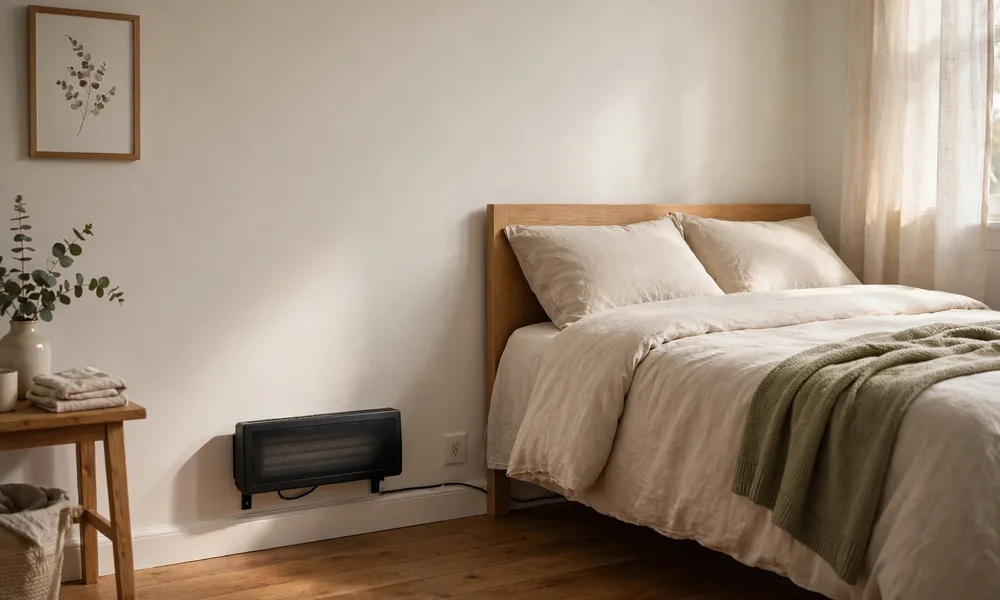
When a heater runs for hours a few feet from your bed, silence matters more than speed. An oil-filled radiator wins here: no fan, no noise, just steady heat that holds the room at a comfortable temperature all night. The radiator keeps giving out warmth for a while after it switches off, which is exactly what you want when you are trying to sleep. It takes twenty to thirty minutes to reach full heat, so switch it on early or use the timer. For a smaller, personal-scale heater for a desk rather than a whole room, our guide to the best desk heaters covers the compact models that warm one person at work.
Best for Large Living Rooms: High-Power Ceramic Tower
A big room defeats a small heater. For an open living room, pick a tall ceramic tower with at least 2,000 watts, a thermostat that holds the temperature steady, and oscillation of 70 degrees or more so the warmth reaches the whole seating area. An eco mode, which drops the power once the room reaches temperature, will save a noticeable amount over a winter. Give it at least a metre of clearance from curtains and sofas. If the room is part of a larger heating setup, our guide to the best smart thermostats explains how to keep the whole house at a steady temperature without wasting heat on empty rooms.
Best for Draughty Rooms: Infrared Panel
When warm air escapes through gaps faster than a fan heater can replace it, an infrared panel wins. It does not heat the air at all: it radiates warmth directly onto you, the sofa and the floor, so you feel warm within minutes even in a room that never quite seals. It is silent, it has no moving parts, and the panel itself stays safe to touch. The trade-off is direction: a panel only warms what it faces, so mount it on the wall opposite the seating area or stand it where it points at the people in the room.

How Much Power Does a Room Need?
The rough rule is about 100 watts per square metre, so a twelve-square-metre bedroom needs around 1,200 watts and a twenty-five-square-metre living room needs around 2,500 watts. That is a starting point, not a law: a well-insulated room needs less, a draughty room with high ceilings needs more, and a room that faces north in winter needs more than the same room facing south.
More power is not always better. A heater that is too powerful for the room will overshoot the temperature, switch off, cool down, and switch on again, cycling all evening. A thermostat fixes this: it holds the room at the temperature you set instead of blasting at full power. If your heater has no thermostat, buy one that does — it is the single feature that saves the most money over a winter.
Safety: The Rules That Matter Most
Space heaters cause more house fires than any other portable appliance, and almost every one of those fires comes from the same handful of mistakes. The rules are simple, and they are worth following exactly. Always plug a space heater directly into a wall socket, never into an extension lead or a power strip, which can overheat under the load. Keep at least a metre of clear space around the heater on all sides, and never put it on a bed, a rug, or a carpet that can trap heat underneath.
Never leave a space heater running while you are out, and never leave one running overnight unless it has a timer, a thermostat and tip-over protection. Keep it away from curtains, bedding and paper, and check the plug regularly for heat — a hot plug is a warning, not a quirk. If you only need heat outside, the rules change completely: our guide to choosing an outdoor heater covers the gas and electric models built for patios and gardens.
Running Costs: What a Space Heater Really Costs
A space heater is the most expensive way to heat a room per unit of heat, and the maths is simple. A 2,000-watt heater running at full power uses two units of electricity an hour, so at average prices that is roughly fifty to sixty pence an hour. Four hours an evening, five evenings a week, for a three-month winter adds up — which is why a thermostat and a timer matter so much.
The honest comparison is with heating the whole house. Running one space heater in the room you sit in while the central heating stays low is usually cheaper than heating every room, but running space heaters in three or four rooms at once is almost always more expensive than central heating.
Checklist: Buying a Space Heater Without Regret
- Check tip-over protection, overheat shut-off and a cool-touch body first, before anything else.
- Match the power to the room: roughly 100 watts per square metre, adjusted for insulation and draughts.
- Pick a model with a thermostat and a timer, so it holds a steady temperature and switches itself off.
- Choose ceramic for fast heat, oil-filled for silent all-evening warmth, infrared for draughty rooms.
- Plan the placement: a metre of clear space on all sides, on a hard floor, plugged straight into the wall.
- Check the weight and wheels if you will move it between rooms, and the noise level if it will run overnight.
Frequently Asked Questions
Are space heaters safe to leave on overnight?
Only with the right features and the right setup. Use a heater with tip-over protection, an overheat cut-off, a thermostat and a timer, keep a metre of clear space around it, and plug it straight into a wall socket. Never leave a heater running in an empty room or while you are out of the house.
How much does it cost to run a space heater?
A 2,000-watt heater at full power uses about two units of electricity an hour, roughly fifty to sixty pence an hour at average prices. A thermostat cuts that sharply, since the heater runs at full power only until the room reaches temperature, then idles to hold it.
What size space heater do I need?
Allow about 100 watts per square metre: around 1,200 watts for a small bedroom and 2,000 watts or more for a large living room. Draughty rooms and high ceilings need more; well-insulated rooms need less.
Ceramic or oil-filled: which is better?
Ceramic fan heaters warm a room in minutes and suit short bursts of heat. Oil-filled radiators are slower but silent and steady, which suits bedrooms and long evenings. If you need heat fast, pick ceramic; if you need heat all evening, pick oil-filled.
Can I plug a space heater into an extension lead?
No. A space heater draws a heavy, continuous load that can overheat an extension lead or a power strip. Always plug it directly into a wall socket, and check the plug regularly for heat or damage.
Do space heaters dry out the air?
Fan heaters can make a room feel dry, because warm air holds less relative moisture and the fan moves it around. An oil-filled radiator or an infrared panel feels less drying. If the air feels dry, a small humidifier in the room helps more than turning the heater down.
The Bottom Line
The best space heaters in 2026 are the safe ones with a thermostat, a timer and tip-over protection — the features that keep a room warm without keeping you worried. Match the type to the room, ceramic for fast heat, oil-filled for silent evenings, infrared for draughty spaces, and always plug it straight into the wall with a metre of clear space around it. Do that, and one good heater will keep the room you actually live in warm all winter for a fraction of what heating the whole house would cost.