
A tool bag is the simplest way to carry your tools, and for most everyday jobs it is the best way too. It is lighter than a toolbox, easier to carry up a ladder than a tool belt, and quicker to load than either. You open it, see your tools, and grab what you need. There is no lid to prop open, no drawers to jam, and no belt digging into your hips by lunchtime.
This guide explains why a good tool bag beats a toolbox for everyday jobs, which shape suits which kind of work, and what to look for before you spend anything: the four main shapes, the materials that last, and the packing habits that turn a bag from a jumble into a working kit.
Key Takeaways
- A tool bag is lighter and faster to use than a toolbox, and easier to carry than a tool belt.
- Open-top bags suit quick jobs; zip-top bags suit carrying tools in a van or in bad weather.
- Buy the bag for the tools you actually own, not the collection you hope to own.
- A reinforced base and stitched, not glued, handles decide how long a bag lasts.
- Pack heavy tools low and in the middle, and keep everyday tools in the outer pockets.

What Makes a Tool Bag Different
A tool bag is a soft-sided carrier, usually made of heavy canvas, ballistic nylon or leather, with an open or zipped top and pockets inside and out. A toolbox is rigid, with a lid and often drawers; it protects tools well, but it is heavy and slow to open. A tool belt is worn on the body, so your tools are always within reach, but it is only comfortable with a light load. A tool bag takes the middle ground: it carries more than a belt and weighs less than a box.
The difference shows up most clearly on a ladder. A toolbox is awkward to carry up a ladder and dangerous to balance on a rung. A tool belt works only if the load is light, because every extra kilo hangs on your hips. A tool bag carries up easily and sits flat on a rung while you work. Our guide to the best and worst toolboxes of 2026 makes the same point from the other side: fabric bags are the best choice for carrying tools up a ladder, because they are light and mould to the space, even though they offer the least protection for sharp or heavy tools.
Open-Top, Zip-Top, Tote or Backpack: The Four Shapes
An open-top bag is the classic shape: a wide mouth, a rigid frame that holds it open, and pockets around the outside. It is the fastest bag to use, and the best choice for work in one place, such as a room you are renovating. Its weakness: no lid, so tools can fall out if it tips over, and rain gets in outdoors.
A zip-top bag closes fully, which makes it the best choice for carrying tools in a van or between sites in bad weather. Nothing falls out and nothing gets wet. The trade-off is speed: you unzip it every time you need a tool. Many tradespeople own both: zip-top for transport, open-top for the job itself.
A tool tote is a wide, shallow bag with two handles, like a sturdy shopping bag built for spanners. It is the lightest shape and the easiest to carry one-handed, and it suits home improvers who own a dozen tools rather than fifty. Its weakness is capacity: heavy tools sit high in it, so it tips over easily.
A tool backpack spreads the weight across both shoulders, which makes it the best choice for carrying a heavy kit over any distance: up stairs, across a building site, or to a job with no parking nearby. It is also the only shape that leaves both hands free. Its weakness is access: you have to take it off to reach your tools.
The Best Tool Bags of 2026
We judged every bag the way it is used: loaded with a real set of tools, carried up stairs and ladders, set down on rough ground, and emptied at the end of the day.
Best Tool Bag Overall: Veto Pro Pac Tech Pac
The Veto Pro Pac Tech Pac is the best tool bag for most people in 2026. Its pockets are deep and well placed, the base is rigid and waterproof, and the bag stands upright even when full. It is expensive, but it survives years of daily use.
Best Budget Tool Bag: Stanley Open-Top Tool Bag
The Stanley open-top bag is the strongest budget choice we tested. It holds a useful set of tools, the frame keeps the mouth open, and the handles are stitched through the body rather than glued on. It will not last as long as the Veto, but for home use it is excellent value.
Best Zip-Top Tool Bag: DeWalt ToughSystem Tool Bag
The DeWalt ToughSystem is the best zip-top bag we found. It closes fully, the zips are heavy and smooth, and it clips into the ToughSystem stacking range. It is the right bag for a van or for working outdoors in bad weather.
Best Tool Backpack: Milwaukee Jobsite Backpack
The Milwaukee Jobsite Backpack is the best choice for carrying tools over a distance. Its shoulder straps are padded and comfortable under a full load, the base is reinforced, and the pockets keep small tools from sinking to the bottom.
Best Leather Tool Tote: Klein Tools Leather Tote
The Klein leather tote is the best choice for anyone who wants a bag that ages well. The leather is thick, the stitching is heavy, and the tote holds its shape when empty. It costs more than canvas, but it still looks good after years of use.
What to Look for When You Buy One
Material is the first thing to check. Heavy canvas, usually sold as waxed canvas, is the traditional choice: tough, tear-resistant, and it ages gracefully. Ballistic nylon is the modern answer: lighter, rain-proof, and cheaper than leather. Leather is the premium choice: it holds its shape and lasts for decades, but it needs occasional conditioning. Avoid cheap thin nylon: it tears at the corners and the bag will not stand upright.
The base decides how the bag behaves in real use. A reinforced base, usually a moulded plastic or rubber slab, keeps the bag upright, stops damp soaking through, and protects the bottom from sharp tools. A bag with a soft fabric base tips over and wears through at the corners within a year.
Handles and straps are where cheap bags fail first. Look for handles stitched through the body, not glued or riveted to the surface: stitching spreads the load, and glue fails when the bag gets hot in a van in summer. A padded shoulder strap is worth having if the bag is heavy, and a strap that clips off beats a fixed one. Check the zips too: a good zip is metal and runs smoothly when the bag is full.
Pockets are what turn a bag into a working kit. The best layout is boring: slim pockets outside for the tools you reach for most, deep pockets inside for the rest, and a dedicated pocket for small items such as screws and driver bits, because anything loose in a big pocket sinks to the bottom. A tape measure deserves its own clip rather than a pocket, and our guide to why a good tape measure matters more than you think explains why that one tool decides whether everything else fits.
The Best Tool Bags Compared
| Bag | Shape | Material | Base | Best for |
|---|---|---|---|---|
| Veto Pro Pac Tech Pac | Open-top | Ballistic nylon | Rigid, waterproof | Daily trade use |
| Stanley Open-Top Tool Bag | Open-top | Heavy canvas | Reinforced | Home use, tight budgets |
| DeWalt ToughSystem Tool Bag | Zip-top | Ballistic nylon | Rigid | Vans, bad weather |
| Milwaukee Jobsite Backpack | Backpack | Ballistic nylon | Reinforced | Walking to jobs |
| Klein Tools Leather Tote | Tote | Leather | Reinforced | Long-term use |
How to Pack a Tool Bag So It Works
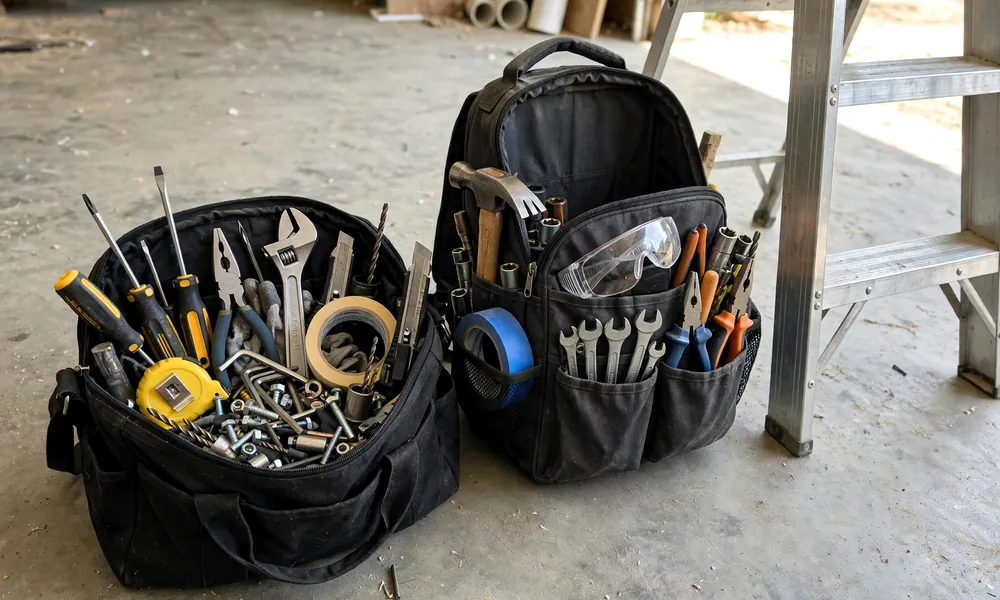
A tool bag is only as good as the way it is packed. Heavy tools go low and in the middle, close to the base, so the bag stays upright. Light tools go high and to the sides. The tools you reach for most go in the outer pockets, where your hand finds them without looking. Fasteners belong in a deep, closed pocket inside.
Think about the rest of your kit too. A tool bag does not carry tools on your body, so for a job where you are up a ladder all day, a belt still has a role: it keeps the two or three tools you use constantly on your hips while the bag waits below. Our guide to the best tool belts of 2026 covers how to balance that weight: belt for the ladder, bag for the kit.

Tool Bag Checklist
- Choose the shape first: open-top for speed, zip-top for transport, backpack for walking.
- Check the base: a reinforced, waterproof base keeps the bag upright and dry.
- Pull the handles hard: they should be stitched through the body, not glued on.
- Count the pockets: slim outer pockets for everyday tools, deep inner pockets for the rest.
- Load it before you buy: a bag that tips over full will tip over on the job.
- Empty it at the end of each day: fasteners left overnight rust and stain the fabric.
Frequently Asked Questions
Is a tool bag better than a toolbox?
For everyday jobs, yes: a bag is lighter, faster to open, and easier to carry up stairs and ladders. A toolbox is better when tools need hard protection, when the kit stays in one place, or when it must stack in a van. Many people own both: bag for the job, box for storage.
How big a tool bag do I need?
Buy the bag for the tools you actually own, not the collection you hope to own. Lay your tools out and buy the bag that fits them with a little room to grow. A bag that is too big is worse than one that is too small, because tools slide around inside it.
Can a tool bag carry power tools?
Small ones, yes: a drill-driver, a compact saw or a multi-tool fit in most large bags. Heavy power tools belong in their own cases, because their weight tips a soft bag over and their edges cut the fabric.
How do I stop my tool bag tipping over?
Pack heavy tools low and in the middle, and keep the base flat on the ground. A bag with a rigid, reinforced base tips far less than one with a soft base, which is why the base is worth paying for.
Should I buy canvas, nylon or leather?
Canvas is the best all-rounder: tough and affordable. Nylon is the best choice for wet work and the lightest load. Leather is the best choice if you want a bag that lasts for decades and looks better with age, and you are willing to pay for it.
How do I clean a tool bag?
Empty it completely, brush out dust and sawdust, and wipe the fabric with a damp cloth. Canvas and nylon can be hosed down and left to dry; leather needs a wipe and an occasional coat of conditioner. Never put a bag away damp, because mildew will follow.
The Bottom Line
The best tool bag is not the biggest or the most expensive. It is the one that fits the tools you actually own, stands upright on its own, and lets you find the right tool in seconds. An open-top bag suits most everyday jobs, a zip-top bag suits transport and bad weather, and a backpack suits anyone who walks to work. Buy for the job you do every day, pack heavy tools low, and choose stitching and a solid base before brand names.


