
A toolbox is the first thing you reach for when something needs fixing, and the last thing most people think about buying well. It holds the tools that hang your shelves, fix your tap, and build your flat-pack furniture, and when it works, you find the right tool in seconds. When it does not work, you waste the first ten minutes of every job digging through a jumble of rusty spanners, and the tool you need is always at the bottom, under everything else.
The gap between the best and the worst toolboxes in 2026 is wider than the price tags suggest. Two boxes can look the same size, hold the same number of tools, and cost nearly the same, yet one will still be opening smoothly and keeping everything in place in ten years, while the other has a broken latch, a cracked lid, and a handle that came off in your hand. The difference lives in the material, the latches, the hinges, the trays, and the way the box is organised inside, and it only shows up once you start using it for real work. This guide puts the two ends of the market side by side, so you can tell them apart before you spend anything.
Key Takeaways
- The best toolboxes keep every tool in its place, open and close with one hand, and survive being dropped, stacked, and carried for years.
- Match the box to the job: a small carry box for home repairs, a chest for a workshop, and a rolling cabinet for a serious collection.
- Steel lasts longest but weighs most; good plastic is light and rust-proof; cheap plastic cracks in the cold and warps in the heat.
- Latches and hinges fail first on bad boxes, so test them in the shop before you buy, and never trust a box that rattles when you shake it.
Pick the Right Type First
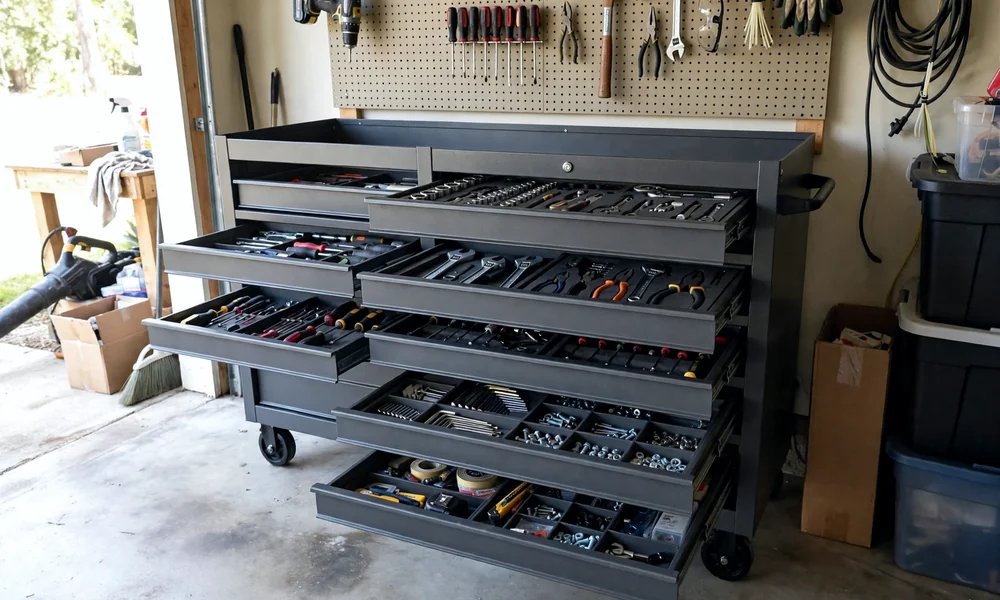
Before looking at any single toolbox, decide how your tools actually live. A classic carry box, the kind with a handle on top and a lift-out tray, suits home repairs: it holds the spanners, screwdrivers, and pliers you use most, and it carries easily from room to room. A tool chest, with two or three drawers, suits a workshop, where tools stay in one place and you want to see everything at a glance. A rolling cabinet, with deep drawers on wheels, suits a large collection, and it follows you around the garage instead of making you walk back and forth.

What the Best Toolboxes Get Right
The best toolboxes are not the biggest ones. They are the ones where every detail has been thought through by people who actually carry tools, in real garages, in real weather. You can feel the difference the moment you pick one up: the lid closes with a solid click, the handle feels comfortable, nothing rattles, and the trays slide smoothly instead of jamming.
Materials That Survive Real Use
A good toolbox starts with honest materials. Steel is the classic choice: it is strong, it does not crack, and a steel box with a good powder-coated finish resists rust for years, though it is heavy and it dents if you drop it. Aluminium is lighter and never rusts, but it costs more and it scratches easily. Good plastic, thick and slightly flexible, is light, rust-proof, and surprisingly tough, and it is the sensible choice for a box that lives in a damp shed or gets carried in the rain.
Latches, Hinges, and Handles That Hold
Latches are the part of a toolbox that fails first, and they are the part most buyers never test. A good latch is metal, it clicks shut with a firm snap, and it stays shut when the box is dropped or turned upside down. A bad latch is thin plastic, it feels vague when you close it, and it pops open at the worst moment, spilling tools across the floor. Draw latches, the kind that pull the lid down tight, are better than simple snap latches, and a latch with a hole for a small padlock is a bonus if the box ever leaves the house.
Hinges deserve the same attention. A good hinge runs the full length of the lid or uses sturdy metal pins, so the lid opens smoothly and stays open at any angle. A bad hinge is a thin strip of plastic that cracks after a few dozen openings, leaving the lid flapping loose. The handle matters too: it should be wide enough to grip with a gloved hand, fixed with metal fittings rather than plastic rivets, and positioned so the box hangs level when you carry it, instead of tipping forward and throwing the tools to one end.
Organisation That Actually Works
The inside of a toolbox decides whether it saves you time or wastes it. The best boxes have a lift-out tray for the tools you use most, with compartments that stop screwdrivers rolling into each other, and a deep well below for larger tools. Foam inserts, cut to the shape of each tool, are the gold standard: they hold everything in place, they show you instantly if a tool is missing, and they stop tools rattling and chipping each other. Drawer dividers do the same job in a chest, and they are worth buying if the box does not come with them.
What the Worst Toolboxes Get Wrong
Broken Latches and Spilled Tools
The most common failure is a latch that gives up. It starts as a latch that needs an extra push to close, and ends with a box that will not stay shut at all, so every time you pick it up the lid falls open and the tools spill out. A broken latch cannot be fixed properly with tape or a strap, and once the lid no longer seals, dust and damp get in and the tools start to rust. A toolbox that cannot stay shut is not a toolbox at all; it is a tray with a lid that does not work.
Handles fail in the same way, and they fail at the worst moment, usually when you are carrying a full box up the stairs. A handle fixed with plastic rivets pulls out under the weight, and a handle that is too narrow digs into your hand and makes you drop the box. The best test in the shop is simple: fill the box, or imagine it full, and lift it by the handle with one hand. If the handle bends, creaks, or feels loose, put the box back on the shelf.
Drawers That Jam and Trays That Tip
In a tool chest or rolling cabinet, the drawers are everything, and cheap drawers are the most frustrating failure of all. A good drawer runs on ball-bearing slides, opens smoothly when it is fully loaded, and stays open while you work. A bad drawer runs on folded metal edges, sticks when it is half full, and slams shut when you least expect it. Worse still are drawers that tip forward when you pull them out too far, spilling their contents onto the floor.
Steel, Plastic, or Fabric: Which Lasts?
Steel is the best choice for a workshop box that stays in one place and takes hard knocks. It dents rather than cracks, it holds its shape for decades, and a steel box with a good finish looks as good in ten years as it did on the day you bought it. Its weakness is weight and rust: a large steel box is heavy even when it is empty, and a scratched finish in a damp garage will rust if you do not look after it.
Good plastic is the best choice for a box that travels, lives in a damp shed, or gets carried in the rain. It never rusts, it is light enough to carry with one hand, and a thick, well-made plastic box can survive drops that would dent steel. Its weakness is heat and cold: thin plastic cracks in winter and warps in summer, so buy thick plastic from a reputable brand, and avoid any box that feels light for its size. Fabric tool bags are the best choice for carrying tools up a ladder, because they are light and they mould to the space, but they offer the least protection, and they are the worst choice for sharp or heavy tools.
Before You Buy: A Short Checklist
Use this checklist on every toolbox you consider, and do not skip a step because the price is good. First, open and close it ten times: the latches should click firmly every time, the hinges should move smoothly, and the lid should stay open on its own. Second, lift it by the handle and shake it gently: nothing should rattle, and the handle should feel solid. Third, check the inside: are there trays, dividers, or foam, and can you see every tool within five seconds? Fourth, think about size: lay out the tools you actually own, and buy the box that fits them with a little room to grow, not the box that looks impressive on the shelf.
Then think about what goes inside it. A toolbox is only as useful as the tools it holds, and a good drill is usually the first tool to earn its place: our guide to the best and worst drills of 2026 compares every type, from drill-drivers to rotary hammers. A tape measure belongs in every box too, and our guide to why a good tape measure matters more than you think in 2026 explains why it is the cheapest tool that decides whether everything else fits. And if your tools outgrow one box, our guide to storage bins worth buying for a tidier home in 2026 covers the bins that keep the rest of the house in order.

Who Each Side Is For
The best toolboxes suit anyone who owns more than a handful of tools, anyone who fixes things around the house, and anyone who has ever lost ten minutes looking for a spanner that was in the box all along. Homeowners, renters with a basic kit, and weekend renovators all benefit from the same things: a latch that stays shut, a handle that holds, and an inside that shows you every tool at a glance.
The worst toolboxes suit nobody, but they keep selling because they look like a bargain and because most buyers only discover the faults after the return window has closed. If you own only a screwdriver and a hammer, a small pouch will serve you better than a bad box, because a bad box will still be there next year, with a broken latch and a pile of rusty tools inside, waiting to spill them across the floor.
The Verdict
The best toolboxes of 2026 are not the biggest ones on the shelf. They are the ones with a latch that clicks shut every time, a handle that holds the full weight, hinges that last for years, and an inside that keeps every tool where you can find it. The worst toolboxes look like a bargain and work like a warning: they crack, jam, spill, and rust, and they cost more in damaged tools and wasted time than the price you saved.
So buy slowly, open and close the box before you pay, and choose the box for the tools you actually own. Choose well, and it will still be keeping your tools safe, organised, and ready to work years after the bargain boxes have gone to the scrapheap.


