How to Choose Track Lighting That Suits Your Room in 2026
Track lighting is a rail fixed to the ceiling with adjustable light heads that slide along it and aim in any direction. It is one of the most flexible ways to light a room, because you can point each head where light is needed: at a counter, a chair, a shelf, or a picture. In 2026, slim tracks, small LED heads, and magnetic systems have made it a genuine choice for living rooms, kitchens, and hallways.
The short answer is that track lighting is worth choosing when a room needs light in several places and a single ceiling light cannot reach them all. The catch is that the rail, the heads, and the bulbs have to match each other and the room: buy a track that is too short, heads that are too dim, or bulbs in the wrong colour, and the result looks worse than a plain ceiling light.
Key takeaways
- Track lighting is a ceiling rail with movable heads, so you can aim light at counters, chairs, shelves, and art.
- Measure the room and plan where each head should point before you buy the rail.
- LED heads are the best choice in 2026: they run cool, last for years, and come in warm and cool colours.
- Choose warm white around 2700K for living rooms and bedrooms, and cooler light around 4000K for kitchens.
- Check whether the track is single-circuit or two-circuit: that decides whether all heads switch on together.
What track lighting is and how it works
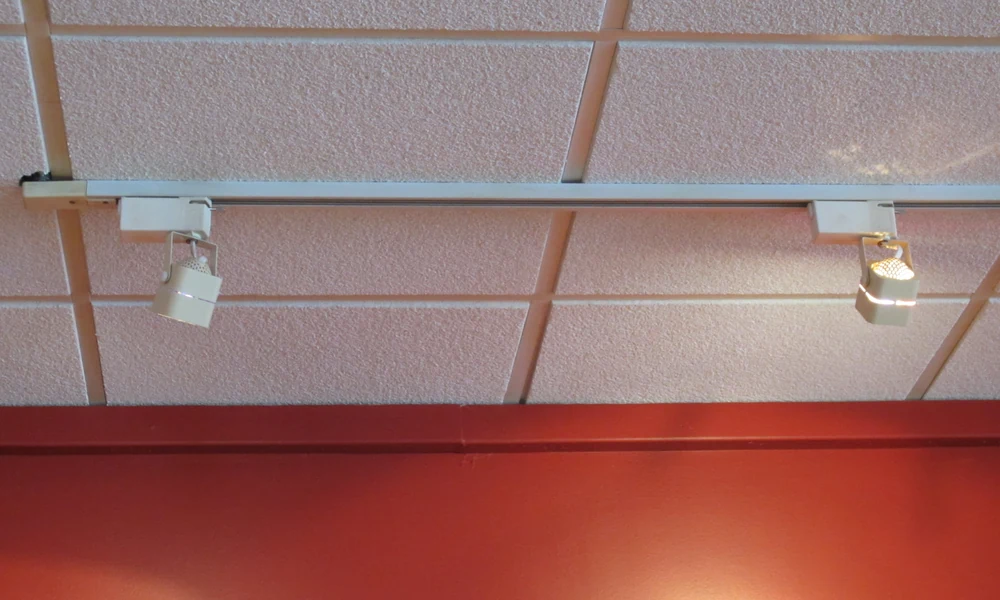
A track lighting system has three parts: the track, the heads, and the power feed. The track is a metal rail screwed to the ceiling, with conductors inside that carry power along its length. Each head clips in, draws power, and slides to any point on the rail. The head pivots and rotates, so you can aim its beam at a surface below or across the room. A power feed connects one end of the track to the ceiling wiring, usually where an old ceiling light used to be.
The advantage over a fixed ceiling light is aim. A pendant lights the table beneath it, while a track with four heads can light a kitchen counter, a dining table, a bookshelf, and a picture wall from the same rail. The advantage over recessed spotlights is flexibility: you can slide a head, turn it, or swap it without cutting new holes. That is why shops and galleries use it. Its weakness is even light: a track is a set of aimed beams, so in a living room it works best alongside a floor lamp.

The main types of track lighting
Track systems fall into a few families, and tracks from different makers are not always compatible, so the type you choose on day one decides which heads you can add later.
Single-circuit track
A single-circuit track powers every head from one circuit, so all the heads switch on, off, and dim together. It is the simplest and cheapest system, and it suits a small room where you always want all the lights on at once, such as a kitchen. The limitation is control: you cannot switch half the heads off while the others stay on.
Two-circuit track
A two-circuit track has two power circuits inside one rail, so you can wire the heads into two groups and switch each group on its own. That lets you light the kitchen counter for cooking and leave the dining heads off. It costs more and needs a two-gang switch or a smart controller, but the flexibility is worth it in an open-plan space. For a room with two purposes, such as a kitchen-diner, it is usually the right call.
Magnetic track
Magnetic track is the newest type. The rail is a slim channel, often recessed into the ceiling, and the heads attach with magnets and draw low-voltage power through the rail. You can move a head, add one, or take one off in seconds with no tools. It suits modern homes and anyone who rearranges rooms often. The trade-off is cost: magnetic systems are more expensive, the heads only work with the same maker’s track, and they are usually less powerful than mains-voltage heads.
Choosing the right heads
The heads decide what the light does. A spot head gives a narrow beam that picks out a picture or a shelf, a flood head gives a wide beam that washes a counter or a table, and a pendant head hangs below the track on a drop rod. Most homes need a mix: two spots for accent light and two floods for task light is a good start. Check the beam angle: 15 to 25 degrees is a spot, 40 degrees or more is a flood.
LED heads are the only sensible choice in 2026. They use a fraction of the power of old halogen heads, run cool enough to touch, and last for years without a bulb change. Many have the light built in, so when the LED fails you replace the whole head, but a good one lasts fifteen years or more. If you prefer replaceable bulbs, look for heads that take a GU10 LED bulb, the common standard.

Brightness and colour: the numbers that matter
Brightness is measured in lumens, not watts. A head aimed at a kitchen counter needs around 400 to 600 lumens, while one aimed at a picture needs 200 to 300 lumens. Four 400-lumen heads give 1,600 lumens, enough for task and accent light alongside a lamp or two. More is not always better: heads that are too bright aimed at a white wall create glare.
Colour temperature is measured in kelvin, and it changes the feel of a room more than brightness does. Warm white at 2700K feels cosy and suits living rooms and bedrooms, while neutral light at 3000K to 4000K suits kitchens and workspaces. Cool white at 5000K and above feels clinical and is best avoided at home. Match the track to the room: warm where you relax, neutral where you work, and keep every head on the same rail the same colour.
Dimming is worth having. A dimmable track runs bright for cooking and low for an evening film. Check that the heads, dimmer, and power supply all support dimming before you buy, or the heads will flicker or buzz. If you want phone control, a smart switch can replace the wall switch and add dimming and schedules.
Where track lighting works best
A kitchen is the best room for track lighting. A rail above the island or worktop lets you aim a head at the chopping board, one at the hob, and one at the sink. Choose heads around 4000K and aim them at the counters, not at people’s faces. A living room is the second-best room: a rail aimed at a reading chair, a bookshelf, and a picture wall gives the room depth.
Some rooms suit it badly. A bedroom with a low ceiling can feel oppressive, because the heads sit in your line of sight when you lie down. A bathroom is a poor choice: steam and track fittings do not mix, and the light is too directional for a mirror. A very high ceiling needs powerful heads, because a beam from four metres up spreads too wide. If the ceiling also needs air movement, our guide to ceiling fans covers the quiet models worth buying.
Installation: what to get right first time
Fitting a track is a job most competent DIYers can do, but it involves mains wiring, so if you are not confident, hire an electrician. The rail screws to the ceiling joists or solid fixings, and the power feed connects to the existing ceiling rose wiring. The most common mistake is fixing the rail to plasterboard with no support, so the track sags under the heads. Find the joists with a stud finder, or use plasterboard fixings rated for the weight, and check the rail is level before you tighten it.
Plan the layout before you drill. Mark where each head should point, and check that no head will shine into someone’s eyes from a chair or sofa. A rail that runs across the room usually works better than one along it, because the heads can aim at both walls. Keep the track at least 30 centimetres from the wall when washing pictures, and clear of ceiling fans and opening doors. A two-circuit track or a dimmer may need an extra wire, so check the wiring before you buy.
Comparison table
| Track type | Cost | Control | Best for |
|---|---|---|---|
| Single-circuit | Low | All heads together | Kitchens and hallways |
| Two-circuit | Medium | Two groups | Kitchen-diners and living rooms |
| Magnetic | High | Move heads freely | Modern living rooms |
Mistakes that make track lighting look bad
The most common mistake is buying too few heads, which leaves dark gaps between pools of light. Four heads on a two-metre rail is a good start, and you can add one later. The second mistake is the wrong colour: cool white in a living room feels like an office, and warm heads in a kitchen make food look dull. The third is aiming heads at seating instead of surfaces. Aim at the counter, the shelf, and the wall.
Another mistake is mixing systems. A head from one maker rarely fits another maker’s track, so pick the system first and buy the rail and heads together. Track lighting is also only one layer: it works best with a soft general light from a lamp or a pendant, and on its own it can feel harsh. Our guide to LED strip lights shows how a second layer can soften a room without another ceiling fitting.
Checklist: choosing track lighting that suits your room in 2026
- Plan the layout first: mark where each head should point before you buy the rail.
- Measure the room and buy a rail long enough to cover every surface.
- Choose single-circuit for one job, two-circuit for a room with two purposes.
- Pick LED heads, warm white for relaxing rooms and neutral white for kitchens.
- Mix spot and flood heads: spots for pictures and shelves, floods for counters and tables.
- Check dimming, weight, and fixings before you drill.
Frequently asked questions
Is track lighting out of date in 2026?
No. Old halogen track looked dated, but slim LED and magnetic systems are a current choice for modern homes.
Can I add more heads to a track later?
Yes, if the track has spare capacity and the heads match the system. Check the maximum wattage for the rail first.
Does track lighting use a lot of electricity?
No. A four-head LED track typically uses 20 to 40 watts in total, less than a single old 60-watt bulb.
Can track lighting light a whole room on its own?
It can light a small room, but in a living room it works best with another light source, such as a floor lamp.
How long should a track be?
Long enough to cover the surfaces you want to light, and no longer. A two-metre rail with four heads suits most kitchens and living rooms.
Can I fit track lighting myself?
You can fit the rail and heads yourself if you are comfortable with basic DIY, but the power feed connects to the mains, so it is a job for an electrician unless you know what you are doing. Never work on live wiring.
The bottom line
Track lighting is worth choosing in 2026 when a room needs light in several places and you want to aim it exactly where it is needed. Plan the layout before you buy, choose a rail long enough for the room, and pick LED heads in the right colour. A single-circuit track suits a kitchen, a two-circuit track suits a room with two jobs, and a magnetic system suits a modern living room.