How to Choose an Exercise Mat That Protects Your Knees in 2026
An exercise mat is the difference between a home workout you look forward to and one your knees dread. On a hard wooden or tiled floor, every kneeling press, plank and stretch sends the impact straight into your joints, and a thin mat does almost nothing to stop it. The right exercise mat absorbs that pressure, stays flat under your feet, and gives you a clean, grippy surface for floor work, from high-intensity intervals to slow Pilates.
Key Takeaways
- For knee protection, choose a mat at least 10 millimetres thick; thinner mats are for grip, not cushioning.
- Density matters as much as thickness: a mat that bottoms out under your knee is no better than the floor.
- Pick a mat at least 180 centimetres long and 60 centimetres wide, or wider if you do floor work with dumbbells.
- A textured, non-slip surface beats a smooth one for sweaty sessions and fast floor moves.
- Foldable mats store easily and suit small flats; roll-up mats suit anyone who takes their mat to a class.
What an Exercise Mat Is, and What It Is Not
An exercise mat is a thick, cushioned mat built for floor workouts: kneeling, lying, rolling and jumping on a hard surface. It is not a yoga mat, and the difference matters more than the name suggests. Our guide to the best yoga mats covers thin mats of 3 to 6 millimetres, designed for grip in standing poses and balance work. A yoga mat keeps you steady; an exercise mat keeps you cushioned.
The second distinction is size. Exercise mats are usually wider and longer than yoga mats, because floor workouts spread out: elbows wide in a plank, knees apart in a stretch, dumbbells resting beside you. A mat that is too narrow forces your elbows or knees off the edge and onto the bare floor, which defeats the purpose entirely.
How Thick Should an Exercise Mat Be?
Thickness is the first number to check, and it is also the most misunderstood. A thicker mat is not automatically better: beyond a certain point, extra thickness makes the mat wobbly, which is bad for balance and for standing moves. The sweet spot depends on what you do on the mat. For gentle Pilates, stretching and abdominal work, 10 to 12 millimetres gives enough cushioning for knees and elbows without feeling unstable. For high-intensity floor work, burpees and kneeling strength moves, 12 to 15 millimetres absorbs the impact of repeated knee drops. For anyone with sore knees, arthritis or a recent knee injury, 15 to 20 millimetres is worth considering, even if it feels softer underfoot.
If you do both floor work and standing exercises, a 12-millimetre mat is the safest compromise.
The Main Types of Exercise Mat
Roll-Up Mats
Roll-up mats are the classic choice: a single long sheet of foam that rolls into a cylinder for storage and carrying. They suit anyone who takes a mat to a class or a gym, because most come with a strap or a carry handle. Roll-up mats are also the easiest to clean, because there are no folds or seams to trap sweat.
Folding Mats
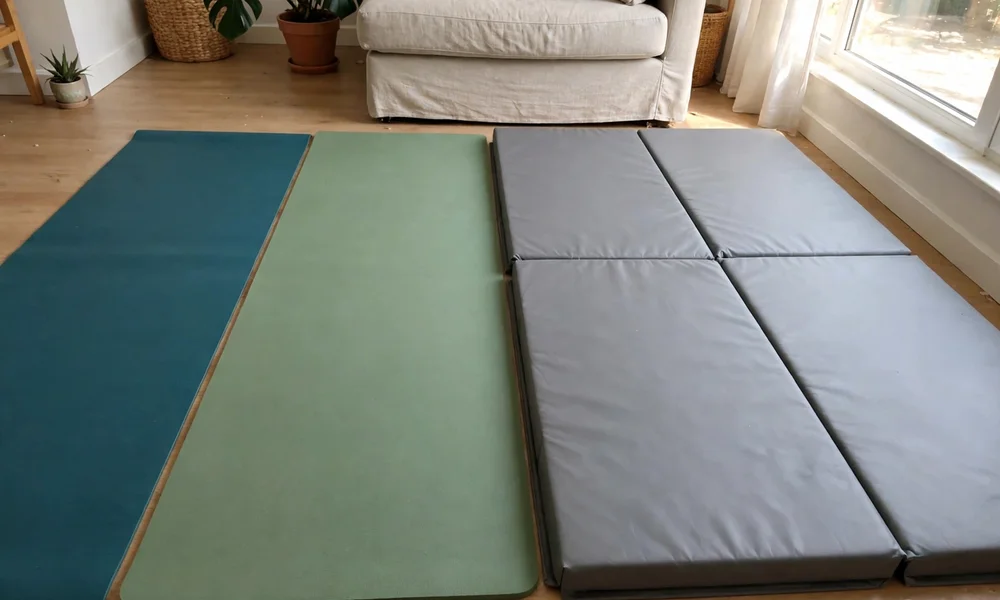
Folding mats are made in hinged panels that fold like a concertina, usually into a compact block. They are the best choice for small flats, because they slide under a bed or behind a door instead of needing a tall corner to lean in. Folding mats are often the thickest option, at 15 millimetres or more, because the panels are rigid foam with a wipe-clean cover.
Exercise Mats Compared
| Mat type | Thickness | Best for | Watch out for |
|---|---|---|---|
| Roll-up mat | 10 to 12 mm | Classes, travel, general floor work | Ends curling, sliding on smooth floors |
| Folding mat | 15 to 20 mm | Sore knees, small flats, home gyms | Hinge ridges under your back |
| Large floor mat | 12 to 15 mm | Circuits, stretching, partner workouts | Heavy, hard to store |
| Thin yoga-style mat | 3 to 6 mm | Balance and standing poses only | No knee protection on hard floors |
Density: The Test That Matters Most
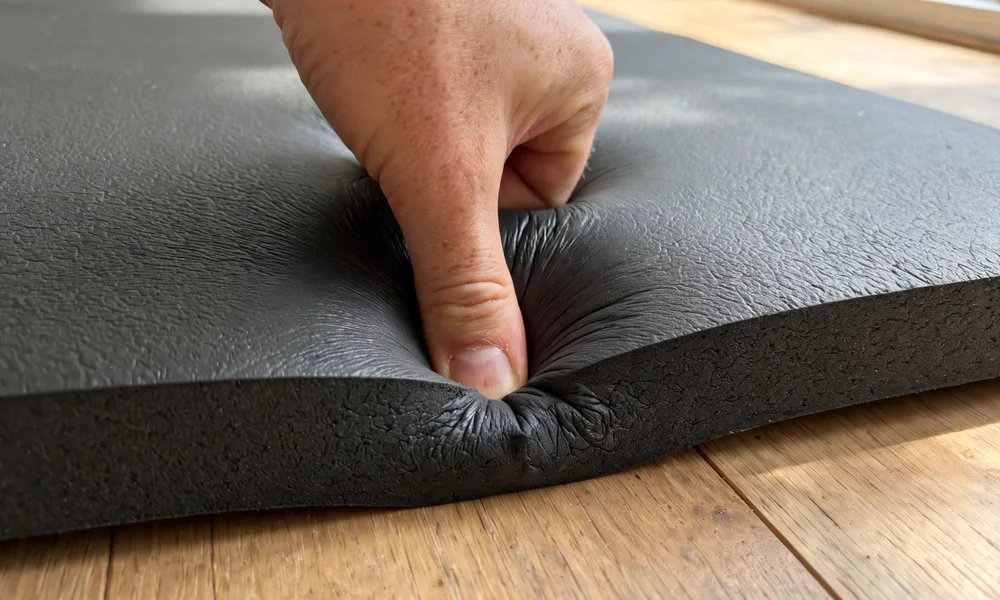
Two mats can be the same thickness and feel completely different, because density decides whether the foam holds you up or collapses under you. A dense foam compresses a little under your knee and then stops, spreading the pressure. A soft foam keeps compressing until your knee meets the floor, which is exactly what you were trying to avoid. Density is rarely printed on the box, so you have to test it. Kneel on the mat with all your weight on one knee for ten seconds, then stand up and look: a good mat springs back within a few seconds, while a cheap one keeps a dent. Press your thumb into the foam as hard as you can; if your thumb reaches the floor through the mat, the foam is too soft, whatever the thickness claims.
Size, Grip and the Floor Underneath
Size is simple to get right and easy to get wrong. Measure your height and add 10 centimetres for length, so your head and feet both stay on the mat during floor work. For width, 60 centimetres is the minimum, and 70 centimetres or more is better if you do side planks or work with dumbbells, because your elbows need room.
Grip decides whether the mat works when you sweat. A textured surface, with a fine pattern pressed into the foam, grips far better than a smooth one, especially for bare feet and fast moves. The underside matters just as much: a mat with a textured or rubberised base stays put on wooden floors, while a smooth base slides the moment you push off it. If your floor is polished wood or tile, test the mat at home and keep the receipt; a mat that slides on your floor is useless, however good it feels under your knees.
Protecting Your Knees in Practice
A good mat helps, but how you use it matters just as much. Kneel with your weight spread across the shin and the front of the knee, not balanced on the kneecap itself, and keep a folded towel under a sore knee for extra padding during long holds.
Recovery matters too. After a hard floor session, a few minutes with a roller loosens the muscles around the knee and stops stiffness setting in. Our guide to the best foam rollers explains how to roll calves, thighs and hips safely, and it pairs naturally with a thick mat: the mat protects your knees during the workout, and the roller looks after the muscles around them afterwards.
Cleaning, Care and Storage
An exercise mat that is never cleaned becomes slippery and starts to smell, and sweat left on foam breaks the surface down over time. Wipe the mat after every sweaty session with a damp cloth and a drop of mild soap, then leave it flat to dry before rolling it up; rolling a damp mat traps moisture and encourages odour.
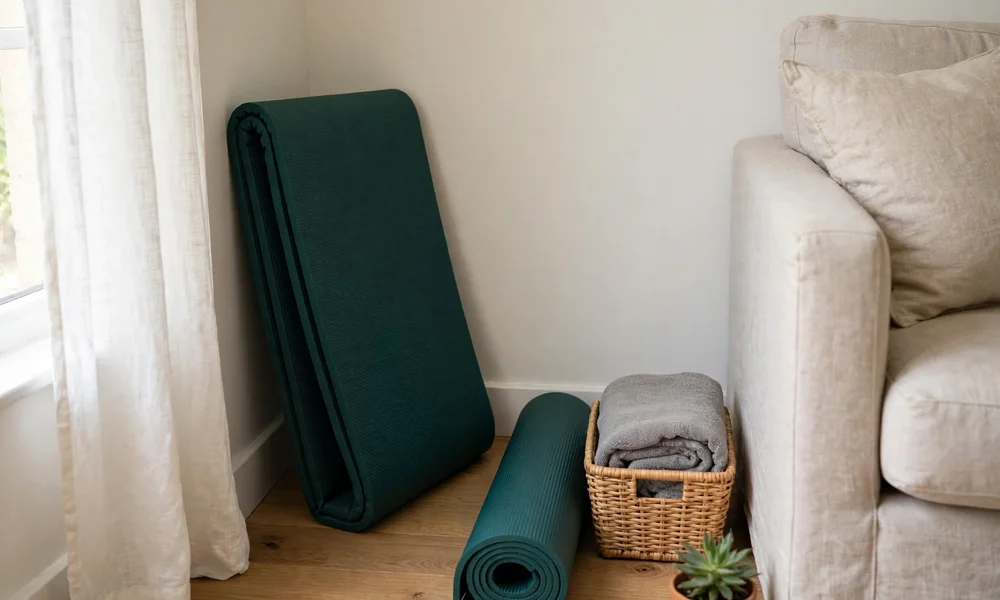
Storage decides how long a mat lasts. Roll-up mats should be rolled loosely with the top surface facing outwards, which stops the ends curling, and stored upright in a corner rather than folded in half. Folding mats should be folded along their hinges and stored flat or upright, never with heavy boxes stacked on top.
What to Pair With Your Mat
A mat is the base of a home workout, not the whole of it. An exercise ball adds core work and stretching that a mat alone cannot offer, and our guide to the best exercise balls covers sizes, burst resistance and the right ball for your height.
Mistakes to Avoid
The most common mistake is buying the cheapest mat and expecting it to protect your knees. Cheap foam is thin, soft and quick to compress, so it feels fine in the shop and fails within weeks at home. The second mistake is buying a yoga mat for floor workouts, because grip is not cushioning, and a mat that is perfect for standing poses can be painful for kneeling work. The third mistake is ignoring size: a mat that is too short or too narrow forces joints onto the bare floor, which is worse than no mat at all, because you expect protection you are not getting.
Checklist: Before You Buy an Exercise Mat
- Choose at least 10 millimetres thick for knee protection, 12 to 15 millimetres for hard floors or sore knees.
- Kneel on it for thirty seconds and press your thumb in: you should not feel the floor through the foam.
- Check the length: your height plus 10 centimetres, and at least 60 centimetres wide, wider for floor work with weights.
- Look for a textured top and a non-slip base, and test it on your own floor type before committing.
- Pick roll-up for classes and travel, folding for small flats, and large floor mats for a dedicated workout space.
- Check cleaning and storage: wipe-clean surface, no harsh chemicals needed, and a size you can actually store.
Frequently Asked Questions
How thick should an exercise mat be for bad knees?
For bad knees, 15 millimetres is a good starting point, and 20 millimetres suits anyone with arthritis or a recent knee injury. Go thicker only if the mat still feels stable when you stand on it, because very soft mats make balance harder.
Can I use a yoga mat instead of an exercise mat?
You can for standing poses and gentle stretching, but not for kneeling floor work on a hard surface. Yoga mats are 3 to 6 millimetres thick and built for grip, while exercise mats are 10 millimetres or more and built for cushioning.
What is the best exercise mat material?
Closed-cell TPE and PVC are the most practical for most people: dense, wipe-clean and slow to absorb sweat. NBR foam is softer and warmer but less stable for standing moves. Natural rubber grips best but is heavy and needs gentle cleaning.
How do I stop my exercise mat sliding on a wooden floor?
Choose a mat with a textured, rubberised base and enough weight to stay put, and keep both the mat and the floor clean, because dust under the mat acts like ball bearings.
How often should I replace an exercise mat?
Every three to five years with regular use, or sooner if the foam stays dented after you stand up, the surface flakes or tears, or the mat slides when it used to grip.
Are folding exercise mats comfortable?
Yes, for floor work, because they are usually the thickest mats available. The hinge lines can feel like ridges under your back, so lie flat across a fold before buying, and choose a mat with narrow, well-padded hinges.
The Bottom Line
The best exercise mat for your knees is a thick, dense mat that fits your body, grips your floor, and stores easily in your home. Start with 12 millimetres if you are unsure, test the density with your knee and your thumb, and buy the size that keeps your elbows and knees on the mat, not on the floor.
Verdict: 10/10. A thick, dense exercise mat is the simplest way to protect your knees during home workouts, and the right one earns its place in a single session. Our verdict is 10 out of 10 for a well-chosen mat that fits your floor, your workouts and your storage.