How to Pick Ceiling Lights That Flatter a Room in 2026
Ceiling lights do more work than any other fitting in a home, and they get the least thought. A ceiling light that is too small leaves the corners dark, one that is too bright turns a cosy living room into an interrogation room, and one hung at the wrong height makes a low ceiling feel lower. Picking ceiling lights that flatter a room in 2026 is mostly a matter of measuring first and choosing second.
This guide covers the ceiling-mounted fittings that light a whole room from above: flush-mount lights that sit tight against the ceiling, semi-flush lights that drop down a few inches, and recessed downlights that disappear into the ceiling itself. A pendant hangs down and marks out a table, a wall sconce washes a hallway from the sides, and a table lamp gives you a warm pool of light to read by. Those are separate jobs with their own guides, linked where they matter.
Key Takeaways
- Measure the room before you shop: a ceiling light should be roughly one-twelfth of the room’s length plus width, in inches of diameter. A light that is too small is the most common mistake of all.
- Warm light flatters people and rooms: aim for 2700 to 3000 Kelvin in living rooms and bedrooms, and save cooler, brighter light for kitchens and workspaces.
- One ceiling light should never do the whole job alone: pair it with a lamp or two so the room has layers, and put the ceiling light on a dimmer wherever you can.
- Flush-mount fittings suit low ceilings, semi-flush fittings suit rooms with a little more height, and recessed downlights suit rooms where you want the light without seeing the fitting.
- Check the fitting, the bulb and the dimmer together: a dimmable bulb in a non-dimmable fitting, or the wrong dimmer switch, is the fastest way to flicker and buzz.
Start With the Room, Not the Fitting
The biggest mistake in choosing ceiling lights is falling in love with a fitting in a shop and only afterwards wondering whether it suits the room. Start with the room itself: how big it is, how high the ceiling is, what the room is used for, and how much daylight it already gets. A dark north-facing living room needs a very different ceiling light from a bright south-facing kitchen.
Ceiling height decides the family of fitting before anything else. Under about 2.4 metres, a flush-mount light is almost always the right call, because anything that hangs down eats into headroom. Between 2.4 and 2.7 metres you have a real choice, and a semi-flush fitting that drops ten to twenty centimetres can throw light sideways as well as down. Above 2.7 metres, a semi-flush fitting or recessed downlights make sense, because a flat fitting on a tall ceiling looks stranded.
Size It Before You Fall for It
Add the length and the width of the room in feet, and that number in inches is roughly the diameter your ceiling light should be. A room twelve feet by fourteen feet adds up to twenty-six, so a fitting around twenty-six inches across, about sixty-six centimetres, is the right scale. A fitting half that size looks like a lost button on a big ceiling, and one much larger dominates the room.
Hang height matters as much as diameter for any fitting that drops below the ceiling. A semi-flush light should leave at least 2.1 metres of clear space underneath it in a walkway, or taller members of the household will be ducking. Over a dining table a fitting can hang lower, around seventy-five to ninety centimetres above the tabletop. When in doubt, choose the flatter fitting: one that is slightly too flat is forgettable, while one that is slightly too low is annoying every day.
Brightness and Colour Temperature That Flatter
Brightness is measured in lumens now, not watts. A living room needs around 100 to 150 lumens per square metre for general light, a bedroom a little less, and a kitchen 300 or more over the worktops. A fifteen-square-metre living room therefore wants roughly 1,500 to 2,000 lumens from its ceiling light. If the fitting takes more than one bulb, add the lumens together, and remember that a frosted shade swallows some light before it reaches the room.
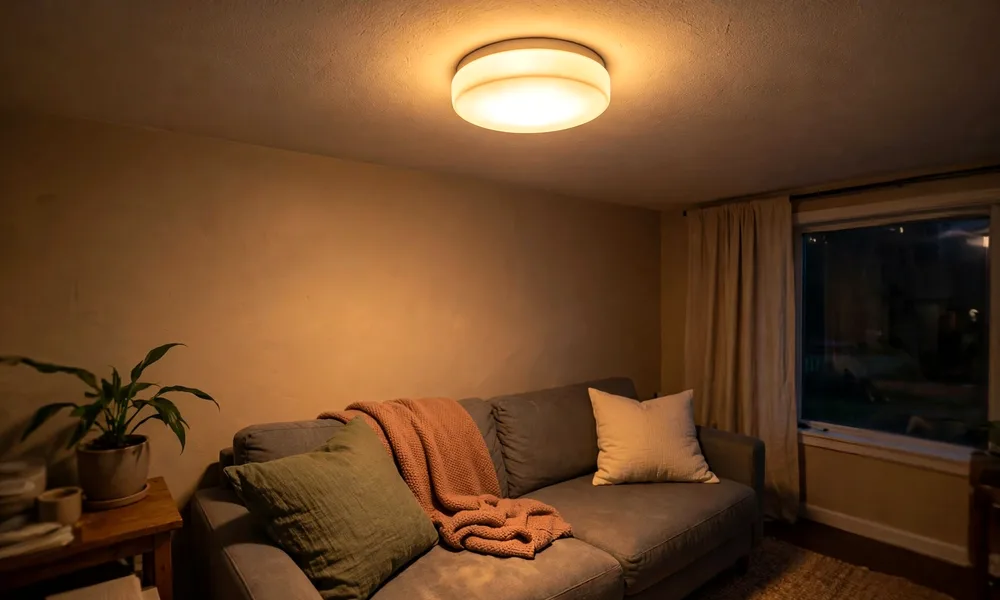
Colour temperature is what makes a room feel warm or cold, and it matters more than brightness for flattery. 2700K is the warm yellow-white of an old-fashioned bulb and flatters skin tones, wood and warm paint. 3000K is a touch cleaner and still warm, and it works well in kitchens and bathrooms. 4000K and above is daylight white: honest and energetic, but it makes a living room feel like an office and shows every flaw in a paint job.
The Main Types Compared
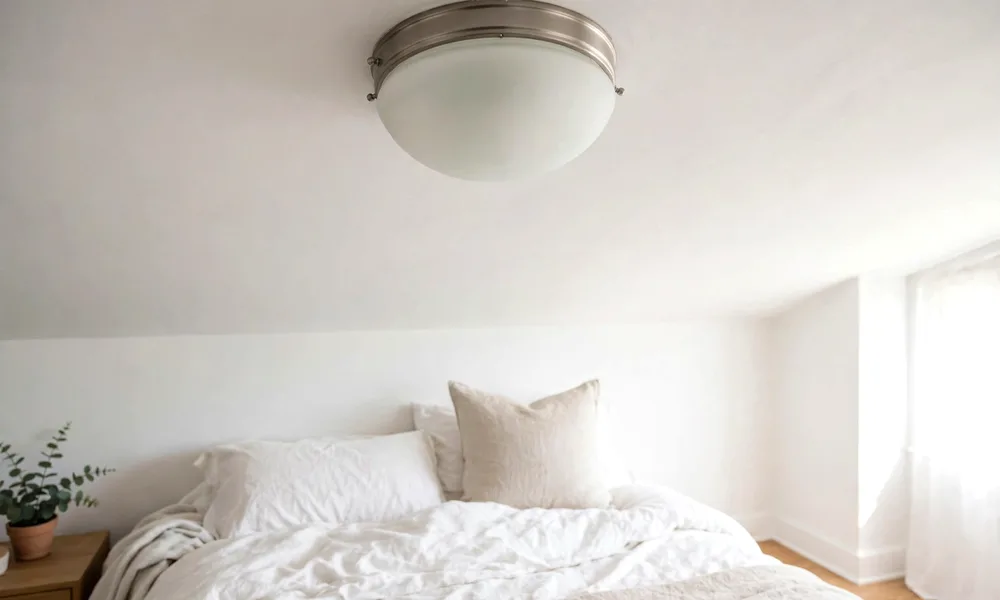
Flush-mount lights sit directly against the ceiling, with no gap and no drop. They are the right choice for low ceilings, small rooms, hallways and anywhere headroom matters. Their weakness is that they throw most of their light straight down, so the walls can look dimmer than the floor. The best ones use a wide diffuser, frosted glass or opal acrylic, that spreads the light sideways as well as down.
Semi-flush lights hang a short stem below the ceiling, usually ten to twenty centimetres, with a bowl or shade that lets light escape upward as well as down. That upward light bounces off the ceiling and fills the room more evenly, which is why a semi-flush fitting makes a room feel taller and airier than a flush-mount in the same spot. They need a little more ceiling height, and they collect dust on top of the shade.
Recessed downlights sit inside the ceiling, with only a small rim visible. They are the neatest option, and in a kitchen or a modern living room a grid of them gives beautifully even light with nothing to dust and nothing to bump into. Their weaknesses are real, though: they need ceiling depth to fit into, they are harder to change later, and a badly spaced grid leaves dark patches or lights that shine straight into your eyes when you sit down.
| Type | Best for | Needs | Watch out for |
|---|---|---|---|
| Flush-mount | Low ceilings, hallways, small rooms | 2.4 m ceiling or less | Can leave walls dim; pick a wide diffuser |
| Semi-flush | Living rooms and bedrooms | 2.4 to 2.7 m ceiling | Dust on top of the shade; needs headroom |
| Recessed downlight | Kitchens, modern rooms | Ceiling depth, careful spacing | Dark patches if spaced badly; glare when seated |
| Statement ceiling fitting | Dining rooms, large rooms | Height and scale to match | Easy to oversize; check the diameter rule |
Two other ceiling fittings deserve a mention because shoppers confuse them with the types above. A pendant light hangs on a long cord or rod and marks out a table or island; our guide to pendant lights covers sizing and hanging height for those. Track lighting is a rail fixed to the ceiling with aimable heads, covered in our guide to track lighting. And a chandelier over the dining table is the classic statement, covered in our guide to chandeliers. None of these replaces a good general ceiling light; they work alongside it.
Materials, Mistakes and Fitting
The mistakes are familiar, and all of them are avoidable. Buying too small is the most common: a ceiling light that is too small makes the ceiling look bigger and emptier, so measure the room, apply the diameter rule, and go one size up if you are torn between two sizes. Choosing light that is too cold is the fastest way to make a comfortable room feel unwelcoming: a 5000K daylight bulb in a living room makes white walls look blue and people look tired, and swapping it for a 2700K bulb changes the room in five minutes. Glare is the third mistake: a bare bulb visible from a seated position puts a bright point in your eyeline all evening, so choose a diffuser or a fitting that hides the bulb. The fourth is relying on the ceiling light alone. One overhead source casts shadows in one direction only, so add a second layer, a table lamp or a floor lamp, and put the ceiling light on a dimmer.
Swapping a like-for-like ceiling light is a job many confident homeowners do themselves, but switch the circuit off at the consumer unit, not just at the wall switch, and check with a tester that the wires are dead. If the old fitting is heavy, check that the ceiling fixing can carry the new weight: a plasterboard ceiling needs proper fixings, not just a screw into the board. Call an electrician when the job goes beyond a straight swap: new wiring, a new position, a replacement dimmer switch, a bathroom fitting, or any sign of old or damaged wiring. Recessed downlights are also best left to a professional, because cutting holes in a ceiling and keeping insulation clear of hot fittings are not beginner tasks.
Checklist Before You Buy
- Measure the room’s length and width and check the fitting’s diameter against the length-plus-width rule.
- Measure the ceiling height and confirm the fitting leaves at least 2.1 metres of clear space underneath in walkways.
- Check the lumens add up to roughly 100 to 150 per square metre for a living room, more for a kitchen.
- Choose 2700 to 3000 Kelvin for relaxing rooms, and check the CRI is 90 or above where colour matters.
- Confirm the bulb, the fitting and the dimmer are all dimmable together, or budget for a matching dimmer switch.
- Check you can open the fitting to clean it and change the bulb, and that the ceiling fixing can carry its weight.
Frequently Asked Questions
What size ceiling light do I need for my room?
Add the room’s length and width in feet, and use that number in inches as the fitting’s diameter. A twelve-by-fourteen-foot room needs a fitting around twenty-six inches, or sixty-six centimetres, across. For long rooms, use two smaller fittings instead of one large one.
Are flush-mount or semi-flush ceiling lights better?
Flush-mount lights suit ceilings under about 2.4 metres because they waste no headroom. Semi-flush lights suit standard ceilings of 2.4 to 2.7 metres because they throw some light upward, which makes the room feel taller and more evenly lit.
What colour temperature is best for a living room ceiling light?
2700 to 3000 Kelvin, which is warm white. It flatters skin tones and warm paint colours. Cooler light above 4000K makes a living room feel like an office and is better saved for kitchens and workspaces.
How bright should a ceiling light be?
Aim for roughly 100 to 150 lumens per square metre in a living room and 300 or more per square metre over kitchen worktops. A fifteen-square-metre living room needs about 1,500 to 2,000 lumens, and a dimmer lets you turn it down in the evening.
Can I put a ceiling light in a bathroom?
Yes, but only a fitting rated safe for wet rooms, with the right IP rating for its zone above the bath or shower. Bathroom lighting is a safety question as well as a style one, so if you are unsure, ask an electrician before you buy.
Why does my ceiling light make the room look flat?
Because one overhead source casts shadows in one direction only. Add a second layer, such as a table lamp or a floor lamp, and put the ceiling light on a dimmer. Layered light is what makes a room feel finished, not a brighter bulb.

Bottom Line
The ceiling light that flatters a room is rarely the most dramatic one in the shop. It is the one that fits the room’s size, suits the ceiling’s height, glows warm enough to flatter the people in it, and dims down when the evening calls for it. Measure first, choose warm light, and size generously.