
A volleyball net is the whole game in a strip of mesh. Without it, a ball tossed over a garden is just a game of catch, and with a sagging net, even a good rally turns into an argument about whether the ball was in or out. A good net stays taut from the first serve to the last point, it stands at the right height, and it goes up without a fight. The best volleyball nets of 2026 are the ones that do all three, in a back garden, on a beach, or in a school hall, and they keep doing it season after season.
What Makes a Volleyball Net Good
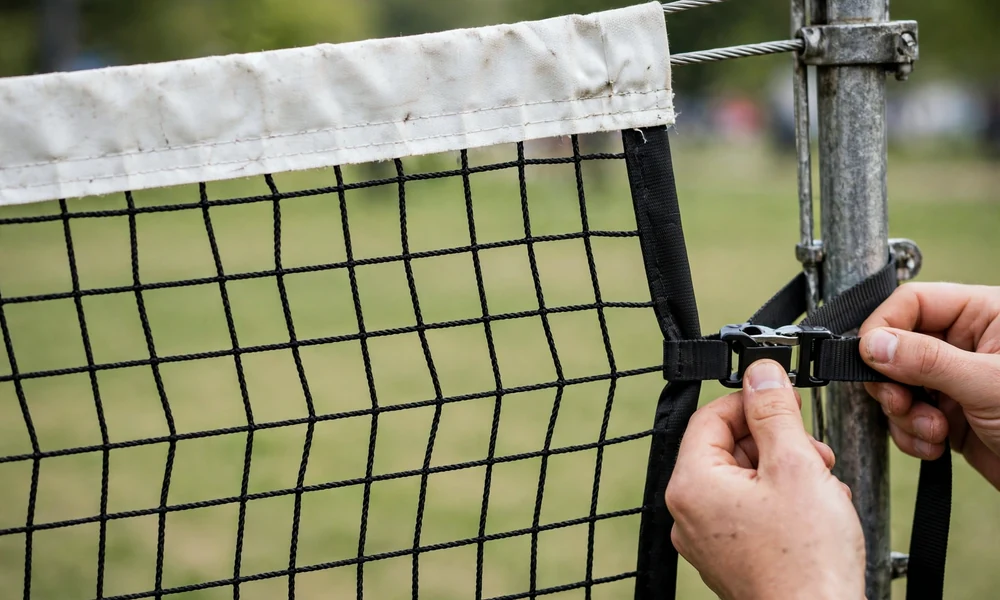
The first thing to judge is the tension. A volleyball net is only useful if it stays tight, and the best nets have a strong top cable or tape, a simple tensioning system, and poles that do not bend or lean when the net is pulled tight. A net that sags in the middle is a net that changes the game, because a ball that clears a sagging net would have hit a taut one, and a serve that drops short looks like a fault when it is really the net that has failed. Tension is the first test, and it is easy to feel: pull the net tight, step back, and look along the top tape. If it runs straight, the net earns trust, and if it dips, it does not.
The second thing is the mesh. The mesh of a volleyball net should be strong, even, and small enough that the ball cannot push through it or catch on it. The best nets use a knotless mesh that holds its shape, with a square size that is tight enough to give a clean rebound and loose enough to let the wind pass through outdoors. A mesh that stretches, frays, or has uneven squares will not last, and it will not play fairly either. A net that is well made feels firm to the touch, the squares are the same size across the whole width, and the edges are finished so the mesh does not unravel at the corners.
The third thing is the poles and the base. A net is only as good as the poles that hold it up, and the best poles are strong, light enough to carry, and easy to set at the right height. Steel poles are the sturdiest choice for regular play, while aluminium and fibreglass poles suit a portable net that has to be carried to a park or a beach. The base matters just as much: a pole that sits in a heavy base, a ground sleeve, or a well-staked guy rope stays upright in a breeze, while a pole that wobbles will lean a little more with every hit. A net that stands straight is a net that plays straight, and a net that leans is a net that will need fixing in the middle of a game.
The Main Types of Volleyball Net
Portable volleyball nets are the most popular choice, and for good reason. They come as a complete set with poles, a net, guy ropes, stakes, and a carry bag, and they can be set up on grass, sand, or a hard court in ten minutes or so. They suit a family, a group of friends, or a school that needs a net that can be packed away after use. They are light, simple, and cheap, and they are the best choice for most people, because they fit anywhere and are easy to move. The trade-off is the sturdiness: a portable net will not be as solid as a permanent one, and in a strong wind it needs its guy ropes staked properly. For most people, a portable volleyball net is the one to buy.
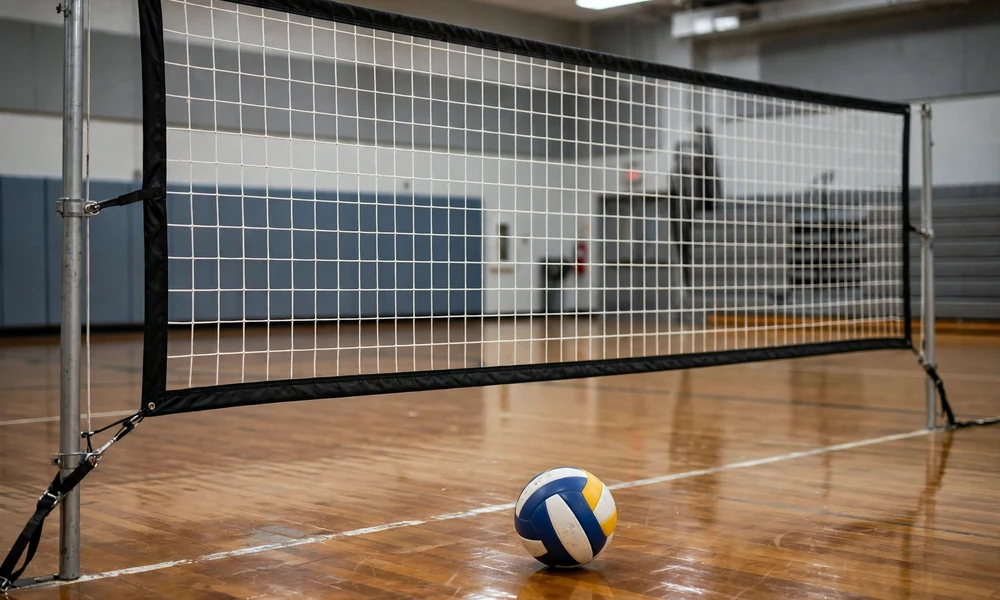
Regulation and indoor volleyball nets are the serious option. They are built to the full official size, with a net that is a metre deep and a top tape that sits at the official height, and they are the best choice for a school, a club, or a coach who trains players for matches. They suit a sports hall, and they are the most accurate option, because the height, the width, and the tension all match what players will meet in a real game. The downside is the cost and the set-up: a regulation net needs proper poles or sockets, it takes longer to put up, and it is too big and too heavy for a small garden. For serious players, a regulation net is the one that works.
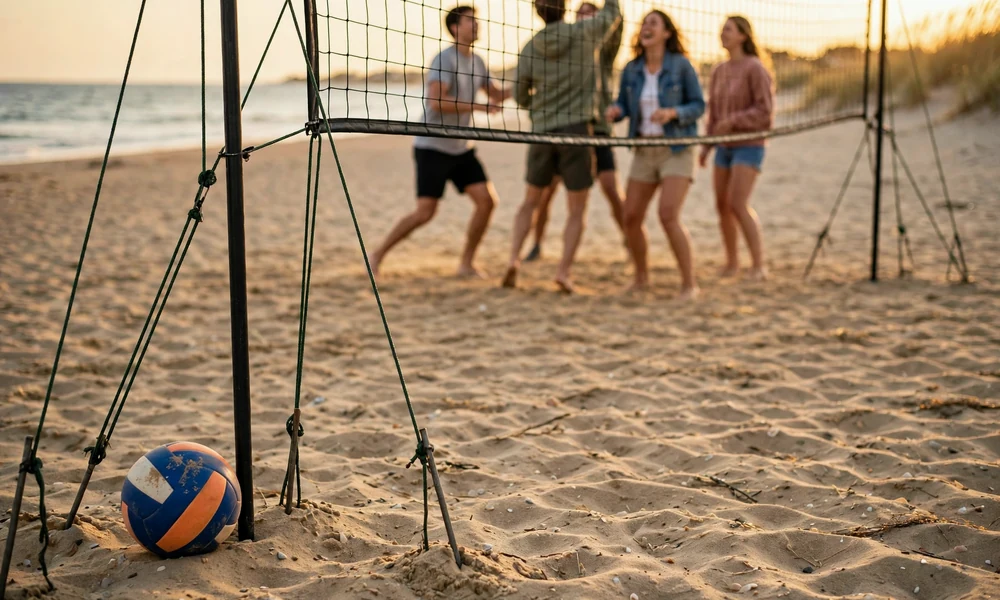
Beach volleyball nets are built for sand. They are wider than an indoor net in some sets and narrower in others, depending on whether they are made for two-a-side beach play or for a casual group, and they are the best choice for a beach holiday, a lakeside, or a sand court. They suit a group that wants to play barefoot, and they are the easiest option to set up on soft ground, because the poles are staked or weighted rather than bolted down. The trade-off is the sand itself: sand gets into the tensioning parts, the net needs a wash after a beach day, and a beach net that is left in the sun will fade faster than an indoor one. For beach games, a beach volleyball net is the one to buy.
How to Choose the Right Size and Height
The size of a volleyball net is the first decision, and it is simpler than it looks. A full-size net is about nine and a half metres wide, which suits a full court and a proper game, while a smaller net of about seven metres suits a garden, a beach group, or a game with fewer players. A net that is too wide for the space will sag at the edges, and a net that is too narrow will make the court feel cramped, so the space should be measured before the net is bought. A garden that is ten metres wide can take a full-size net, a garden that is seven metres wide needs a smaller one, and a beach needs a net that fits between the tide line and the dunes.
The height is the second decision, and it matters more than most buyers think. The official height for men is 2.43 metres, and for women it is 2.24 metres, and a net that sits at the wrong height changes every serve, spike, and block. A family game does not need official heights, but it does need a height that suits the shortest and the tallest players, and a net that can be lowered for children is worth more than a net that only goes to full height. The best nets have height markings on the poles, so both sides can be set to the same height in a minute, and the poles lock firmly at each setting. A net that is set level is a net that plays fairly, and a net that slopes is a net that will cause arguments.
Setting Up and Keeping the Net Taut
Setting up a volleyball net is a job for two people, and it goes faster when the poles are put up first, the net is attached loosely, and the tension is added last. The poles should be set the same distance apart as the net is wide, the guy ropes should be staked at an angle that pulls the poles outward, and the net should be clipped to the poles before the tensioning strap is pulled tight. A net that is tensioned before the poles are secure will pull the poles inward, and a net that is set up on sloping ground will lean, so the ground should be checked first. A good set-up takes ten minutes, a rushed set-up takes twice as long to fix, and a net that is set up well will stay taut for the whole game.
What to Avoid When Buying a Volleyball Net
The first mistake is buying a net that is too cheap to hold its tension. A very cheap net often has thin poles, a flimsy top tape, and a tensioning system that slips, and it will sag within a few games. A net that sags is not a bargain, it is a waste of money, because it will need replacing and it will spoil the games it was bought for. A better net costs more, but it lasts longer, it plays better, and it is cheaper over two or three summers than two cheap nets bought one after the other. The price should be judged over the life of the net, not on the day it is bought.
The second mistake is buying a net without checking what is in the box. A complete set should include the net, the poles, the guy ropes, the stakes, and a carry bag, and a set missing any of those will need extra parts bought separately. Check the box before buying, because a set missing a stake will not stand up properly on the first day it is used.
Who Should Buy Which Net
A family that plays in the garden should buy a portable or backyard net. It should be easy to set up, it should fit the garden, and it should be adjustable so children can play at a lower height. A net that is too big, too heavy, or too hard to set up will stay in its bag, and a net that stays in its bag is a net that was wasted. A family net should be light enough for one adult to carry, strong enough to survive a summer of games, and simple enough that a teenager can set it up without help. For a family, the best volleyball net is the one that gets used the most, and that is usually the simplest one that fits the space.
Volleyball is not the only game that turns a garden into a court. A household that likes backyard games often ends up with more than one set, and the same care that goes into choosing a net applies to the rest of the kit. If the garden already has a hoop, our guide to the best basketball hoops is a useful companion, and a smaller court game is well served by our guide to the best pickleball paddles. For a lighter, faster rally game, our guide to the best badminton rackets covers the kit that suits a small garden best.
The Verdict
The best volleyball net of 2026 is the one that stays taut, stands at the right height, and suits the ground it is played on. For most people, that is a portable net that sets up in ten minutes and packs away into a bag, because it is the net that gets used the most. For a family that plays every weekend, a backyard net is the better buy, because it is sturdier and stays up all summer. For a school or a club, a regulation net is the only honest choice, because it matches the real game. Buy the net that fits the space, check the tension before the first serve, and the game will take care of itself.


