
Pickleball looks simple from the side of the court. Two or four players, a low net, a light plastic ball with holes, and a short paddle that looks like an oversized table tennis bat. Yet the paddle in your hand changes almost everything about how the game feels. A good pickleball paddle gives you control at the net, enough power to finish a point when the ball sits up, and a grip that stays comfortable through a long session. A bad one feels dead on soft shots, wild on hard ones, and heavy in the hand by the third game. The best pickleball paddles of 2026 are not the most expensive paddles, and they are not the ones with the loudest colours. They are the paddles that match your hand, your swing and the way you like to play.
What Makes a Pickleball Paddle Good
The first thing to judge is how the paddle feels when the ball meets the face. A good paddle gives you feedback without jarring your arm. A soft shot, the dink, should come off the face gently and drop just over the net. A firm shot should leave the face cleanly, without the paddle twisting in your hand. If the paddle vibrates badly on off-centre hits, or if the ball seems to fly off the face faster than you expected, the paddle is working against you. The best paddles feel calm and predictable, even when the rally speeds up.
Weight is the next thing to notice. Most pickleball paddles weigh between about 7 and 8.5 ounces, and a small change makes a big difference. A lighter paddle is quicker at the net, easier on the wrist and shoulder, and better for fast exchanges close to the net. A heavier paddle gives you more power on groundstrokes and serves, and it can feel more stable when you block a hard drive. The trade-off is real: extra weight helps you hit harder, but it also tires the arm sooner and slows your reactions. Most beginners and many regular players are happiest in the middle of the range, where the paddle is quick enough for the kitchen line and solid enough for a drive.
The Main Types of Paddle
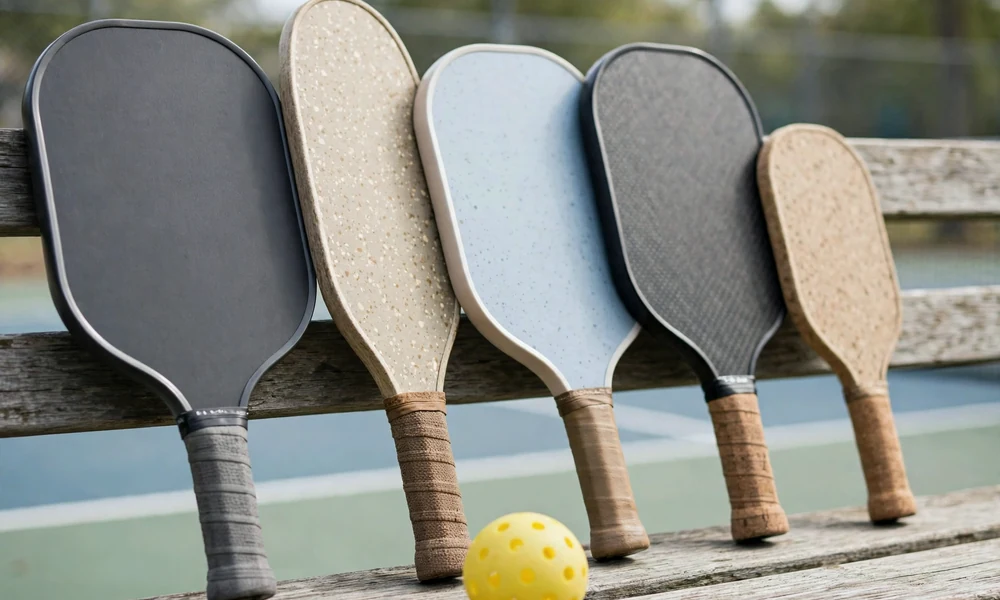
Composite paddles are the middle ground, and they are where most players start their first proper paddle. The face is usually made from fibreglass, and the core is usually a polymer honeycomb. Fibreglass gives the ball a lively bounce, so composite paddles tend to offer good power for the price. They are lighter than wood, more forgiving on off-centre hits, and available in a wide range of shapes and weights. Their weakness is control. The same lively face that adds power can make soft shots harder to judge, and the ball can come off the face a little faster than you meant. For a player who is still learning to place the ball, a composite paddle is a friendly, affordable choice.
Carbon fibre and graphite paddles are the most popular choice among regular and serious players. The face is stiffer and more textured than fibreglass, so it grips the ball slightly on contact and gives you more spin and more control. The feel is quieter and more precise: a dink stays a dink, and a drive goes where you aimed it. Carbon paddles are usually lighter than composite paddles, and they tend to be kinder to the arm. They cost more, and a raw carbon face can wear over time, but for most players who play twice a week or more, the extra control is worth the price. If you have come from tennis, you will notice the difference at once: the touch at the net is far closer to a soft volley than to a hard tennis stroke, and our guide to the best tennis rackets of 2026 shows how a different sport solves the same balance between power and control.
Shape, Thickness and Core
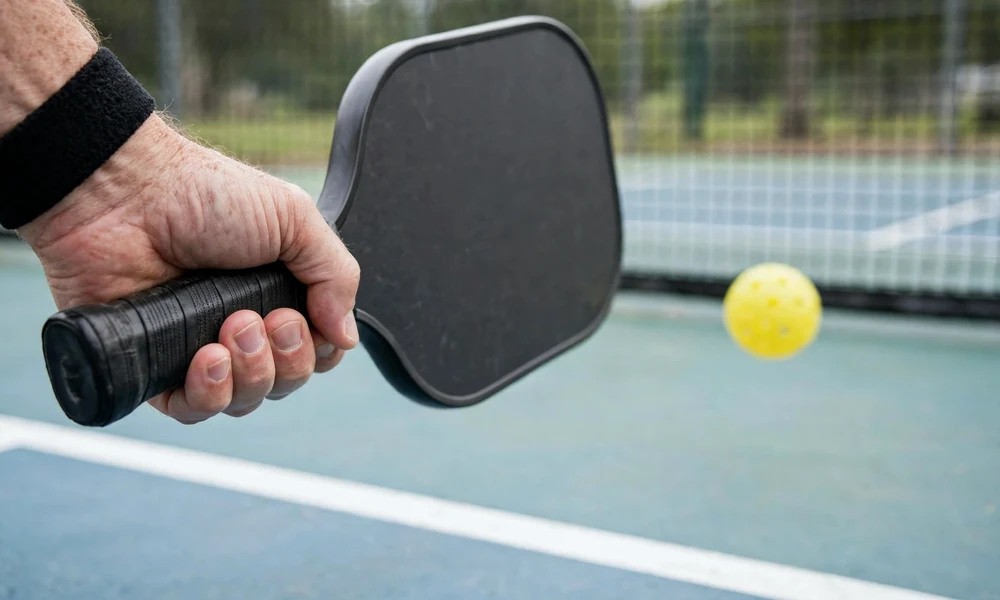
Paddle shape changes the size of the sweet spot, the area of the face where the ball comes off cleanly. A wide, standard-shaped paddle has a large sweet spot and a shorter handle, and it is forgiving when you do not hit the ball in the middle of the face. An elongated paddle is longer and narrower, with a bigger reach and a smaller sweet spot, and it gives you more power and more leverage on serves and overheads. A hybrid shape sits between the two. Beginners and most doubles players are happiest with a standard or hybrid shape, because the larger sweet spot forgives the small errors that happen in every rally. Elongated paddles suit taller players and singles players who want the extra reach.
How to Choose the Right Paddle
Start with how often you play and how you play. If you play once a month with friends, a good composite paddle will give you everything you need without a large outlay. If you play twice a week and you are starting to think about your dinks, your third shot and your positioning, a carbon paddle will reward you every time you step on court. If you play competitively, you will already know whether you need power, control or a balance of the two, and you should choose the paddle that fills the gap in your game rather than the paddle that looks the most impressive.
Think about where you win and lose points. If most of your points are won at the net, with quick hands and soft shots, choose a lighter, thicker paddle with a large sweet spot. If most of your points are won from the back of the court, with drives and serves, choose a slightly heavier, thinner paddle with a little more reach. If you lose points because the ball flies long, you need more control, not more power. If you lose points because you cannot finish a high ball, you need a paddle with a little more pop. The paddle should fix a real weakness in your game, not add to a strength you already have.
Paddles for Beginners
For a beginner, forgiveness is the most important quality. You are still learning to find the middle of the face, to judge the bounce and to place the ball, so a paddle with a large sweet spot and a soft, controlled feel will help you far more than a powerful paddle that punishes every small error. A standard-shaped composite or entry-level carbon paddle, around 16 millimetres thick and in the middle of the weight range, is the usual starting point. It will not do anything spectacular, and that is the point: it will let you learn the game without fighting the paddle.
Paddles for Intermediate Players
Intermediate players usually know what they want, even if they cannot name it yet. They have a reliable serve, a decent third-shot drop and a dink that stays low, and they are starting to notice where the paddle helps and where it holds them back. This is the point where a carbon face starts to make a real difference. The extra grip on the ball gives you more spin on serves and more control on drops, and the quieter feel makes it easier to judge a soft shot. A 16-millimetre carbon paddle with a hybrid shape is a common choice at this level, because it keeps the control you need at the net while giving you enough power to finish a point.
Paddles for Power and for Control
Most players are best served by a paddle in the middle, with a little of both qualities. A 16-millimetre carbon paddle with a hybrid shape and a mid-range weight is the closest thing to an all-rounder, and it is where most regular players settle. It will not hit the hardest drive on the court, and it will not give you the softest dink, but it will do both well enough that you can play your whole game without changing paddles. That versatility is worth more than a small edge in one part of the game.

Looking After Your Paddle
Paddles last longer with a little care. Keep yours dry, because moisture can work into the edge guard and the core, and keep it out of extreme heat, such as a car boot in summer, because heat can soften the core and warp the face. Do not leave a paddle leaning against a wall in direct sun for hours, and do not use it to pick up a ball by scraping it along the court. The edge guard is there to protect the paddle, but it is not indestructible, and a cracked edge guard lets dirt and water into the core.
Carry a spare ball or two, and keep your kit together so you are ready to play whenever a court is free. A bag that holds your paddles, balls, water and shoes is a small thing, but it means you never arrive at the court and realise you have left the one thing you need at home. On a rest day, a quiet indoor pastime can be a pleasant change from the court, and our guide to the best and worst puzzles of 2026 is a good place to start if you want something calm to do between games.
Mistakes to Avoid
A common mistake is ignoring the grip. A paddle with the wrong grip size will make every shot harder, and it is the easiest problem to fix. Try a few grip sizes, add overgrip tape if you need it, and replace the grip when it wears out. Your hand is the only connection between you and the paddle, and it deserves as much attention as the face or the core.
The Bottom Line
There is no single best pickleball paddle for everyone, because the best paddle depends on your hand, your game and how often you play. A wooden paddle is fine for an occasional game. A composite paddle is a friendly, affordable start. A carbon paddle gives you the control and spin that regular players need. A thicker paddle helps your soft game, a thinner paddle helps your power, and a standard shape forgives more than an elongated one. The best pickleball paddle of 2026 is the one that matches your game, feels good after an hour on court, and puts the ball where you meant it to go. If you want to see how the same choice looks in a head-to-head format, our guide to the best and worst tennis rackets of 2026 shows what to praise and what to avoid in a racket sport, and much of it applies to paddles too.
The simplest way to find your paddle is to try a few properly. Borrow a demo, play a full game with each one, and notice which paddle your hand reaches for the next time you play. That paddle, whatever its price or its colour, is your best paddle. Keep it dry, replace the grip when it wears, and enjoy a game that is easy to learn, hard to master, and far more fun with the right paddle in your hand.


