
Key Takeaways
- The best bike mirrors in 2026 show you the traffic behind you at a glance, so you can move out without wobbling.
- Bar-end mirrors suit flat-bar commuters, helmet mirrors suit road riders and multi-bike riders, and clamp-on mirrors give the biggest view.
- A mirror that vibrates is worse than no mirror, so a stiff arm and solid clamp matter more than large glass.
- Convex glass shows more road but makes vehicles look further away, so learn how your mirror reads before trusting it.
- Fit the mirror on the traffic side, angle it to show the lane behind you, and still glance over your shoulder before moving.
The best bike mirrors in 2026 solve a problem every rider on a busy road knows: you can hear traffic coming, but you cannot tell where it is or how fast it is closing. A good mirror answers both questions with a quick glance, without you turning your head and drifting across the lane. This guide compares the mirrors that earn their place in 2026.
A bike mirror mounts on your handlebars or helmet and shows you the road behind you as you ride forwards. Our guide to the best and worst bike lights of 2026 covers the device that makes you visible after dark; this guide is about the device that lets you see what is coming up behind you. A light helps drivers see you; a mirror helps you see them.
The rest of the kit on your bars is different too. A bike computer shows your speed and route — see our guide to the best bike computers in 2026. A bell warns people with sound, as our guide to bike bells that keep rides safe in 2026 explains. None of these do the mirror’s job.
What a Bike Mirror Actually Does for You
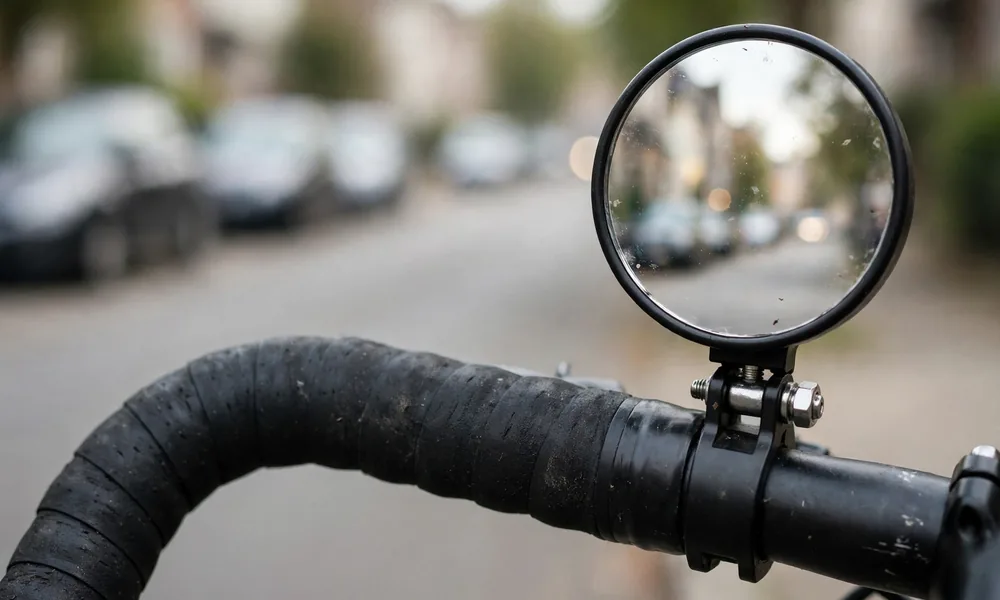
A mirror changes the way you ride in traffic. Without one, every move around a parked car starts with a shoulder check: a full second with your eyes off the road ahead while your bike drifts towards the way you turn your head. With a mirror, you already know what is behind you, so the shoulder check becomes a confirmation, not a discovery. You still look before you move, because a mirror has blind spots.
The Main Types of Bike Mirror
There are four main types, and the mount decides how steady it is, how much road you can see, and how easy it is to adjust.
Bar-End Mirrors
A bar-end mirror plugs into the open end of a flat handlebar, with a short arm holding a round or oval piece of glass just beyond your grip, usually convex for a wide view behind. Commuters and tourers like it because it sits low, adjusts easily, and folds inwards when you park. The drawback is that it sits below your line of sight, and drop handlebars often have no open bar end for it.
Helmet-Mounted Mirrors
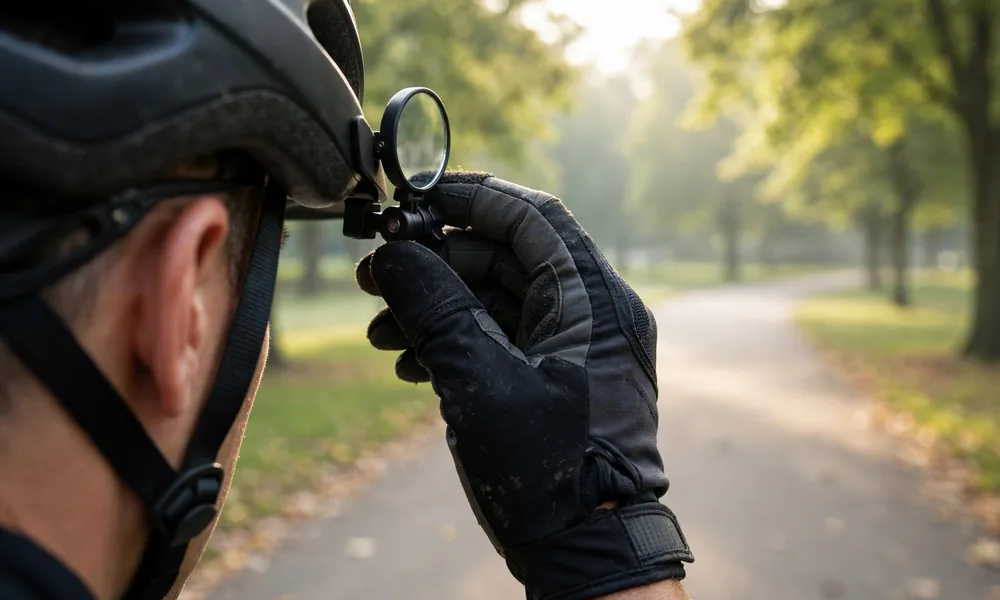
A helmet mirror is a small mirror on a thin arm that clips to the side of your helmet, aimed by turning your head slightly. It is the favourite of road riders and people who ride several bikes, because it moves with you: fit it once, and it works on every bike you own, including a hire bike. It sits in your peripheral vision, so glances are quick — though it takes a week or two to get used to, and a cheap one vibrates or slips.
Clamp-On Mirrors
A clamp-on mirror bolts around the handlebar near the grip and holds a larger piece of glass on a longer arm. It suits riders who want the biggest, clearest view, including many e-bike riders and tourers in fast traffic, and the clamp is the most secure mount of all, so it vibrates least. The drawback is bulk: it sticks out further, clashes with bells and lights on crowded bars, and catches most easily on door frames in crowded racks.
Folding and Adjustable Mirrors
Some mirrors fold flat against the bar when you do not need them, or swivel through a wide range for riders who share a bike. They suit commuters who lock their bike in a crowded stand, where a sticking-out mirror gets knocked. The joint is the weak point: a loose hinge will not hold at speed, and a stiff one is hard to adjust one-handed. Buy one only if the hinge feels firm and stays put when tapped.
Comparison Table
| Mirror | Best For | Mount | Glass | Weight |
|---|---|---|---|---|
| Mirrycle MTB Bar End Mirror | Best overall | Bar end | Convex, shatterproof | 84 g |
| Hafny HF-MR095 | Best clamp-on | Handlebar clamp | Convex, anti-glare | 112 g |
| Sprintech Compact | Best for drop bars | Bar end | Convex | 48 g |
| CatEye BM-45 | Best budget pick | Bar end | Convex | 78 g |
| Third Eye Pro Helmet Mirror | Best helmet mirror | Helmet mount | Flat, wide angle | 28 g |
The Best Bike Mirrors in 2026
Mirrycle MTB Bar End Mirror: Best Overall
The Mirrycle is the mirror most bike shops reach for first. The glass is large for a bar-end mirror, the convex curve gives a wide view behind, and the stiff arm keeps the image sharp at speed on rough roads. It fits any flat bar with a simple expanding wedge, sets with one hand, and folds inwards for parking, and the shatterproof glass survives knocks in a rack. It does not fit drop bars, but for flat-bar commuters and tourers it is the safest buy.
Hafny HF-MR095: Best Clamp-On Mirror
The Hafny is for riders who want the biggest, clearest view. The glass is larger than any bar-end mirror here, the clamp fits bars from 22 to 32 millimetres, and the anti-glare coating keeps the image readable when the low sun is behind you. It is heavier and bulkier than a bar-end mirror, and you need a spare few centimetres of bar space, but on an e-bike in fast traffic the extra view is worth it.
Sprintech Compact: Best for Drop Bars
Road riders have fewer mirror choices, because drop bars leave nowhere to plug a standard bar-end mirror, and the Sprintech is the best answer we found. It fits into the end of a drop bar, weighs almost nothing, and sits below the drops, clear of your hands. The glass is small, so the view is narrower, but it is sharp and steady.
CatEye BM-45: Best Budget Pick
The CatEye costs about half what the best mirrors cost, and it does most of what they do. The glass is clear, the convex curve gives a useful wide view, and the bar-end fitting is simple and secure. It vibrates a little more than the Mirrycle on rough roads, and the shorter arm narrows the view slightly, but for a rider who wants to try a mirror without spending much, it is an excellent first buy.
Third Eye Pro Helmet Mirror: Best Helmet Mirror
The Third Eye Pro is the lightest mirror here at 28 grams, and the most versatile, because it works on any bike you own. It clips to the side of your helmet, and a thin wire arm holds a small flat mirror in your peripheral vision. You aim it by turning your head a fraction — a few rides to learn — and then you can check behind you with the smallest eye movement of any mirror here, while its flat glass gives a true sense of distance.
Fitting and Adjusting Your Mirror
Fitting a bar-end mirror takes about five minutes. Remove the bar plug, slide the wedge into the open bar end, and tighten the bolt until it grips firmly — but do not overtighten, as a cracked bar end is an expensive mistake. Sit on the bike in your normal position and set the angle so the mirror shows the lane behind you, kerb just visible at the inner edge. Ride around the block and adjust again: the right angle on the stand is rarely the right angle on the move.
Fitting a helmet mirror takes a little longer. Clip the mount to the traffic side, and bend the wire arm so the mirror sits just outside your peripheral vision. Look straight ahead, then glance at it: you should see the road behind you without turning your head. Adjust it in small steps over a quiet ride, and do not judge it until you have done three or four rides.
What to Check Before You Buy
- Bar type: flat, swept-back or drop? A bar-end mirror will not fit drop bars, and a clamp-on mirror needs spare space.
- Side: fit it on the traffic side, so you see the vehicles that matter most without turning your head.
- Glass: convex for a wide view, or flat for true distance. Never buy one whose glass looks unclear in the shop.
- Stability: tap the glass and shake the bars; if the mirror drifts or buzzes, it will be worse on the road.
- Folding: if you park in a crowded rack, buy one that folds inwards, or you will replace it after the first knock.
- Compatibility: check it does not clash with your bell, light, computer or phone mount — a crowded handlebar has no room to spare.
Frequently Asked Questions
Do I really need a bike mirror?
You do not need one by law in most places. But a mirror makes riding in traffic noticeably easier, because you know what is behind you — and for busy-road commutes and e-bikes, it is one of the cheapest safety upgrades there is.
Are bike mirrors legal?
Yes, in almost every country a bike mirror is legal, and in some places it is encouraged for e-bikes. No common jurisdiction bans them. It does not replace the legal requirement for lights after dark.
Will a mirror vibrate too much to be useful?
A cheap mirror on a loose mount vibrates until the image is a blur. A good mirror on a stiff arm and a solid clamp stays sharp at speed, which is why stability matters more than glass size. If yours vibrates, tighten the joints first; if it still buzzes, replace it.
Can I fit a mirror on drop handlebars?
Yes, but your choices are narrower. A bar-end mirror made for drop bars, such as the Sprintech, fits into the end of the drops, and a helmet mirror works on any bike. A standard flat-bar mirror will not fit, so do not force one.
How do I judge distance in a convex mirror?
Convex glass makes vehicles look further away and smaller than they are, so do not trust it for exact distance. Use the mirror to tell you something is there and how fast it is closing, then use a shoulder check to judge the gap — after a few weeks, you will learn how your mirror reads.
Do mirrors work in the rain?
They work, but the glass gets spotted and harder to read. Wipe it with your glove before a busy junction, and keep a small cloth in your pocket on wet rides. A drop of rain repellent, the kind used on car mirrors, helps the water bead off.
The Bottom Line
The best bike mirrors in 2026 are the ones you actually use: the one that stays put, stays clear, and shows you the lane behind you at a glance. For most riders on flat bars, that is the Mirrycle: cheap, steady and easy to fit. For road riders on drop bars, it is the Sprintech or a helmet mirror. For e-bike riders in fast traffic, it is the Hafny clamp-on. Fit it on the traffic side, angle it carefully, and keep looking over your shoulder before you move.


