
Car floor mats are the hardest-working part of your car that nobody thinks about until they fail. Every muddy shoe, spilled coffee, and melted snowball lands on them first, and they are the only thing standing between that mess and the carpet underneath. A good set disappears into the background for years, quietly catching everything and rinsing clean in minutes. A bad set slides under the pedals, soaks through in a week, and turns a tidy car into a damp, stained embarrassment. The difference between the best and the worst car floor mats in 2026 is not about luxury or brand names. It is about fit, material, grip, and how the mat behaves after a winter of real use.
This head-to-head comparison puts the two sides against each other properly, instead of praising good mats on one page and complaining about bad ones on another. On one side, the mats that earn their place: custom-fit liners with raised edges, heavy rubber mats that refuse to move, and carpet mats built thick enough to last. On the other, the ones that disappoint from the first rainy day: floppy universal mats, thin carpet that holds water like a sponge, and bargain sets that curl up and creep toward the pedals. By the end, you will know which kind belongs in your car and which kind should never have been bought.
Key Takeaways
- A mat cut for your exact car model beats a universal mat almost every time, because coverage at the edges is what stops water reaching the carpet.
- Raised edges and deep channels matter more than thickness alone: they hold slush and spills on the mat instead of letting them run off onto the floor.
- Weight and grip decide whether a mat stays where you put it; light mats slide, bunch, and creep toward the pedals, which is a genuine safety problem.
- Rubber and thermoplastic liners are the easiest to clean, while good carpet mats win on quiet comfort and looks if you keep them dry.
- Check the anchor points before ordering, because a mat that does not fit your car is a mat you will replace within months.
What Makes a Great Car Floor Mat
A great car floor mat is judged by four things: how well it covers the floor, how much mess it can hold, how firmly it stays in place, and how easily it cleans up. Coverage comes first. The footwell is not a flat rectangle; it curves up at the sides, wraps around the seat rails, and narrows near the pedals. A mat cut for your exact model follows those curves, so mud and meltwater have nowhere to go except onto the mat. A mat that leaves a gap at the edge lets dirty water through, and once it reaches the carpet underneath, it stays there.
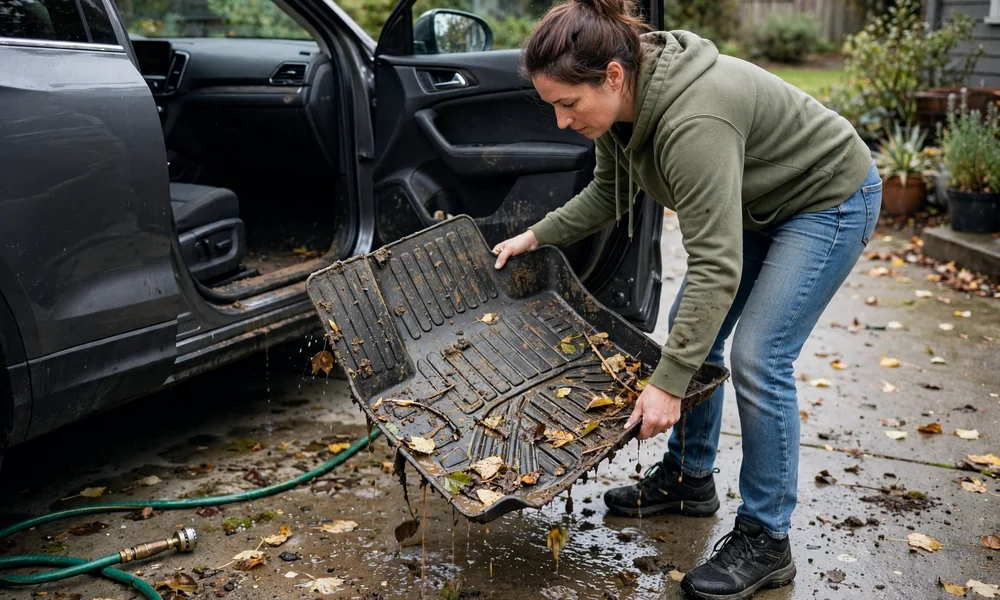
The Best Side: Mats That Earn Their Keep
The best car floor mats were designed for a real car, a real climate, and real mess. They do not pretend that one shape fits every footwell, and they do not rely on a pretty pattern to hide cheap material. They are heavy where they need to be heavy, grippy where they need to be grippy, and shaped so that water, grit, and crumbs stay on the mat and off your carpet.
Custom-Fit All-Weather Liners
Custom-fit liners are the top of the pile for most drivers, and it is not close. They are moulded to the exact shape of one car model, with raised edges that climb up the sides of the footwell and a deep channel pattern across the surface. That raised lip turns a mat into a tray: slush from winter boots, a knocked-over bottle, or a muddy dog paw stays inside the liner until you lift it out and empty it. The material is usually a flexible thermoplastic that stays supple in the cold instead of going stiff and cracking.
Heavy Rubber Mats That Stay Put
Heavy rubber mats are the workhorses of the floor mat world, and their greatest strength is the simplest one: they do not move. A thick rubber mat weighs enough to sit flat under your feet and stay there, and the nibbed underside bites into the carpet beneath it. The top surface is a pattern of ridges and cups that traps water and grit while giving your shoes grip on wet days. When the mat gets filthy, you pull it out, shake it, hose it down, and put it back while it is still damp, with no drying time and no worry about mildew.
Carpet Mats Done Properly
The trick is knowing what separates a proper carpet mat from a thin one. Pick it up: a good mat feels heavy and stiff, with a dense pile that springs back when you press it, while a bad one feels light, floppy, and papery at the edges. Check the backing, which should be thick and slightly rubbery, and the binding, which should be tight and even. A proper carpet mat also uses the factory anchor points. Keep a rubber set for winter if you can, and use the carpet mats for the dry months. A clean car is easier to keep clean when the mats work with you, and the same goes for the rest of the interior, which is why a good car vacuum is worth having alongside them.
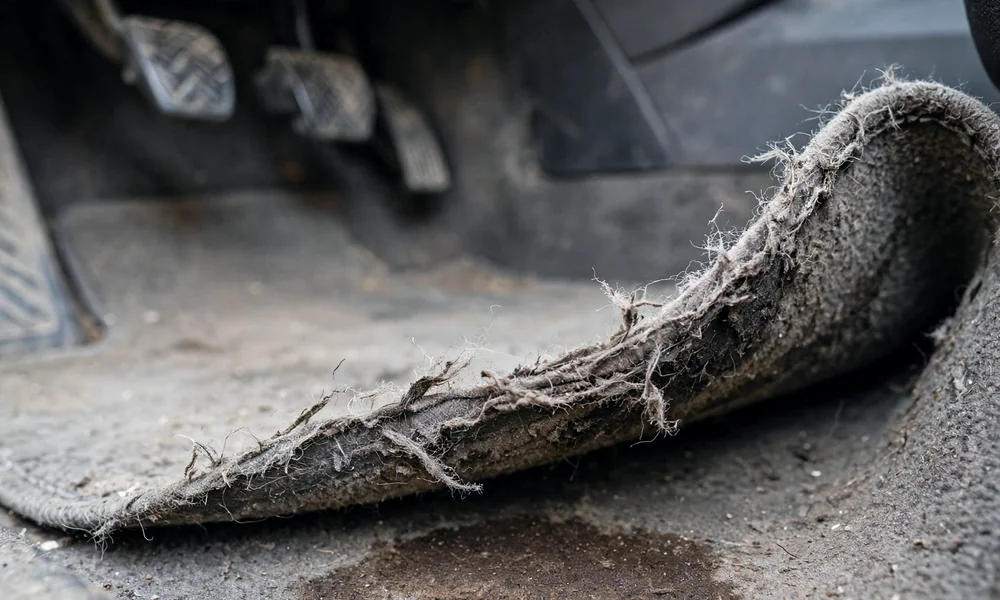
The Worst Side: Mats That Let You Down
The worst car floor mats all fail in the same quiet way: they look fine on the day you fit them, and they fall apart over the next few months. The corners curl, the mat slides forward, the carpet underneath gets wet, and by the first winter you are either buying a replacement or living with a damp smell you cannot shift.
Universal Mats That Slide Around
Universal mats promise to fit every car, and that promise is exactly the problem. A footwell is a specific shape, and a mat designed to fit all of them fits none of them properly. The edges stop short of the sides, leaving bare carpet where water runs, and the mat is usually too narrow at the pedals or too wide at the seat rails, so it buckles and folds. Because it was never shaped for your car, it has no anchor points that line up, so nothing holds it in place except its own weight, and most universal mats are far too light for that job.
Thin Carpet That Soaks Straight Through
Thin carpet mats are the most common disappointment in this category, because they look respectable in the box and fail the first time it rains. The pile is shallow, the backing is little more than a thin sheet of foam, and the whole mat weighs almost nothing. The first wet day soaks straight through to the carpet underneath, and because the mat is thin, it holds that damp against the floor for days. The smell arrives soon after, and no amount of air freshener fixes a mat that never fully dries.
The Pedal Problem
The warning signs are simple and worth checking every time you fit a new mat. The driver-side mat must sit flat, must not overlap the pedals, and must not move when you press it firmly forward with your foot. It must be a single mat, never two mats stacked on top of each other, because the top one will always slide. If your car has hooks in the footwell, use them, and if the mat you bought has no holes or clips for them, that tells you everything about how seriously its maker took safety. Winter makes all of this worse, since snow adds weight and slipperiness, and the worst cars for winter driving are the ones where small problems like this turn into big ones.

Best vs Worst at a Glance
Put the two sides next to each other and the pattern is clear. The best mats are heavy, shaped for one car, edged with a raised lip, and fixed to the floor with proper anchors. They hold water instead of passing it through, they stay flat for years, and they clean up in minutes. The worst mats are light, universal, flat, and loose. They slide, soak, curl, and wear through, and they cost more in replacements than a good set would have cost in the first place.
The material choice matters less than the execution. A thick, well-made carpet mat beats a thin rubber mat, and a heavy rubber mat beats a flimsy liner that was never shaped properly. What counts is fit, weight, edges, and anchors, in that order. If a mat nails all four, it will protect your car through winters, muddy dogs, and spilled drinks without complaint. Keeping the rest of the car ready for winter matters too, and a flat tyre in the cold is nobody’s idea of fun, which is where a reliable tyre inflator earns its place in the boot.
The Verdict
The best car floor mats of 2026 are the custom-fit all-weather liners, with heavy rubber mats a close second for anyone who values toughness over looks. They win because they solve the whole problem at once: they fit, they hold water, they stay put, and they clean easily. The worst are the thin universal sets sold in discount packs, which fail on every count that matters and can even become a safety problem under the pedals. Between those extremes sits the honest middle ground of a good thick carpet mat, which is a fine choice for dry climates and careful drivers, provided it is shaped for your car and anchored properly.
Our verdict is simple: spend the money once on a mat made for your exact car, with raised edges and proper anchors, and you will not think about floor mats again for years. That is the whole point of the purchase. A floor mat should be boring, reliable, and invisible, doing its job so well that you forget it is there until the day you lift it out, hose it off, and realise how much mess it caught for you.
Who Should Buy Which
Drivers in wet or snowy climates, parents, dog owners, and anyone who regularly drives on dirt or gravel should buy custom-fit all-weather liners for the front and rear, and a matching boot liner if one is available. The raised edges and easy cleaning will pay for themselves within the first winter. Drivers with work vehicles, farm trucks, or cars that carry tools and muddy boots should go for heavy rubber mats, which take abuse without complaint and rinse clean in seconds.
Drivers in dry climates who value a quiet, smart-looking interior should choose thick, properly made carpet mats cut for their exact model, and keep a cheap rubber set in the garage for the rare wet week or the muddy trip. Budget buyers should save up for one good set rather than buying two cheap ones, because the cheap set will need replacing within a year and the carpet underneath will already be stained. Whatever you choose, fit it, anchor it, and test it with your foot before you drive: push it forward hard, check the pedals are clear, and make sure it cannot bunch.


