
A fishing rod is a simple tool with a hard job: it has to throw a lure further than you can, feel a bite you cannot see, and then hold a fish that does not want to be held. The best fishing rods of 2026 do all three without drama. They cast straight and true, they telegraph the smallest tap on the line, and they bend in a smooth curve when a fish runs instead of snapping at the worst moment. The worst rods fail at the first of these jobs. They cast like a broom handle, they feel dead in the hand, and they break at the ferrule just when the fish of the day is on. This comparison puts the best fishing rods of 2026 against the worst, judging them the way you would actually fish with them: how they cast, how they feel, how they handle a hooked fish, and whether they are still in one piece a season later.
Fishing rods have changed a lot since the heavy fibreglass sticks of a generation ago. Modern blanks are mostly carbon fibre, which is lighter, stiffer and far more sensitive, and a good rod today weighs less than a paperback while casting further than the rods our grandfathers used. The market now stretches from short spinning rods for canals and ponds to long surf rods for the beach, and from delicate fly rods for rivers to heavy boat rods for the sea. What has not changed is what matters. The blank decides how the rod casts and how much it tells you, the guides decide how smoothly the line runs, and the handle decides whether your wrist is still happy at the end of the day.
Key Takeaways
- Feel matters more than price: a rod that talks to your hand catches more fish than a stiff, dead one at any price.
- A good blank casts smoothly and bends in a progressive curve; a bad one is either a poker or a noodle.
- Guides are the weak point of cheap rods: rough or loose guides fray line and kill casting distance.
- Match the rod to the water and the fish: a short light rod for small rivers, a longer heavier one for lakes and the sea.
- Telescopic rods are convenient for travel but are the first to break; two-piece rods are the safer buy for most anglers.
How Fishing Rods Work — and Where They Fail
Every fishing rod does three things: it stores energy from your cast and releases it to throw the lure, it transmits vibrations from the line to your hand, and it spreads the load of a fighting fish along its length. The blank is the tapered tube that does all of it. A fast-action blank bends mostly near the tip, which gives long, accurate casts and a firm hook set. A slower blank bends deeper into the rod, which forgives a clumsy cast and cushions a sudden run. Good designers tune the taper so the rod loads smoothly and recovers without wobbling; bad ones make a blank that is stiff in the wrong place and floppy in another.
The guides are the small rings the line runs through, and they matter far more than most buyers think. Good guides are smooth, firmly seated and lined with a hard ceramic that lets the line glide. Cheap guides are rough, loosely glued, and often slightly out of line, which frays the line on every cast and steals distance. The reel seat must hold the reel solidly without wobbling, and the handle must fit your hand: cork is warm and grippy when wet, while cheap foam gets slippery and crumbles with use.

The Best Fishing Rods of 2026
The best fishing rods of 2026 share one trait: they feel alive in the hand. Pick one up and it balances at the grip, neither tip-heavy nor butt-heavy. Cast it and the line sails out with a flick of the wrist, landing where you aimed instead of in the next swim. When a fish taps the bait, you feel it as a clear knock rather than a vague tremor. When the fish runs, the rod bends in a smooth, even curve from tip to butt, spreading the strain instead of concentrating it at one weak joint.
Build quality is where the best rods earn their price. The blank is straight and even, the joints fit snugly without play, and the guides are perfectly aligned and firmly fixed. The reel seat locks the reel in place with no wobble, and the handle is comfortable for hours of casting. Weight matters too. A rod under two hundred grams can be cast all day without a tired wrist; a heavy rod feels fine for the first hour and like an anchor by the fourth. The best rods are also honest about their limits: the casting weight printed on the blank is one you can actually use.
The Worst Fishing Rods of 2026
The worst fishing rods of 2026 fail in ways that are obvious within the first hour on the bank. The rod will not cast straight: it wobbles after every cast, the line piles up in a tangle, and the lure lands ten metres short of where you aimed. The blank feels dead, so you miss bites you should have felt, and when you do hook a fish the rod either stays rigid like a scaffold pole or folds over like a wet noodle. The guides are the first thing to go: an insert pops out, a ring cracks, and the line starts fraying on the rough edge.
Cheap telescopic rods are the worst offenders. They promise a full-length rod that fits in a rucksack, and they deliver a wobbly stick that jams shut, collapses mid-cast, and snaps at the thinnest section the moment a decent fish pulls. The joints are loose, the guides are glued on at slight angles, and the reel seat loosens after a few outings. The money saved at the till is spent twice over in lost lures, broken line, and the fish that got away because the rod gave up first.
Spinning vs Fly vs Baitcasting
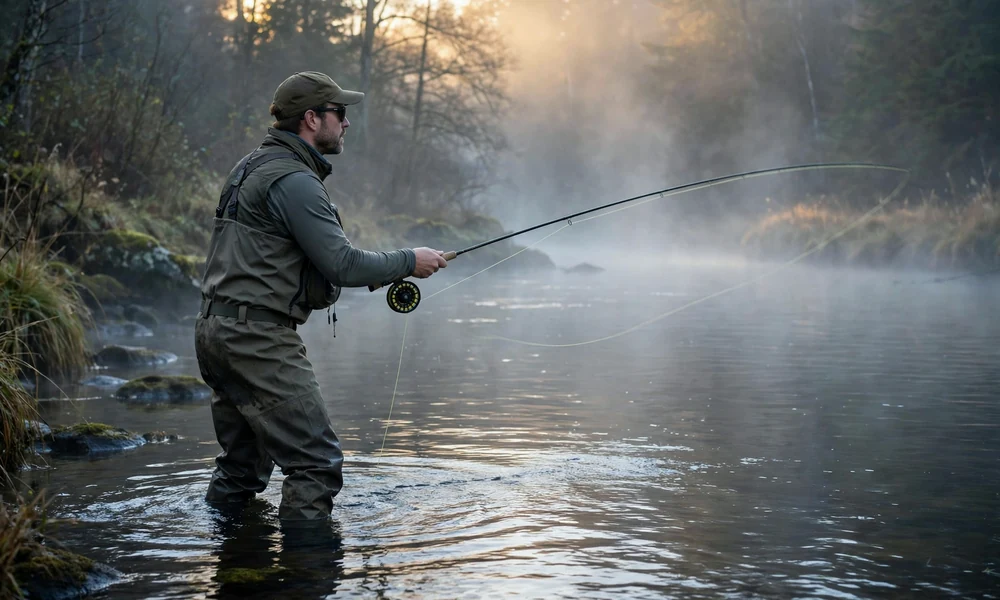
The three big families of rod suit different kinds of fishing. A spinning rod is the most forgiving place to start: the reel hangs below the rod, tangles are rare, and it handles light lures and small fish with ease. It is the right choice for canals, ponds and general coarse fishing. A fly rod is a different craft entirely: you cast the line, not the lure, and the rod is long, light and supple, built for presenting a tiny fly to a wary trout. A baitcasting rod puts the reel on top and suits heavier lures and bigger fish, but it punishes a sloppy cast with a bird’s nest of line.
None of these is better in itself; the mistake is buying the wrong one for your fishing. A fly rod on a still lake full of carp is the wrong tool, and a heavy baitcaster on a small stream is overkill. Start with a spinning rod if you are new, learn how a rod should feel, and only then branch out into fly or baitcasting once you know what you enjoy.
Two-Piece vs Telescopic
Two-piece rods are the standard for a reason. They break down into two halves that fit in a car, they assemble in seconds, and the joint is strong because it is a simple, well-engineered taper. They cast better and last longer than any telescopic rod at the same price, and if one section breaks you can often replace it. Telescopic rods solve a different problem: they collapse into a short tube that fits in a suitcase or a rucksack, which is genuinely useful for travel and for fishing on holiday.
The gap has narrowed, but only at the top end. A good telescopic rod from a serious maker is usable, though it will never quite match a two-piece for feel or strength. A cheap telescopic rod is a different story: the sections jam, the guides sit at odd angles, and the thinnest section snaps under load. If you only fish on holiday and need something packable, spend properly on a good telescopic; otherwise a two-piece rod is the better buy every time.

What to Check Before You Buy
Before you spend anything, check five things. First, hold the rod and check the balance: it should sit comfortably in your hand without tipping forward or back. Second, look down the blank from the butt and check it is straight, with the guides in a clean line. Third, flex the rod gently and watch it bend: the curve should be smooth, with no flat spots or sudden kinks. Fourth, check the casting weight printed on the blank and match it to the lures you actually use. Fifth, look at the warranty: a maker that offers a two-year warranty on a blank believes in it, and one that offers thirty days does not.
- Hold it first and check the balance at the grip.
- Sight down the blank: it should be straight, with guides in line.
- Flex it gently and look for a smooth, even curve.
- Match the casting weight to the lures you actually throw.
- Budget for a reel, line and a few lures, not just the rod.
A rod rarely goes out alone. It goes with the rest of your outdoor kit, and the best days on the water start with knowing the basics. If you are just starting out, our guide to the best fishing rods for beginners and weekend anglers in 2026 is the place to begin, with the forgiving rods that make a first season easy. For the days when the fishing is done from the water rather than the bank, our comparison of the best and worst kayaks of 2026 covers the boats that get you to the quiet corners the bank cannot reach. And when the trip stretches into an overnight stay, our look at the best and worst camping tents of 2026 shows which shelters keep you dry and which ones leak at the first shower.
The Verdict
The best fishing rods of 2026 are the ones that disappear in your hands: light, balanced, sensitive to the smallest bite, and strong enough to bend deep when a good fish runs. They cost more, but they get used more, and that is the real value. The worst rods are the ones you fight all day: wobbling casts, dead blanks, guides that fray your line, and joints that snap when it matters most. The difference is not mysterious, and it is not only about money. It is about blank quality, guide work, balance and honest design. Hold the rod, sight down the blank, flex it and check the warranty. Do that, and the rod will do what it promised on the box: a clean cast, a clear bite, and a fish in the net at the end of a good day.


