A salad spinner is a simple idea: a basket that spins wet lettuce dry so your dressing sticks instead of sliding off in a puddle. When it works well, you barely think about it. You wash the leaves, give the handle a few turns, and tip out crisp, dry greens that are ready for the bowl. When it works badly, the whole salad suffers. The leaves come out soggy, the dressing slides to the bottom, and the spinner itself wobbles across the counter, leaks water everywhere, or bruises the lettuce into a sad, limp pile.
This comparison puts the best salad spinners of 2026 head to head against the worst, judging them the way you would actually use them: how dry the greens come out, how steady the spinner sits on the counter, how easy it is to pump or crank, how it survives the dishwasher, and whether it still works well after a year of weekly salads. The best vs worst mixing bowls decide what your salad is served in; this guide decides whether the leaves inside are crisp or soggy.
Key Takeaways
- Judge a salad spinner by how dry the leaves come out, because a spinner that leaves greens wet has failed at its one real job.
- A heavy, non-slip base and a smooth pump or crank matter most, since a spinner that walks across the counter is a nuisance on every use.
- Look for a basket that lifts out easily and a bowl that doubles as a serving dish, because those details decide whether the spinner earns its cupboard space.
- Clear, sturdy plastic or stainless steel lasts longest, while thin, cloudy plastic cracks, stains, and starts to smell.
- The worst salad spinners are light, wobbly, and hard to spin, with lids that leak and baskets that bruise delicate leaves.
What Makes a Great Salad Spinner
A great salad spinner starts with the spin itself. The basket needs to turn fast and smoothly, with a mechanism that keeps its speed through several turns without your hand cramping. A good pump handle gives a satisfying, even spin with each press, and a good crank turns without grinding or sticking. The brake matters too: the best spinners stop the basket quickly and cleanly when you press it, instead of letting it coast on and fling water over the rim.

Stability is the second thing that separates the best from the worst. A spinner with a wide, heavy base and a rubber ring underneath stays exactly where you put it, even when the basket is full of wet, heavy greens. A light spinner with a smooth plastic bottom slides and tips, and once it tips, the water goes everywhere. The bowl should also feel solid in the hand, with a rim you can grip, and the basket should lift out without catching on the lid. When all of that works, drying salad takes about thirty seconds and feels like nothing at all.
The Best Salad Spinners of 2026
The best salad spinners of 2026 share the same strengths: they spin fast, sit still, and dry a full load of greens in one go. They are built from materials that stay clear and clean, and their parts come apart easily for washing. Here is what sets them apart.
A Fast, Smooth Spin That Dries in Seconds
The best spinners get the basket up to speed quickly and keep it there. A few pumps of the handle, or a few turns of the crank, and the water flies off the leaves and collects in the bowl below. You do not need to spin for a minute or shake the basket by hand afterwards. The greens come out dry enough that dressing clings to every leaf, which is the whole point. A weak spinner leaves the leaves damp, and damp leaves make a watery salad no matter how good the dressing is.
A Base That Stays Put on the Counter
Weight and grip decide whether spinning is easy or annoying. The best spinners have a broad base, a rubber ring underneath, and enough weight that the whole thing stays planted while the basket whirs inside. You can pump with one hand and hold a tea towel with the other, and nothing moves. Cheaper spinners skitter across the worktop the moment you start pumping, and you end up chasing them with one hand while trying to spin with the other. It is a small detail that changes the experience completely.
Baskets and Bowls That Work Twice as Hard
In the best designs, every part earns its place. The basket lifts out of the bowl so you can carry the greens straight to the table, and the bowl itself doubles as a serving dish or a storage container with the lid on. The best bowls are clear enough to see the water level, deep enough to hold a whole head of lettuce, and shaped so they stack neatly in the cupboard. Some even come with a lid that keeps the salad fresh in the fridge, which means one less container to wash.

Parts That Come Apart and Wash Clean
A salad spinner touches wet leaves every time you use it, so it needs to come apart for cleaning. The best ones break down into three simple pieces, basket, bowl, and lid, with no hidden corners where water and old lettuce can hide. The top rack of the dishwasher handles them without warping, and the plastic stays clear instead of going cloudy after a few months. The worst spinners have fiddly mechanisms that trap water, and once they start to smell, no amount of washing fixes them.
The Worst Salad Spinners of 2026
The worst salad spinners of 2026 look fine in the shop and fail in the kitchen. They spin slowly, leak, wobble, and leave your greens wet or bruised. They are usually the cheapest option on the shelf, and they cost you more in ruined salads than you saved at the till. Here is what goes wrong.
A Weak Spin That Leaves Greens Soggy
The most common failure is a spin that never gets fast enough. The mechanism feels stiff or gritty, the basket turns in jerks, and no matter how many times you pump, the leaves come out nearly as wet as they went in. Some cheap spinners have a handle that slips or a gear that catches, so half your effort goes nowhere. You end up shaking the basket over the sink by hand, which is exactly the job you bought the spinner to do.
A Light Base That Walks Across the Counter
Bad spinners are light, narrow, and smooth underneath, which is the worst possible combination. The moment the basket gets up to speed, the whole spinner starts to travel, and if you let go for a second it can tip over entirely. Spilled water runs across the counter and onto the floor, and the greens end up on the worktop. A spinner that needs one hand to hold it down while the other pumps is not a labour-saving tool; it is a two-person job pretending to be a gadget.
Lids That Leak and Baskets That Bruise
Cheap lids are the next weak point. They fit loosely, they pop off mid-spin, and they let water spray out of the gap between the lid and the bowl. The baskets are often just as bad: sharp edges inside the basket tear delicate leaves, and holes that are too big let small herbs slip through and end up in the water at the bottom. The result is a salad that looks battered before it reaches the table, with half the herbs missing. A good spinner treats the leaves gently; a bad one beats them up.
Plastic That Cracks, Clouds, and Smells
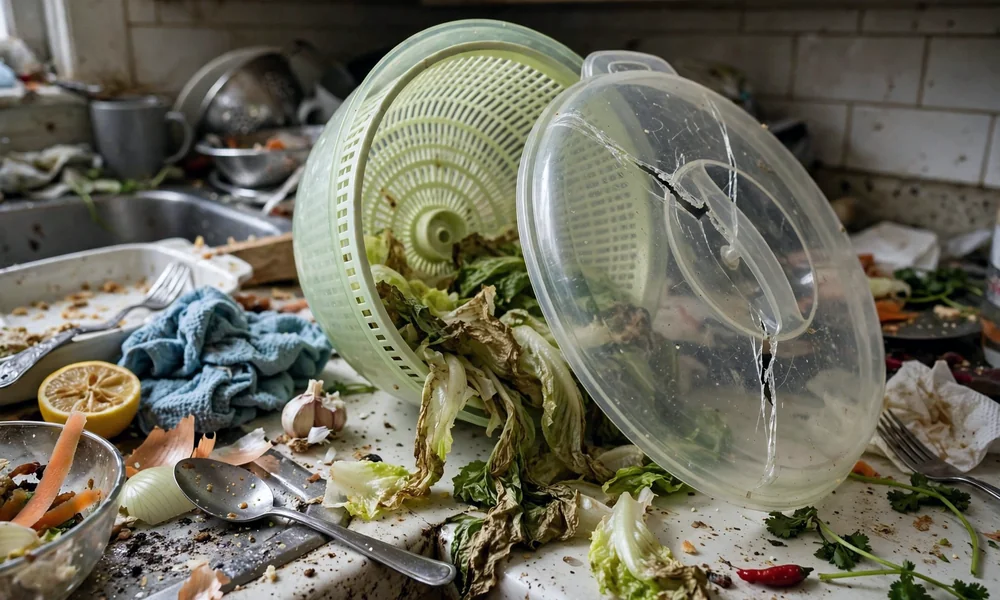
Thin plastic is the quiet killer of cheap spinners. It goes cloudy after a few washes, it cracks around the handle and the lid, and it picks up smells that never wash out. A spinner that once held garlic or onion can taint a salad weeks later. The plastic also warps in the dishwasher, so the lid stops fitting and the basket stops spinning true. Once the parts no longer fit together properly, the spinner is finished, and most people throw it away within a year. The best vs worst meal prep containers face the same plastic problem, and the lesson is the same: cheap plastic costs more in the end.
Best vs Worst: The Head-to-Head
Put the two sides next to each other and the gap is obvious. A good spinner dries a full basket of greens in about twenty seconds, stays still while it does it, and comes apart for a quick wash. A bad one takes twice as long, leaves the leaves damp, wanders across the counter, and leaks water down the side of the bowl. The good one makes salad night easier; the bad one makes it messier than washing the leaves by hand. The difference is not the idea, which is the same in both, but the build: weight, grip, a smooth mechanism, and plastic or steel that holds its shape. If you make salad more than once a week, the good spinner pays for itself in saved time and better salads within a month.
The Verdict
The best salad spinners of 2026 win clearly. A well-built spinner with a heavy base, a smooth pump or crank, and a basket that lifts out easily is one of the most useful tools in a salad lover’s kitchen, and it will last for years. The worst spinners are a false economy: they spin weakly, leak, wobble, and crack, and they turn a thirty-second job into a soggy mess. Spend a little more on a solid, stable design, and check that the base grips and the parts come apart before you buy. Your salads will taste the difference every single time.
Who Each Salad Spinner Is For
A good salad spinner is for anyone who makes salad at home more than once a week. If you buy whole heads of lettuce, wash herbs, or prep vegetables for the week ahead, a sturdy spinner saves time and keeps your greens crisp for days. It is also worth it for small kitchens, because the best bowls double as serving dishes and storage. A cheap spinner suits nobody very well, but it might do for someone who makes salad once in a blue moon and does not mind a bit of mess. Even then, a colander and a tea towel do the same job better. If you care about crisp leaves at all, buy the good one.
Frequently Asked Questions
How dry should a salad spinner get the leaves?
Dry enough that no water comes off when you shake a leaf, and dry enough that dressing sticks instead of pooling at the bottom of the bowl. A good spinner gets there in about twenty seconds of spinning. If the leaves still feel wet after a full spin, the spinner is too weak.
Can I put a salad spinner in the dishwasher?
Most good spinners are dishwasher safe on the top rack, but the lid mechanism is the part to watch. Check the maker’s guidance, and wash the pump or crank by hand if it feels stiff after a dishwasher cycle. Thin plastic warps easily, which is another reason to buy a sturdier design.
Do I need a salad spinner if I buy pre-washed salad?
Not really. Pre-washed bagged leaves are already dry, so a spinner adds little. A spinner earns its place when you wash whole heads of lettuce, herbs, or vegetables yourself, which is cheaper and fresher. If that is your habit, a good spinner is worth the cupboard space, and the best vs worst kitchen scales are worth a look too if you like precise cooking.