A sander is the tool that decides whether a weekend project looks like it was made by a careful pair of hands or by someone in a hurry. A good one takes a rough pine board and leaves it smooth enough that paint sits flat and varnish shines without a ripple. A bad one leaves swirls you can see from across the room, dips you can feel with your fingertips, and edges that are rounded where they should be square. The best sanders of 2026 make the good result the normal result. The worst make every surface a gamble, and a sander that gambles with your work is a bad buy at any price, no matter how cheap the box looks on the shelf.
This comparison looks at sanders as their own tool, not as an afterthought in a bigger kit. We judged them the way you would actually use one at home: opening the box on a Saturday, fitting a sanding disc, smoothing a tabletop before painting, taking the rough edge off a garden bench, and working a shelf bracket into a corner. We looked at finish quality, dust control, comfort, noise, and whether the sander is still pleasant to hold after half an hour of steady work. A great sander is not the most powerful one on the shelf. It is the one that leaves a surface you are proud to show, and this guide shows you how to tell the two apart before you spend a penny.
Key Takeaways
- Finish quality matters most: the best sanders leave a surface smooth and swirl-free, while the worst leave visible scratches and dips that paint only makes worse.
- Random orbital sanders are the safest first buy: they smooth flat surfaces quickly without gouging, while a belt sander in careless hands can ruin a board in seconds.
- Dust control decides whether you enjoy the job: the best sanders catch most of their own dust, while the worst fill the room and coat everything you own.
- Comfort decides whether you finish the job: the best sanders balance well and vibrate little, while the worst numb your hands in ten minutes.
- The same honest cost check helps with our comparison of the best and worst power tools of 2026, where sanders sit alongside drills and saws in a full home kit.
How We Judged the Sanders
We judged every sander on six things that matter when you actually work with one rather than when you look at the specification sheet. First, finish quality: whether the surface comes out smooth and even, or whether it is marked with swirls, scratches, and shallow dips. Second, speed: whether the sander removes material at a useful rate, or whether you spend an afternoon on a job that should take an hour. Third, dust control: whether the dust bag or extraction port catches the dust, or whether it escapes into the air and across the bench. Fourth, comfort: whether the sander balances in your hand, or whether it pulls your wrist and tires your arm. Fifth, noise and vibration: whether you can work for an hour without your hands buzzing afterwards. Sixth, running costs: whether sanding discs and belts are cheap and easy to find, or whether every refill costs more than it should.
The Best Sanders of 2026
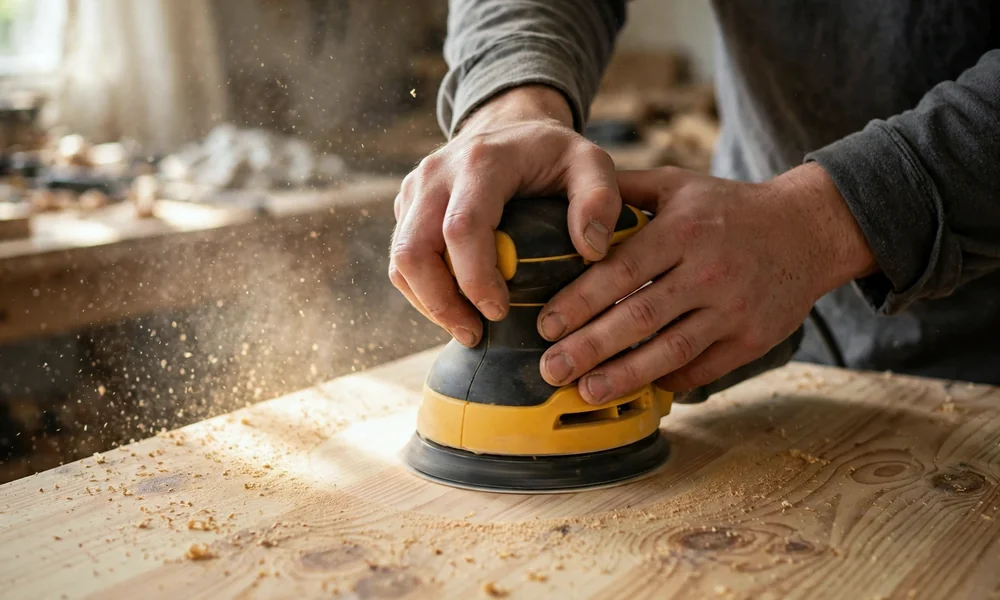
The best sanders share one habit: they remove material steadily and leave a surface that needs no apology. A good random orbital sander is the workhorse of the group. Its round pad spins and wobbles at the same time, so it smooths quickly without leaving the circular marks a simple spinning pad would leave. Hold it flat, let its own weight do the work, and move it slowly across the board. The result is a surface that feels like glass under your palm, ready for paint or varnish with no extra hand sanding. The best ones keep their speed when you press a little harder, and their pads stay true instead of tilting and digging into one corner.
A good belt sander earns its place when there is real material to remove. It is the fastest way to flatten a rough board, strip an old finish, or level a joint that stands proud of its neighbour. The best belt sanders track straight, so the belt stays centred instead of creeping sideways and chewing the edge. They have a steady speed that does not dip when the belt bites, and a front handle that lets you steer with both hands. Used with care, a belt sander can take a weathered garden bench from grey and rough to clean and smooth in a single afternoon, and that is a job no orbital sander can do in the same time.
A good detail sander, sometimes called a mouse sander, is the tool for the places the others cannot reach. Its pointed pad slips into corners, along window frames, and around the edges of a shelf bracket where a round pad would leave a rough triangle untouched. The best detail sanders are light enough to hold overhead without your arm aching, and their pads grip the sandpaper firmly so it does not peel away halfway through a corner. They are not fast on a big flat board, and nobody sensible would use one there, but for the last ten per cent of a job they are the difference between finished and nearly finished.
The best cordless sanders have finally caught up with their corded cousins for ordinary home work. A good cordless random orbital sander runs long enough on one battery to smooth a tabletop, and it frees you from dragging a cable across a freshly sanded surface. The best ones share a battery with the rest of the maker’s tools, so the battery you already own for a drill fits the sander too. They are a little heavier than a corded sander, because the battery sits on top, but the best balance that weight over the pad so the sander still feels steady in your hand.
The Worst Sanders of 2026
The worst sanders fail in ways that show up on the wood itself, and that is the cruelest kind of failure, because you cannot undo a gouge with more sanding. A bad random orbital sander is the most common disappointment. It spins too fast with too little control, so it leaves pale swirls across the surface that only appear when the light catches them, usually after you have already painted. Others slow down the moment you press them to the wood, so you push harder, the pad tilts, and one edge digs a shallow hollow into the board. Either way, the surface you get is worse than the one you started with, and you end up hand sanding the whole thing again.
A bad belt sander is a more dramatic problem, because it works fast enough to do real damage before you notice. The worst ones track badly, so the belt creeps sideways, frays against the housing, and snaps halfway through a pass. Some have a motor that strains and slows under load, which leaves a rippled surface like a washboard. Others have no dust collection at all, so the air fills with fine dust within minutes and you are working blind. A belt sander that cannot keep its belt straight is not a bargain at any price; it is a tool that will eat the very board you are trying to save.
A bad detail sander fails quietly, which makes it easy to keep using long after it should have been replaced. Its pad wears lopsided, so one corner does all the work and the other floats above the wood. Its sandpaper peels away because the hook-and-loop backing has lost its grip, and you find yourself holding the paper in place with your fingers. The worst ones vibrate so hard that your hand goes numb in minutes, and their tiny dust bags clog after a few passes and then blow dust back out of the seam. They look like a clever little tool in the shop, and they feel like a punishment in the hand.
The worst cordless sanders are the ones that die halfway through a job and take too long to come back. A small battery that lasts fifteen minutes is no use on a tabletop that needs forty, and a charger that takes three hours turns a Saturday job into a weekend of waiting. Some cheap cordless sanders are also badly balanced, with the battery hanging off the back so the pad lifts at the front and sands unevenly. The worst of all are the ones with a battery that fits nothing else you own, so when the battery wears out you are buying a whole new tool instead of a new battery. A sander that stops when the work is half done is worse than no sander at all, because it leaves you with a surface that is smooth in one half and rough in the other.

Best vs Worst at a Glance
Dust is the second test, and it is the one most buyers forget until they have used the tool once. A good sander catches most of its dust in the bag or the extraction hose, so the bench stays clean enough to see the work. A bad sander fills the room, coats your clothes, and leaves a film on everything in the garage. The same kind of honest check helps with our comparison of the best and worst saws of 2026, where dust and accuracy matter just as much as they do here. If you sand indoors, dust control is not a luxury; it is the difference between a job you enjoy and a job you dread.

The Verdict
Buy a random orbital sander first, and buy a good one. It is the sander that suits most home jobs, from smoothing a tabletop to preparing a door for paint, and a good one will last for years of steady use. Add a belt sander only when you have rough boards to flatten or old finishes to strip, and add a detail sander when you start working in corners and along frames. If you already own a battery platform, a cordless sander from the same maker is a sensible choice; if you do not, a corded sander gives you more power for less money and never runs flat halfway through a job.
The sander to avoid is the cheapest one on the shelf with the loudest promises on the box. It will leave swirls, fill the room with dust, and wear out its pad before the year is over, and you will end up buying the good sander anyway. Spend the money once, on a sander that sits flat, catches its dust, and leaves a surface you are proud of. The same rule applies to the best and worst drills of 2026, the tool most people buy before they ever think about sanding. A good sander does not make you a better woodworker on its own, but it stops the tool from being the reason the work looks rough, and that is exactly what a good tool should do.