Soy milk is the oldest plant milk on the shelf, and it is still the one that behaves most like dairy. It is made from soaked soybeans, ground and strained into a smooth, creamy drink, and it carries more protein than any other plant milk — around seven or eight grams a glass, close to cow’s milk. When it is made well, a glass of soy milk tastes gently beany and clean, pours with real weight, and blends into hot coffee without a wobble. When it is made badly, the same carton gives you a thin, grey drink that tastes of raw beans, splits the moment it meets coffee, and leaves a chalky film on the glass.
The gap between the best soy milks of 2026 and the worst is wide, and it usually shows up in four places: the protein, the beany flavour, the sweetness, and the way it behaves when heated. A great soy milk tastes of the bean first, not of sugar or thickener, and it stays smooth from the first pour to the last. A bad one is watery enough to see through, or so sweet it belongs in a dessert, or so full of gums that it coats the tongue. This comparison puts them head to head the way you would actually use them: poured over breakfast, stirred into a morning coffee, and drunk cold from a glass. We look at flavour, body, sweetness, how they hold up in heat, and whether a carton earns its place in the fridge or only its place on the shelf.
Key Takeaways
- A good soy milk is creamy and high in protein, with a clean, gently beany flavour and no chalky or chemical aftertaste.
- Check the protein on the label: the best cartons give around 7–8 grams per glass, while the worst give barely half that.
- Unsweetened soy milk is the safest all-rounder for coffee and cooking, while sweetened versions suit cereal and drinking cold.
- The worst soy milks are thin and watery, split in hot coffee, or so sweet they overpower everything they touch.
- The same honest approach sits behind our comparison of the best and worst coffees of 2026, because soy milk is judged hardest in the cup it is poured into.
How We Judged the Soy Milks
We judged every soy milk on five things that matter at the breakfast table rather than on the carton. First, flavour: whether the milk tastes gently of real soybeans, with a fresh, clean finish, or of raw beans, cardboard, and additives. Second, body: whether it feels like milk in the mouth, with a little weight and creaminess, or like flavoured water that vanishes before you swallow. Third, sweetness: whether the sweetness is balanced and honest, or so heavy that it turns coffee into a pudding and cereal into a dessert. Fourth, behaviour in heat: whether it blends smoothly into hot coffee and tea, or curdles, splits, and floats in sad white flecks on the surface. Fifth, the label itself: how much protein is actually in the carton, what has been added to thicken or sweeten it, and whether the maker is honest about what is inside.

The Best Soy Milks of 2026
The best soy milks of 2026 share one quality above all: they taste like food, not like a formula. They are made from whole soybeans, they carry real protein, and they pour with a creamy weight that makes a bowl of cereal feel like breakfast rather than a chore. The flavour is warm and gently beany, with a clean finish and no chemical aftertaste. In coffee they behave like dairy, blending in smoothly and softening the bite of a dark roast without turning the cup grey. Drunk cold, they are satisfying on their own, with enough body to feel like a proper drink rather than a flavoured water.
What sets the top cartons apart is how little they need to hide behind. The ingredient list is short: soybeans, water, a little salt, and perhaps calcium and vitamins. There is no long parade of gums, emulsifiers, and flavourings, because a well-made soy milk does not need them. The best unsweetened cartons are the most versatile of all — they work in coffee, in cooking, and over cereal — while the best sweetened ones taste like a treat without crossing into dessert. Both kinds keep well in the fridge, pour cleanly to the last glass, and never leave a chalky film on the tongue.
Reading the Carton: What the Label Really Tells You
The front of the carton tells you what the maker wants you to believe; the back tells you the truth. Start with the protein: a good soy milk gives around seven or eight grams per glass, and anything under four grams is a warning sign that the carton is mostly water. Next, look at the soybean content, or at least the order of the ingredients — soybeans should come first, not after water and sugar. Then check the sugar: unsweetened should mean no added sugar at all, and a sweetened carton should stay under about five grams a glass if it is going to work in coffee as well as cereal.
The additives list matters too. A short list of gums is normal and harmless in small amounts, but a long one usually means the maker is thickening a thin milk rather than making a good one. Watch for calcium carbonate and added vitamins, which are a genuine plus, and for flavourings, which are usually there to cover a weak base. The best cartons are honest about all of this, with clear numbers and no vague claims. If the label hides the protein, buries the sugar, or leans on words like natural and wholesome instead of numbers, put the carton back. The best soy milks are the ones whose labels read like a recipe, not like a sales pitch.

The Worst Soy Milks of 2026
The worst soy milks fail in ways that are hard to forgive, because soy milk has no excuse for being bad — the bean is cheap, the method is old, and the bar is well understood. The most common failure is thinness: a carton that is mostly water, with barely enough soybean in it to colour the glass, let alone flavour it. It pours like skimmed milk, tastes of nothing much, and turns cereal into a soggy disappointment. The second failure is the raw bean taste: a green, grassy flavour that no amount of sugar can hide, left by beans that were rushed through the process. The third is splitting in coffee, which is the failure that shows up in front of guests and ruins the morning.
Then there are the cartons that try to fix a weak base with sweetness and flavourings. They taste of vanilla, chocolate, or sugar first, and of soybeans hardly at all, which defeats the point of buying soy milk in the first place. Some are so sweet they make a bowl of cereal taste like a dessert, and some are so thick with gums that they coat the mouth like wallpaper paste. The worst of all are the cartons that combine these faults — thin, sweet, beany, and splitting — and still charge a premium for the privilege. They are the reason some people say they do not like soy milk, when what they really do not like is a bad carton.
Soy Milk in Coffee, Cereal, and Cooking
In coffee, soy milk is the plant milk with the most to prove and the most to gain. A good carton blends smoothly into a hot cup, softens the roast, and even froths into a passable foam for a flat white. A bad one splits, and the split is unmistakable: white flecks floating on dark coffee, and a sour note that no amount of stirring will fix. The trick is to pour slowly, to use a barista carton if you drink milky coffee every day, and to warm the milk gently before it meets the hottest coffee. Soy milk is also one of the few plant milks that can stand up to a strong espresso without vanishing into it, which is why cafes that take plant milk seriously usually keep a soy carton behind the counter.
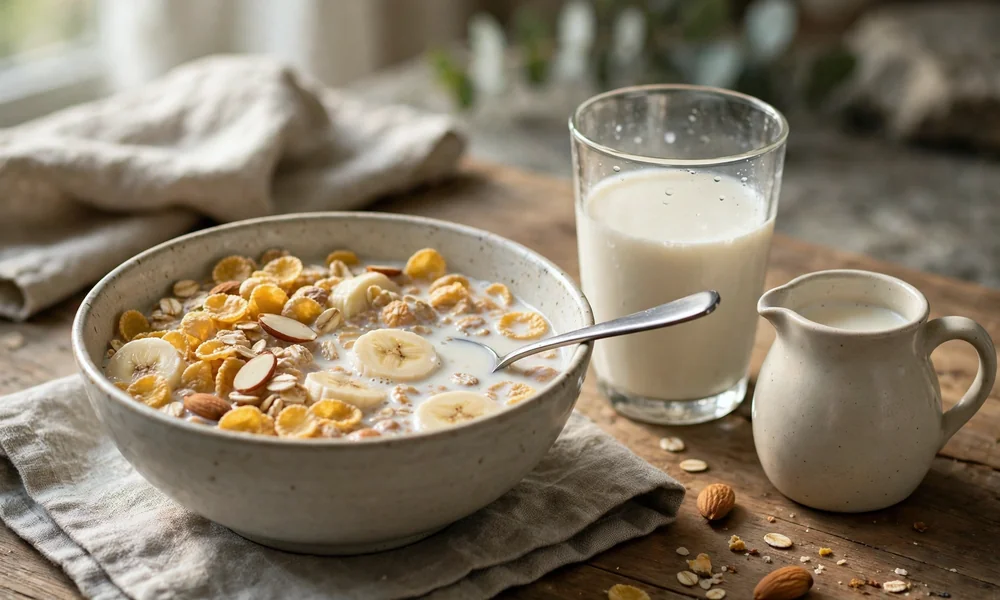
Over cereal, soy milk is at its most forgiving. Its creaminess softens flakes without drowning them, and its protein makes the bowl feel like a proper breakfast. Sweetened cartons work well here, and so do unsweetened ones if the cereal is already sweet. In cooking, unsweetened is the only sensible choice: it thickens sauces, enriches soups, and bakes into cakes without adding sweetness where none belongs. It handles heat better than almond milk, which makes it the safer choice for a white sauce or a creamy soup, though high heat will still make even a good carton split, so warm it gently and stir it in late.
How to Choose a Soy Milk by How You Use It
The best soy milk for a coffee drinker is not always the best for a cereal eater, so start with how you actually use it. If coffee is the main job, choose a barista carton or a good unsweetened one, and test it in a hot cup before you commit to a second carton. If cereal and drinking cold are the main jobs, a lightly sweetened carton is fine, and the flavour matters more than the frothing. If you cook with it, pick unsweetened every time, because a sweetened carton will quietly sweeten every sauce and soup it touches. A household that uses soy milk for everything should keep two cartons: one unsweetened for coffee and cooking, and one sweetened for cereal and cold drinking.
Think about the rest of the household too. Soy milk is not suitable for anyone with a soy allergy, however good the carton is, and it is worth remembering that it is one of the few plant milks that genuinely competes with dairy on protein — a point our comparison of the best and worst oat milks of 2026 makes clear, since oat milk is creamier but far lighter on protein. Buy the smaller carton first if you are trying a new one, keep it cold, use it within a few days of opening, and trust your own mouth over the claims on the front. The best soy milk is the one that tastes good in your coffee, your cereal, and your glass, and the worst is the one that only looks good on the shelf.
The Verdict
The best soy milks of 2026 are the quiet, honest ones: real soybeans, real protein, a short label, and a flavour that tastes of the bean itself. They pour cleanly, they behave in hot coffee, and they make breakfast taste better without shouting about it. The worst are thin, beany, or drowned in sugar, and they fail exactly where it matters most, in the cup and in the bowl. Between the two sits a wide middle of perfectly drinkable cartons that do the job without ever delighting anyone. Pick by how you use it, read the label before you buy, and keep a carton you trust in the fridge. The same care that goes into choosing a good cereal makes the milk on top of it worth pouring, as our comparison of the best and worst cereals of 2026 shows, because breakfast is only as good as its weakest part.