
There is a particular kind of thirst that only shows up on a trail. You have been walking for hours, the sun has been on your shoulders since mid-morning, and the stream ahead looks cold, clear, and perfect. It is also, almost certainly, full of things you do not want to drink. A stomach bug two days from the trailhead can end a trip outright. A good camping water filter turns that stream into safe drinking water in a minute or two.
The market has settled into a few clear designs, and each one suits a different kind of trip. Pump filters are the workhorses. Squeeze filters are the ultralight favourite. Gravity systems do the heavy lifting at base camp while you do something else. Straw-style filters are the lightest option of all and the simplest to use. The right pick depends on how you travel and how much weight you will carry.
How to Choose a Camping Water Filter
Start with the water you will be drinking. A clear mountain stream and a muddy desert pothole ask different things of a filter. Most camping filters use a hollow-fibre membrane with 0.1-micron pores, fine enough to catch protozoa and nearly all bacteria. Viruses are smaller and not reliably removed, so add chemical treatment if you travel where waste is heavy in the water.
Flow rate is the number that matters most in daily use. A filter that produces a litre a minute feels effortless. One that manages a quarter of a litre a minute feels like a chore, and you will notice it every time you fill a bottle. Flow falls as the filter clogs, fastest in silty water. The best filters are the ones you can backflush or shake clean in the field, because a filter that cannot be cleaned becomes a paperweight halfway through a trip.
Weight and packed size come next. A solo backpacker counting grams will accept a slower filter that weighs almost nothing. A family at a drive-up campsite will happily carry a heavier gravity system that fills a pot while dinner cooks. Think about how many litres a day your group drinks: a solo hiker might need three, a group of four twelve.
Best Overall: The Pump Filter That Does Everything Well
The classic pump filter remains the best all-round choice for most campers, and the current generation is better than ever. It fits in a side pocket, pumps smoothly, and the cartridge can be removed and cleaned without tools. You drop the intake hose into the stream, pump, and clean water comes out of the other side into your bottle or pot.
What sets the best pump filters apart is how they behave with dirty water. A good prefilter on the intake hose keeps the worst of the silt out, and the main cartridge can be scrubbed or backflushed when the flow slows. That means you can filter from a shallow, muddy pool that would choke a squeeze filter, and from trickles a gravity bag cannot reach.
The trade-off is weight and effort. A pump filter is heavier than a squeeze filter, and pumping a dozen litres for a group is real work. For one or two people, though, it is the most versatile tool in the category. It filters quickly, handles poor water, and fills a cooking pot directly. If you only buy one filter, this is the one.

Best Squeeze Filter: The Ultralight Favourite
Squeeze filters have taken over the ultralight world for a simple reason: they weigh almost nothing and there is almost nothing to break. The filter is a small tube that screws onto a soft water bag or a standard bottle. Fill the bag, screw on the filter, and squeeze the water through. No moving parts, no batteries, no pumping.
The best squeeze filters flow fast when they are new, easily a litre a minute with a firm squeeze, and they pack down to the size of a thumb. That makes them ideal for solo hikers. They also pair naturally with the bottles most hikers already carry, which is why a good reusable bottle is the natural partner for this kind of filter: fill the dirty bag, squeeze into the clean bottle, and walk on.
The weakness is silt. Squeeze filters clog faster than pump filters in murky water, and backflushing is fiddly. The fix is to prefilter: pour water through a bandana or let it settle in a pot for a few minutes before it goes into the dirty bag. Do that, and a squeeze filter will serve you for hundreds of litres. For clear mountain water, nothing beats it for weight and simplicity.
Best Gravity Filter: Set It and Forget It
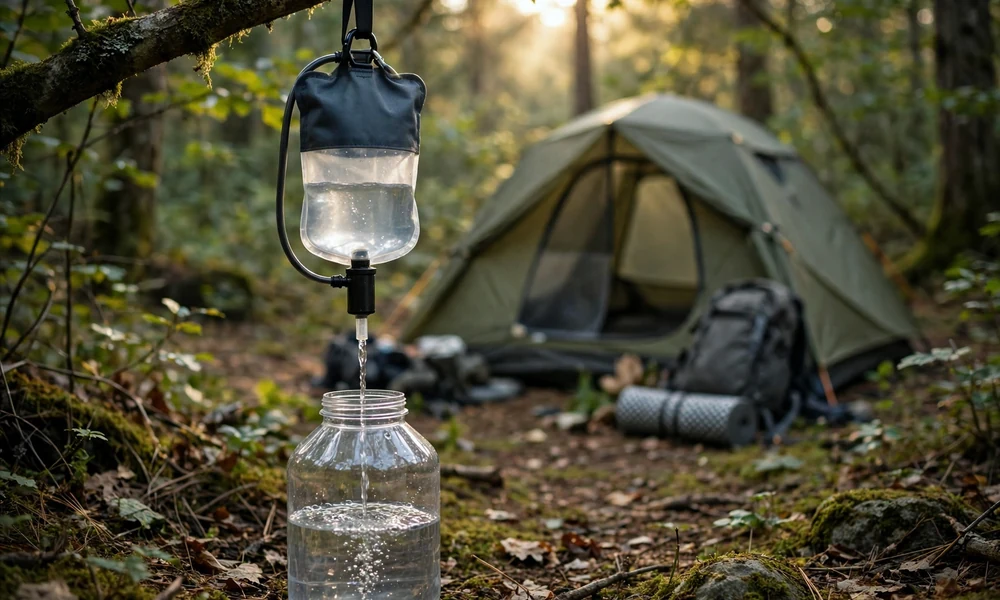
Gravity filters are the quiet luxury of camp water. Fill a large bag, hang it from a branch, and let gravity push the water through into a clean container below. Set it up, pitch the tent, and come back to several litres of clean water.
The best gravity systems hold three to four litres and filter at a respectable pace, roughly a litre every couple of minutes when the filter is clean. That suits base camps and family trips, where you need a lot of water at once for cooking, washing up, and filling bottles. The bag doubles as a water carrier, which saves you bringing a separate container.
The obvious limitation is that you need something to hang the bag from, and a water source deep enough to fill a wide-mouthed bag. Shallow trickles are a struggle. Gravity filters are also the bulkiest option here, so they suit car camping and short walk-in sites more than long backpacking trips. For a group camped in one place, though, the convenience is hard to overstate.
Best Straw Filter: The Lightest Option There Is
A straw filter is exactly what it sounds like: a tube you drink straight through, with the filter built in. It is the lightest, simplest way to make wild water safe: kneel at the stream and drink.
That simplicity is also the limitation. A straw only filters the water you drink through it, so it cannot fill a bottle or a cooking pot. For a day hiker or a trail runner, that is fine. For someone cooking dinner at camp, it is not enough on its own. The best straws are still worth carrying as a backup, though. They weigh almost nothing, cost very little, and are the filter you will actually have with you when your main filter clogs or gets left behind. Some straws come with a squeeze-bag adapter, which makes them far more useful.
Best Budget Pick: Safe Water Without the Premium Price
You do not need to spend a fortune to drink safely in the backcountry. The budget end of the market has improved enormously, and the cheapest reliable filters now use the same hollow-fibre technology as the premium ones. The difference is usually in the accessories and the flow rate, not in the safety of the water that comes out.
A good budget filter will be a simple squeeze or straw design with a replaceable cartridge and a straightforward backflush method. What you give up is speed: budget filters often flow more slowly, and they clog sooner in silty water. For weekend trips near clear streams, that is a reasonable trade. Be wary of the very cheapest options with no recognisable testing behind them, though. A filter is a safety device, and an untested one is a gamble. Stick to brands that publish independent test results, and check replacement cartridges are available before you buy.
What to Look For Before You Buy
Pore size is the first specification to check, and the one that matters most for safety. A 0.1-micron hollow-fibre membrane is the standard for camping filters, and it removes protozoa and bacteria. Some filters advertise 0.2 microns, which is still effective against protozoa and most bacteria but leaves less margin. Activated carbon is a different thing entirely: it improves taste and removes some chemicals, but it does not make water safe on its own. If a product leans on carbon alone, it is not a backcountry filter.
Flow rate and filter life are the next numbers. Manufacturers quote flow rates for clean water, so expect less in the field, and the best filters last thousands of litres with regular cleaning. Finally, check the connections. Does the filter screw onto the bottles you already own? Does it come with a bag, or will you need to buy one? Can it be backflushed with a syringe, shaken clean, or scrubbed in the field? A filter that fits your kit and cleans in a minute will get used; one that needs special bottles will sit in a drawer.

Care, Cleaning, and Storage
A camping water filter is only as good as its last cleaning. After every trip, backflush the filter with clean water, let it dry completely, and store it somewhere it will not freeze. A frozen hollow-fibre membrane can crack, and a cracked membrane no longer filters. That is the most common way a good filter dies.
In the field, backflush whenever the flow noticeably slows, and do it before the filter is fully clogged. If you are filtering silty water, let it settle first or pour it through a cloth. The few minutes this takes will add hours of life to the cartridge.
Filtered water makes everything else at camp better: cleaner coffee, no grit in the pasta water, easier washing up. If you are the person who makes the morning brew, you will notice the difference immediately, and a proper camp coffee maker is worth pairing with clean water. It is a small luxury, but camp mornings are built from small luxuries, and clean water is the first of them.
Mistakes to Avoid
The most common mistake is assuming clear water is safe water. It is not. The clearest stream can carry Giardia from an animal upstream, and you will not see it, smell it, or taste it. Filter every time, even when the water looks perfect.
The second mistake is cross-contamination. The dirty bag, the intake hose, and your hands after handling them are all contaminated. Keep the clean side clean: do not let the dirty hose touch your bottle, and wash your hands before you eat. Most cases of trail sickness come from hands and bottles, not from the filter failing.
The third mistake is leaving the filter until you are already thirsty. Filter water when you pass a source, not when you run out. Fill your bottles at every good stream, and you will never face the choice between drinking untreated water and walking thirsty for another hour.
The Shortlist
If you want one recommendation, take the pump filter for versatility, the squeeze filter for weight, or the gravity system for group camps. A solo backpacker will be happiest with a squeeze filter and a straw as backup; a couple should take the pump filter; a family at a drive-up site should buy the gravity system. And if you are heading out with a camera to record the trip, a tough action camera is the other piece of kit that earns its weight on the same trails.
Whatever you choose, test it at home before the trip. Fill a basin, filter a litre, time it, and practise backflushing. The campsite is the wrong place to discover that your filter needs a part you did not bring. Do that dry run, and the stream will be safe to drink from every time.


