
Wrapping Paper That Makes Gifts Look Special in 2026
Wrapping paper that makes gifts look special does its work before the gift is even opened: crisp folds, clean corners, and a pattern that suits the occasion turn an ordinary box into something worth pausing over. The paper itself decides most of that. Good wrapping paper is thick enough not to tear, smooth enough to fold sharply, and strong enough to hold its creases. The best wrapping paper in 2026 comes in sheets and rolls for every occasion, from plain kraft to bold prints for birthdays, and this guide covers the types, the weights, the finishes, and the folding technique that makes the difference.
Key Takeaways
- Thickness decides everything: paper around 80 to 100 gsm folds crisply without tearing or showing the box beneath.
- Kraft paper is the most versatile choice, suiting any occasion with ribbon, twine, or a sprig of greenery.
- Coated and foil papers look festive but crease badly if folded twice, so use them for simple folds.
- Buy rolls for big or awkward gifts and pre-cut sheets for small boxes that you wrap often.
- Wrapping paper is sheets or rolls for covering a gift; a gift bag is a ready-made carrier.
What Wrapping Paper Actually Is
Wrapping paper is decorative paper made to cover a gift, and it is judged on three things: how it folds, how it tears, and how it looks. A good sheet folds into a sharp crease that stays put, tears cleanly along a straight line, and holds its colour without scuffing. A bad sheet does the opposite: it splits at the corners, wrinkles instead of creasing, and shows every fingerprint.
It helps to be clear about what wrapping paper is not. It is not a gift bag. Wrapping paper is a flat sheet or roll that you cut, fold, and tape around a gift, shaping it to the box. A gift bag is a ready-made carrier: you drop the gift in, add tissue, and you are done. Paper suits boxy gifts and occasions where the wrapping is part of the present; bags suit awkward shapes and last-minute gifts. Neither is better, but they are different tools.
It is also not kitchen paper. Parchment paper and plastic wrap belong in the kitchen, not under the tree, and they behave nothing like gift wrap. Our guide to parchment paper that stops sticking explains what that paper is for, and it is a useful contrast: parchment is built to survive an oven, while wrapping paper is built to fold, crease, and look beautiful for an afternoon.
The Types of Wrapping Paper Worth Knowing
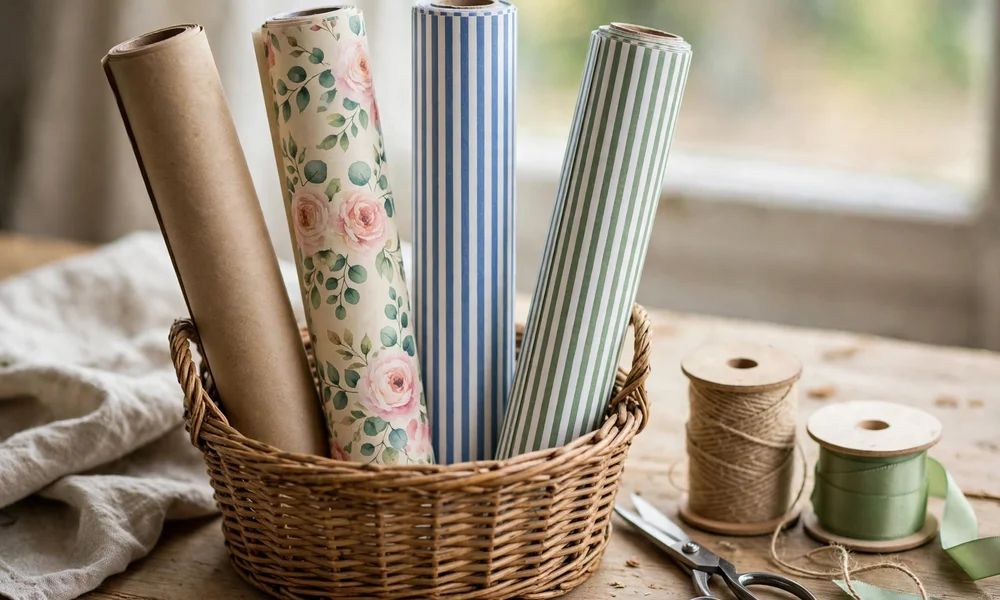
Kraft paper is the workhorse. It is plain brown paper, usually uncoated, with a warm natural look and a slightly rough texture that takes a crease beautifully. It is strong, cheap, and recyclable, and it suits every occasion: dress it up with ribbon for a birthday, with twine and greenery for Christmas, or with a hand-drawn tag for a personal gift. If you buy only one kind of wrapping paper, buy kraft.
Coated and printed paper is the festive choice. It carries bold patterns, from florals to geometrics, on a smooth coated surface that looks bright and resists scuffs. The coating makes it slightly stiffer, so it folds well once but creases badly if you refold it, and tape sticks to it less firmly than to kraft. Use it for simple folds, and keep a spare sheet for mistakes.
Foil and metallic paper is the showpiece. A thin metallic layer gives it a shine that catches the light, and it is the paper for milestone birthdays and celebrations. It is also the least forgiving: it tears easily, shows every crease, and cannot be refolded. Buy it for one special gift, not for a whole pile of presents.
Tissue paper is the helper, not the wrapper. It is too thin to wrap a box on its own, but it is perfect for stuffing a gift bag, cushioning a fragile gift inside a box, or layering over a wrapped present for a soft finish. Keep a few sheets in white and one accent colour, and they will cover most occasions.
Weight and Thickness: The Number That Matters
Paper weight, measured in grams per square metre, decides how wrapping paper behaves. Thin paper under 60 gsm tears at the corners, shows the box through it, and wrinkles when you crease it. It is cheap, but it makes wrapping harder, not easier. Paper around 80 to 100 gsm is the sweet spot: thick enough to hide the box, strong enough to survive folding, and still easy to cut and crease.
Above 100 gsm, paper becomes card-like. It holds a crease beautifully and looks luxurious, but it fights you on small boxes and sharp corners, and it needs strong tape to stay closed. Save heavy paper for large, simple shapes.
When you shop, the test is simple: take a corner of the sheet and fold it. A good sheet makes a sharp crease that stays. A poor sheet springs back, wrinkles, or splits along the fold. That one test tells you more than the price or the pattern ever will.

How the Best Wrapping Papers Compare in 2026
| Type | Best for | Weight | Folding | Weakness |
|---|---|---|---|---|
| Kraft | Any occasion, any gift | 80-100 gsm | Crisp, forgiving | Plain without dressing |
| Coated printed | Birthdays, festive gifts | 70-90 gsm | Good once | Creases if refolded |
| Foil metallic | Milestone celebrations | 60-80 gsm | Sharp but fragile | Tears easily, shows creases |
| Tissue | Bags, cushioning, layering | 20-30 gsm | Soft, no crease | Too thin to wrap alone |
| Recycled | Everyday gifts, eco occasions | 80-100 gsm | Crisp | Duller colours |
How to Wrap a Gift Well
Start by measuring. Lay the box on the paper and check that the sheet wraps around it with a few centimetres to spare on each side. Too little paper leaves gaps; too much makes bulky folds. Cut straight, with long scissors and one smooth motion, because a jagged edge shows at the seam.
Fold the long edges first, pulling the paper snug against the box and creasing each edge with your thumb or a bone folder. Then fold the ends: push the sides in to make triangles, fold the top flap down, and the bottom flap up, creasing as you go. The corners are where good wrapping shows, and sharp triangles are the whole secret.
Tape matters more than most people think. A narrow strip of clear tape on the seam is enough, and double-sided tape hides the join entirely. For foil paper, use tape made for glossy surfaces, since ordinary tape peels off. Our guide to masking tape that tears clean covers tape that holds without tearing paper, which is exactly what you want when a fold needs a second chance.
Finish with ribbon, twine, or a tag. A simple bow in a contrasting colour lifts even plain kraft paper, and a handwritten tag makes the gift personal. Keep the decoration simple: one ribbon, one tag, and no more, because the paper should do the talking.

What to Look For When You Buy
Choose the format first. Rolls are cheaper per sheet and suit large or awkward gifts, since you can cut exactly the length you need. Pre-cut sheets lie flat, waste less paper, and suit small boxes you wrap often. If you wrap gifts all year, keep one roll of kraft and a pack of sheets in a pattern you like.
Check the print quality. A good print is sharp, with colours that stay true at the fold and do not rub off on your hands. Cheap prints look fine flat but crack along the crease, leaving white lines. Fold a corner before you buy a whole roll, if you can.
Think about the gift, not just the paper. A heavy gift needs strong paper and strong tape; a light gift can take delicate foil. A gift for a child suits bright patterns; a gift for a colleague suits plain kraft with a neat ribbon. If the gift is an awkward shape, a ready-made carrier may suit it better: see our guide to gift bags for when a bag beats paper.
Finally, check whether the paper is recyclable. Most plain and printed papers are, but foil and glitter papers usually are not, because the metallic layer cannot be separated. If that matters to you, choose kraft or recycled paper, and skip the glitter.
Common Mistakes That Spoil a Wrapped Gift
The most common mistake is using too little paper. A sheet that barely reaches around the box leaves a gap at the seam and corners that will not close. Measure generously, and remember that a little extra paper is easier to fold away than a gap is to hide.
The second mistake is wrapping on a rough surface. A wooden table or a carpet catches the paper and tears it as you pull. Wrap on a smooth, clean table, and keep scissors and tape within reach so you are not dragging the gift around.
The third mistake is over-decorating. Three ribbons, two bows, and a handful of stickers do not make a gift look generous; they make it look busy. One ribbon and one tag, done well, will always look better than a pile of extras.
Your Wrapping Checklist
- Pick paper of 80 to 100 gsm: thick enough to hide the box, light enough to fold.
- Measure before you cut, leaving a few centimetres spare on every side.
- Cut with long, smooth scissor strokes so the edge stays straight.
- Crease every fold sharply with your thumb or a bone folder.
- Use tape that suits the paper, and double-sided tape to hide the seam.
- Finish with one ribbon and one tag, and stop there.
Frequently Asked Questions
How much wrapping paper do I need for one gift?
Measure around the box in both directions and add a few centimetres on each side. As a rule, a sheet that is twice as wide as the box and one and a half times as long will wrap it comfortably, with enough left for neat end folds.
Is kraft wrapping paper recyclable?
Yes, plain kraft paper is widely recyclable, as is most printed paper without foil or glitter. Remove tape and ribbons first, since those are not recyclable with the paper.
Can I reuse wrapping paper?
You can, if it was opened carefully. Smooth the paper flat, iron it on a low heat through a cloth if it is creased, and store it rolled rather than folded. Foil paper rarely survives reuse, but kraft and coated paper often do.
What is the best wrapping paper for awkward shapes?
Soft, medium-weight paper of 80 to 100 gsm works best, because it moulds around curves without tearing. For very awkward shapes, wrap the gift in tissue first to smooth the outline, then wrap it in paper, or use a gift bag instead.
Why does my wrapping paper keep tearing at the corners?
Thin paper and rough handling are the usual causes. Paper under 60 gsm tears easily, and pulling it tight around a sharp box corner will split it. Use thicker paper, fold the corners in triangles, and do not pull the paper tighter than it needs to go.
Should I use wrapping paper or a gift bag?
Use wrapping paper for boxy gifts and occasions where the wrapping is part of the present, and a gift bag for awkward shapes, fragile items, or last-minute gifts. Paper looks more considered; a bag is faster and more forgiving.
The Bottom Line
The best wrapping paper is thick enough to fold crisply, strong enough not to tear, and suited to the gift and the occasion. Keep a roll of kraft for everyday gifts, a printed roll for celebrations, and a few sheets of tissue for the finishing touches. Measure generously, crease sharply, and finish simply, and the gift will look special before it is ever opened.


