
Parchment paper is the quiet workhorse of the kitchen, and it is also the thing most home bakers blame when a batch sticks. Parchment paper that actually stops sticking in 2026 is not hard to find, but it is easy to buy badly. A good sheet releases cookies cleanly, lifts a loaf out of its tin in one piece, and survives a hot oven without scorching.
This guide treats parchment paper as its own subject, not as an afterthought to a baking tray. It covers bleached versus unbleached paper, the silicone coating that does the real non-stick work, the heat limits that matter, and the difference between lining a tin and wrapping food. The right sheet saves scrubbing, saves ruined bakes, and costs pennies per use.
Key Takeaways
- Good parchment paper is cellulose paper coated on both sides with food-grade silicone, and that coating is what stops food sticking.
- Unbleached parchment is brown, bleached parchment is white, and for everyday baking they perform the same, so choose on price.
- Most parchment is rated to about 220 degrees Celsius (425 degrees Fahrenheit), and exceeding that rating is why sheets scorch or curl.
- Pre-cut sheets lie flatter than rolls, while rolls are cheaper per sheet and better for odd sizes and wrapping.
- Parchment is best for lining, baking, and wrapping, but it is no substitute for foil under a grill and must never touch an open flame.
What Parchment Paper Actually Is
Parchment paper, also sold as baking paper, starts as cellulose paper made from wood pulp. It is run through a bath of sulphuric acid, which bonds the fibres into a dense, grease-resistant sheet. That alone would not stop food sticking. The non-stick magic comes next, when both sides are coated with a thin layer of food-grade silicone, which lets a cookie slide off and gives good parchment its slight sheen and smooth feel.
It is worth knowing what parchment is not. It is not wax paper: wax paper is coated with paraffin wax, which melts in a hot oven, so it should never go in the oven. It is not greaseproof paper either, since that has no silicone coating and sticky foods still cling to it.

Bleached vs Unbleached: Does It Matter?
The first choice you meet in the shop is colour. Bleached parchment is white, because the paper has been treated with a bleaching agent before coating. Unbleached parchment is a natural tan or brown, because it skips that step. The colour is the only difference most bakers will ever notice. In the oven the two behave the same.
So why choose one over the other? Price and preference are the honest answers. Unbleached parchment is often a little cheaper, and some bakers prefer it because it skips a processing step. Bleached parchment is whiter and shows browning more clearly.
The Silicone Coating: Why Some Paper Sticks and Some Does Not
If your parchment ever stuck, the coating is almost always the reason. Good parchment carries an even silicone coat on both sides, thick enough to survive a full bake without breaking down. Cheap parchment carries a thin, patchy coat, and once the coating fails in one spot, the food bonds to the bare paper underneath.
Moisture is the other enemy of a weak coating. Wet batters, meringues, and sticky doughs sit on the paper for a long time before they set, and a thin coat gives way under them. The fix is not more grease, which soaks into the paper and breaks the coating down. The fix is better paper, used once for the jobs that stress it most.
Heat Limits: How Hot Is Too Hot?
Most parchment paper is rated to about 220 degrees Celsius (425 degrees Fahrenheit), and some premium sheets are rated to 230 degrees. That rating is a real limit, not a suggestion. Above it, the paper darkens, the edges curl up, and the silicone coating starts to break down. A sheet that darkens at the edges has already told you it is too hot for the job.
The practical rule is simple. For anything baked at 220 degrees or below, parchment is safe and reliable. For pizza, flatbreads, and roasting at 230 degrees or more, use a heavy-duty sheet rated for the temperature, or skip the paper and bake directly on the tray. Never let parchment hang over the edge of a tray and touch the oven wall, and never use it under the grill. Our guide to baking sheets for even browning explains why the tray matters.
Lining vs Wrapping: Two Jobs, Two Techniques
Parchment does two different jobs in the kitchen, and each has its own technique. Lining is the first: a sheet laid flat in a tin or on a tray so food never touches the metal. Cut the sheet to fit, rather than folding a too-big sheet into the corners, where it bunches and leaves ridges in a cake. For a round tin, fold a square into quarters, cut a curve, and open it into a circle that fits the base.
Wrapping is the second job, and it is where parchment earns its keep beyond baking. A parcel of fish, chicken, or vegetables, folded and sealed, steams gently in its own juices and opens at the table with a puff of aroma. Fold the paper in half, place the food on one side, fold the other half over, and crimp the edges in small overlapping folds.
Rolls, Pre-Cut Sheets, and Rounds: Which Format Wins?
Parchment comes in three main formats, and the best one depends on how you cook. Rolls are the cheapest per sheet and the most flexible: you tear off exactly what you need, which makes them ideal for odd-sized tins and large parcels. Their weakness is the curl. Paper from a roll wants to roll back up, and a sheet that will not lie flat is a nuisance under a wet batter.
Pre-cut sheets are the convenience buy. They come flat, they lie flat, and they are sized to a standard half-sheet tray, so there is no measuring and no curl. Rounds are the specialist format: circles cut to fit cake tins, sold in packs by diameter. If you only buy one format, buy pre-cut sheets for everyday baking and a roll for wrapping and odd jobs.
| Format | Best for | Cost per sheet | Lies flat |
|---|---|---|---|
| Roll | Odd sizes, wrapping, parcels | Lowest | No, needs scrunching |
| Pre-cut sheets | Everyday baking, cookies, roasting | Medium | Yes |
| Rounds | Cake tins, lining round pans | Highest | Yes |
| Heavy-duty sheets | High heat, wet batters, reuse | Highest | Yes |
When Parchment Is the Wrong Choice
Parchment is versatile, but it is not universal. Under the grill it scorches, so use foil or a bare tray instead. On a barbecue it burns, so again, foil is the right tool. For very wet, very sticky batters like meringue or macarons, a silicone baking mat is often the better choice, because it releases more reliably and can be reused hundreds of times.
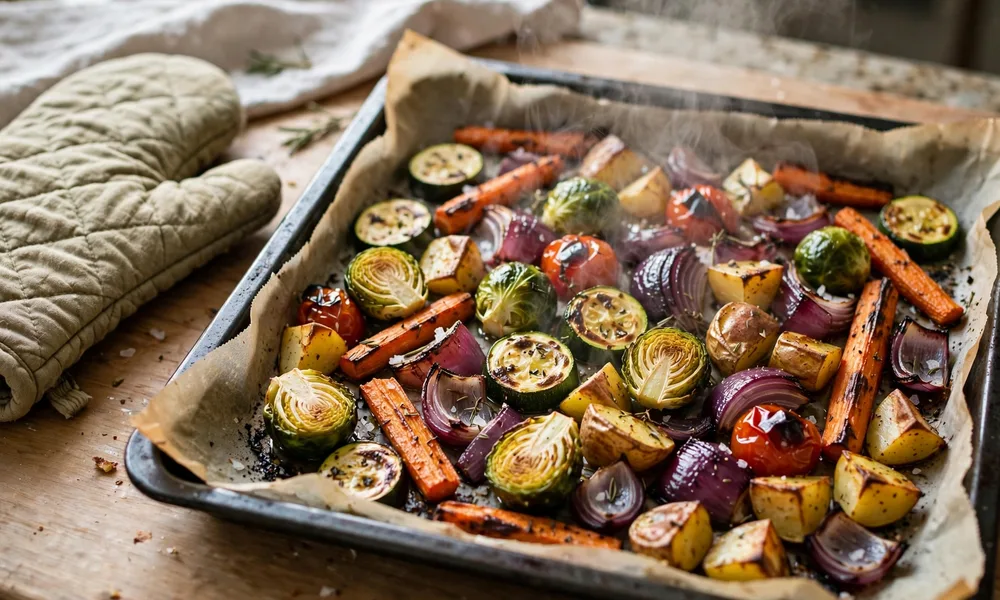
There is also the question of reuse. A sheet used for dry baking, like cookies or roast vegetables, can often be used a second time, and sometimes a third, as long as it is not torn, scorched, or soaked with grease. A sheet used for a wet batter or a sticky bake should be thrown away after one use, because the coating has already done its hardest work. Never reuse a sheet that smells burnt or has darkened at the edges.
How to Use Parchment So It Never Sticks
Technique matters as much as the paper. Start by cutting the sheet to fit the tray with a small margin, not a large overhang. Overhanging paper catches the heat at the edges and curls, and curled paper lifts food off the tray and browns unevenly.
Cooling matters too. Many bakes release better once they have cooled for a few minutes on the tray, because the sugars and starches firm up and let go of the paper. Pulling a hot cookie off the sheet is the most common cause of a torn base. Let the tray sit for five minutes before lifting.

What to Buy in 2026
The best parchment paper in 2026 is not a single brand, because the market is full of good options and the differences between the top ones are small. What matters is the specification. Buy paper that is coated on both sides with silicone, rated to at least 220 degrees Celsius, and thick enough to feel smooth rather than papery.
Check the size before you buy. A standard half-sheet tray needs a sheet of about 30 by 40 centimetres, and a roll that is too narrow for your trays is a false economy. The guide to baking sheets for cookies pairs naturally with this one. Buy one good box, use it properly, and the roll in the drawer stops being a gamble.
Shopping Checklist
- Check the heat rating on the pack and make sure it reaches at least 220 degrees Celsius for your oven.
- Feel the paper: it should be smooth and slightly slick on both sides, not dry or papery.
- Choose pre-cut sheets for everyday baking and a roll for wrapping and odd-sized tins.
- Match the sheet size to your trays so the paper does not overhang and curl at the edges.
- Buy unbleached or bleached on price and preference, since they perform the same in the oven.
- Keep a spare box in the cupboard, because running out mid-bake is the one problem no technique can fix.
Frequently Asked Questions
Is parchment paper the same as baking paper?
Yes, the two names describe the same product: cellulose paper coated on both sides with food-grade silicone. Baking paper is the name most often used in Britain and Australia, parchment paper in North America, but the paper in the box is the same.
Can parchment paper go in the oven?
Yes, up to its rated temperature, which is usually about 220 degrees Celsius (425 degrees Fahrenheit).
Which side of parchment paper goes up?
It does not matter, because good parchment is coated with silicone on both sides. Either side will release food the same way.
Can you reuse parchment paper?
Sometimes. A sheet used for dry baking, such as cookies or roast vegetables, can be reused once or twice if it is not torn, scorched, or soaked with grease. A sheet used for a wet or sticky bake should be thrown away after one use.
Is parchment paper compostable?
Unbleached parchment is compostable in most home compost heaps, as long as it is not heavily soiled with grease. Bleached parchment is also compostable in many systems, but check the pack and your local rules first.
What is the difference between parchment paper and wax paper?
Wax paper is coated with paraffin wax, which melts in a hot oven, so it must never go in the oven. Parchment paper is coated with silicone, which is heat-resistant, so it is safe in the oven up to its rated temperature.
The Bottom Line
The best parchment paper in 2026 is a thick, double-coated sheet rated to at least 220 degrees Celsius, in the format that suits your cooking: pre-cut sheets for everyday baking, a roll for wrapping and odd sizes. Bleached and unbleached perform the same, so choose on price, and skip the cheapest thin rolls that tear and stick. That is a small price for bakes that come out clean. Cut it to fit and keep it below its heat limit.


