Which Silicone Baking Mat Replaces Parchment Best in 2026?
A silicone baking mat that truly replaces parchment has to do three things at once: release food cleanly without grease, survive your oven’s real temperatures without warping or smelling, and wash up in seconds so you actually reach for it again. The best silicone baking mat in 2026 does all three, and once you have used one, the roll of parchment in the drawer starts gathering dust. The worst ones stick, stain, curl at the corners, and leave a faint chemical smell on everything they touch. This guide sorts the two apart and shows you how to pick a mat that fits your pans, your oven, and the way you actually bake.
Parchment paper is convenient, but it is also a recurring cost and a recurring bit of waste: a roll lasts a few months in a busy kitchen, and every sheet goes in the bin after one bake. A good silicone mat can last for years and thousands of bakes. That only works if the mat is well made. Thin, cheap mats are the reason so many people try one, hate it, and go back to parchment. The difference between a mat you love and a mat you throw away is almost entirely in the thickness, the fibreglass core, and the quality of the silicone coating.
Key Takeaways
- A fibreglass-core mat with a thick food-grade silicone coating is the best all-round choice, because it lies flat, heats evenly, and does not curl or warp.
- Match the mat to your pan: a half-sheet mat for a standard baking tray, a quarter-sheet mat for smaller trays, and a round mat for cake tins.
- Look for a heat rating of at least 230°C (450°F); cheaper mats that top out at 200°C can scorch or smell in a hot oven.
- Silicone mats beat parchment for cookies, roasted vegetables, and sticky bakes, but parchment still wins for very wet batters and lining deep tins.
- Wash a mat with hot soapy water and air-dry it flat; never fold it, cut on it, or put it under a grill, and it should last for years.
What a Silicone Baking Mat Actually Replaces
At its simplest, a silicone baking mat is a reusable non-stick sheet that sits on a baking tray. You put dough, vegetables, or pastry straight on it, and nothing sticks. It replaces parchment paper in most everyday baking, and it replaces greasing a tray in almost all of it. What it does not replace is a tray itself: a mat needs a rigid baking sheet underneath, because on its own it is far too floppy to carry into the oven.
The non-stick surface works differently from parchment. Parchment is a disposable barrier; a silicone mat is a slightly tacky, flexible surface that food releases from as it cools, often with no grease at all. That matters for cookies, where greasing a tray can make them spread too far, and for roasted vegetables, where the oil belongs on the vegetables, not the pan.
There is one thing parchment still does better. Very wet batters can slide around on a slick silicone surface, and lining a deep or oddly shaped tin is easier with a sheet of paper you can fold and cut. Most bakers who switch keep a roll of parchment for those jobs and use the mat for everything else.
The Best and Worst Silicone Baking Mats at a Glance
| Mat type | Best for | Heat limit | Durability | Verdict |
|---|---|---|---|---|
| Fibreglass-core, thick silicone | Everyday baking, cookies, roasting | 230–260°C | Years, thousands of bakes | Best |
| Perforated silicone mat | Choux pastry, macarons, even browning | 230°C | Very good | Best |
| Thin silicone sheet, no core | Light use, lining trays | 200°C | Months, curls quickly | Worst |
| Silicone mat with printed guides | Macarons, evenly sized cookies | 230°C | Good, guides fade over time | Best |
| Cheap unbranded thin mat | Nothing much | Often unstated | Poor, smells and stains | Worst |
How to Choose a Mat That Actually Works
Start with the size of your tray
Measure your baking tray before you buy anything. The most useful size for most kitchens is the half-sheet mat, roughly 42 by 30 centimetres, which fits a standard large baking tray. A quarter-sheet mat suits smaller trays and toaster ovens. A mat that is too big will bunch up at the edges and bake unevenly; a mat that is too small leaves bare metal where food will stick. If you own several trays, buy the mat for the one you use most.
Thickness and the fibreglass core matter most
Pick up the mat and bend it. A good mat feels substantial, springs back flat, and has a woven fibreglass mesh inside that you can sometimes see as a faint grid through the silicone. That core is what stops the mat curling at the corners in a hot oven and what spreads heat evenly. A thin mat with no core feels flimsy, wrinkles when you unroll it, and will start to curl within a few bakes, so one side of your cookies browns while the other stays pale.
Check the heat rating, and believe it
A reputable mat states its maximum temperature clearly, usually 230°C or 260°C. That rating matters because a mat that tops out at 200°C will struggle with pizza, roast potatoes, and any recipe that calls for a properly hot oven, and an overheated mat can give off a smell that lingers in the food. If a listing states no heat rating at all, do not buy it.
Food-grade silicone, not just silicone
Not all silicone is equal. Food-grade silicone is made to a standard that limits fillers, and it should be odourless when new. A mat that smells strongly of chemicals out of the packet should go back. Good mats also resist staining from turmeric and tomato far better than cheap ones, though no silicone mat stays perfectly pristine forever.

What Bakes Best on a Silicone Mat
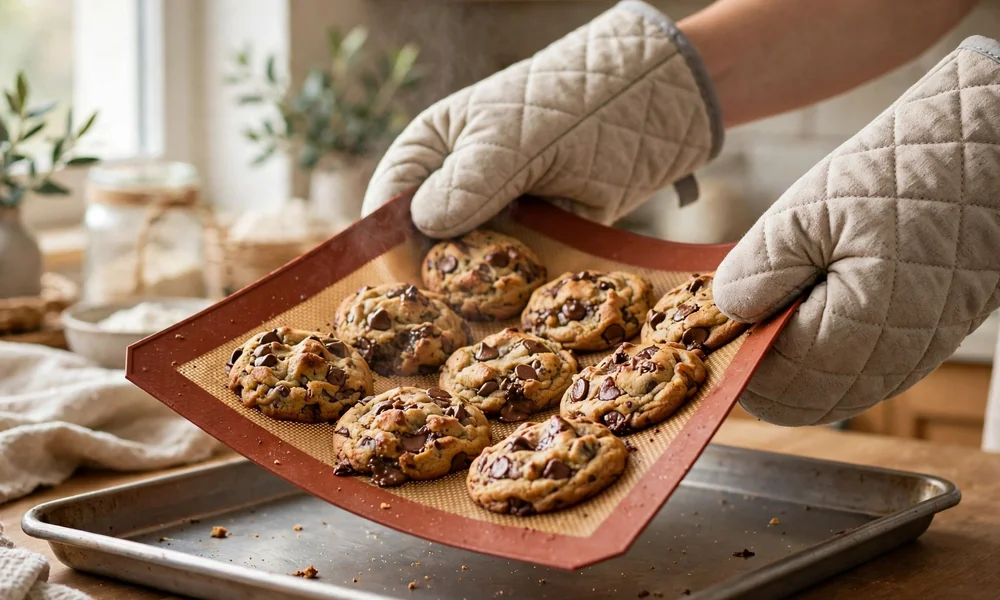
Cookies are the classic case. A silicone mat gives cookies a slightly softer base than parchment, because the mat insulates the dough a little from the metal tray, and it also means cookies spread a touch less, so they hold their shape better. Macarons and choux pastry benefit too, especially on a perforated mat, which lets steam escape from underneath and gives a more even bake. Roasted vegetables are another win: they crisp without sticking, and the tray underneath stays clean enough to wipe rather than scrub.
Pastry work is where a mat earns its keep a second time. A large silicone mat on the worktop stops pastry sliding around while you roll it, and many have faint measurement guides printed on them, which help you roll a tart base to the right size without reaching for a ruler. Bread is a mixed case: a mat is excellent under a loaf for the first part of the bake, but for the deepest crusts, baking directly on a hot stone or steel still wins. For a truly crisp base, like a thin pizza, the mat’s insulation works against you, so parchment or a bare tray is the better call.
If you are building out your baking kit, a mat pairs naturally with the rest of it. A good baking sheet is the foundation the mat sits on, and the two should be bought as a pair in the right size. Likewise, a sturdy mixing bowl and a reliable oven mitt complete the setup that makes a mat genuinely useful rather than a gadget that sits in a drawer.
Where Silicone Mats Go Wrong
The most common complaint is a greasy film that never washes off. This usually comes from cooking spray, which leaves a residue that bonds to silicone and builds up over bakes. The fix is simple: never use cooking spray on a silicone mat. If a mat already feels tacky, a paste of baking soda and water, left for an hour and scrubbed off, will usually rescue it.
The second complaint is smell. A mat stored rolled up while still damp can develop a musty odour, and a cheap mat can pick up the smell of strong foods. Both are avoidable: dry the mat fully before storing it, and wash it promptly after cooking anything pungent. A mat that smells of chemicals from the first bake, though, is a manufacturing problem, and no amount of washing will fix it.

Cleaning and Storing Your Mat
Cleaning is one of the best reasons to own a mat. Most of the time, hot water and a little washing-up liquid are enough, with a soft sponge doing the work. For baked-on residue, soak the mat in the sink for ten minutes and it will come away. A dishwasher is fine for most mats, but hand-washing is gentler and keeps the surface in better condition for longer. Avoid abrasive scourers, which wear the coating down.
Storage has one rule: do not fold it sharply. A mat folded in half will develop a crease that never fully flattens, and that crease becomes a line of uneven baking. Roll it loosely, store it flat in a drawer, or hang it from a hook. Kept this way, a good mat will outlast several rolls of parchment many times over.
Silicone Mat Buying Checklist
- Measure your baking tray first, and buy the mat size that fits it exactly.
- Choose a thick mat with a fibreglass core that lies flat and springs back when bent.
- Check for a stated heat rating of at least 230°C and food-grade certification.
- Smell the mat when it arrives; a strong chemical smell means it should go back.
- Skip cooking spray entirely, and never cut food directly on the mat.
- Wash with hot soapy water, dry fully, and store flat or loosely rolled, never sharply folded.
Frequently Asked Questions
Do silicone baking mats really replace parchment paper?
For most everyday baking, yes. Cookies, roasted vegetables, pastry, and sticky bakes all release cleanly from a good mat, with no grease and no waste. Parchment still wins for very wet batters and for lining deep or oddly shaped tins, so most bakers keep a roll for those jobs and use the mat for everything else.
Are silicone baking mats safe at high temperatures?
A good food-grade mat rated to 230°C or higher is safe in a normal domestic oven. Never use one under a grill or over a direct flame, and never exceed the maker’s stated temperature. If a mat has no stated rating, do not buy it.
Why does my silicone mat feel greasy after washing?
That is almost always residue from cooking spray, which bonds to silicone. Stop using spray, and clean the mat with a paste of baking soda and water left for an hour, then wash it in hot soapy water.
Can I put a silicone baking mat in the dishwasher?
Most mats are dishwasher-safe, but hand-washing is gentler and keeps the non-stick surface in better condition for longer.
How long does a silicone baking mat last?
A well-made mat with a fibreglass core should last for years and thousands of bakes, as long as you do not cut on it, fold it sharply, or overheat it. A thin, cheap mat may start curling and staining within a few months, which is why thickness and quality matter more than price.
Do cookies bake differently on silicone than on parchment?
Yes, slightly. The mat insulates the dough a little from the tray, so cookies tend to have a softer base and spread a touch less. Most bakers prefer the result, but if you want a very crisp base, parchment or a bare tray will give you that instead.
The Bottom Line
The silicone baking mat that replaces parchment best in 2026 is a thick, fibreglass-core mat in the exact size of your most-used baking tray, rated to at least 230°C, made from odourless food-grade silicone. It will handle cookies, roasting, and pastry without grease or waste, wash up in seconds, and last for years if you never cut on it, fold it sharply, or reach for the cooking spray.