
Baby swimwear is not a smaller version of adult swimwear. A baby cannot tell you that a strap is digging in, that a suit is riding up, or that the sun is burning the back of their neck, so the suit has to do the work for them. The best baby swimwear of 2026 is soft against delicate skin, stays put through kicking and splashing, covers the shoulders and back properly, and dries quickly enough that a damp baby is not sitting cold in the shade afterwards. The worst of it looks sweet on the hanger and then fails on the first swim: it sags when wet, chafes at the neck, lets the sun straight through thin fabric, or needs three hands and a wrestling match to get on and off.
What Makes Baby Swimwear Different
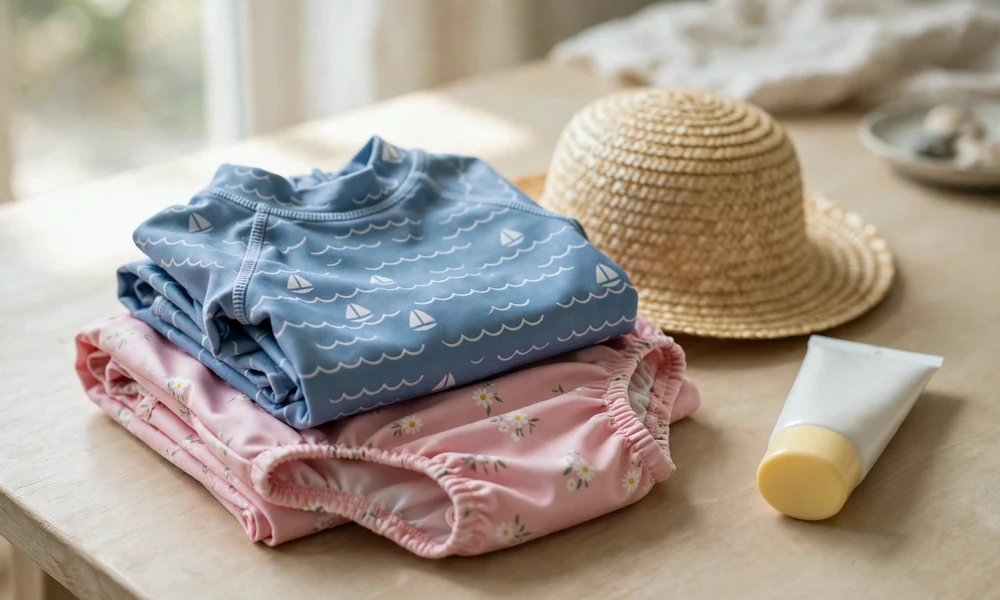
The first difference is coverage. A baby has a lot of skin exposed relative to their size, and their skin is thinner and more sensitive than an adult’s, so a suit that covers the shoulders, chest, and back does far more than a tiny two-piece ever will. Long-sleeve rash guard styles are the default choice for many parents for exactly this reason: they cover the arms as well as the torso, they stay in place, and they mean less skin is left to protect with cream. A one-piece with a higher neckline is the next best thing, especially for babies who are crawling or sitting in shallow water.
The second difference is the fastening. Babies do not sit still while they are dressed, and a wet baby is harder still, so poppers, a back zip, or a wide stretchy neck all matter more than they would on an older child. Back zips are quick and keep the front smooth against the skin, but check that the zip has a fabric guard behind it and a small cover at the top so it cannot catch the neck. Popper fastenings at the shoulder or at the nappy line make nappy changes possible without taking the whole suit off, which is a genuine blessing on a beach with no changing room in sight.
Sun Protection Comes First
Sun protection is the single most important job of baby swimwear, and it is worth understanding what the labels actually mean. UPF is the fabric equivalent of SPF: a UPF 50 fabric blocks about 98 percent of ultraviolet rays, while a UPF 30 fabric blocks about 97 percent. Either is a big step up from an ordinary cotton vest, which may only rate around UPF 5 when it is wet. Look for a stated UPF rating on the label rather than a vague claim about sun protection, and treat a suit with no rating as unrated rather than assuming it will do.
That said, no swimsuit is a complete sun plan on its own. The parts it does not cover — the face, ears, hands, feet, and the back of the neck if the suit is low cut — still need shade and sunscreen, and the suit itself needs a hat to go with it. Many paediatricians advise keeping babies under six months out of direct sun altogether, and suggest shade, light clothing, and a hat as the first line of defence, with sunscreen used on small areas of exposed skin only when shade is not enough. Check the guidance that applies where you live, and ask your own paediatrician if you are unsure, because advice varies by country and by the baby’s age.
Fit: Snug, Not Tight
Baby swimwear should fit snugly when it is dry, because it will loosen a little when it is wet. A suit that looks perfect on the hanger is often too big in the pool, so the right fit feels slightly close at first — smooth across the tummy, no gaping at the neck or the legs, and straps that stay on the shoulders without digging in. At the same time, it should never leave red marks, pinch at the thighs, or restrict how the baby kicks and wriggles. If you can slide two fingers easily under a strap, it is probably about right; if the strap is cutting a groove, size up or choose a different cut.

Swim Nappies: The Part Nobody Wants to Think About
Every baby in a pool or at the beach needs a swim nappy, and the swimwear you buy has to work with it. Most public pools require a swim nappy under the swimsuit, and many require a double layer — a reusable swim nappy under the suit, or a disposable swim nappy with a snug suit over the top. A reusable swim nappy is a close-fitting, washable garment with elastic at the waist and legs, designed to contain solids while letting water through; it is not absorbent like an ordinary nappy, and it is not meant to be. Check the rules of the pool you use before you go, because being turned away at the door with a disappointed baby is easily avoided.
Styles Worth Buying
The long-sleeve rash guard set is the most useful style for most babies: a close-fitting top with long sleeves, paired with matching bottoms or a swim nappy. It gives the best sun coverage, it stays in place, and it dries quickly. It is also the easiest style to get on and off, since the top pulls on like a T-shirt and there is no zip to wrestle with. For very small babies, a one-piece with a zip at the back and poppers at the bottom is often easier, because it goes on in one piece and there is nothing to ride up. For older babies who are walking and paddling, a one-piece with a frill or a two-piece with a short-sleeve top gives a little more freedom of movement.
Prints and colours are a matter of taste, but they do have a practical side. Bright colours and bold prints make a baby easier to spot in a busy pool or on a crowded beach, which is a real safety advantage. Light colours show stains and sun cream marks more quickly, while darker colours hide them but absorb more heat in strong sun. Avoid suits with ties, dangling ribbons, or small decorative buttons near the face, because anything that can be pulled off and put in a mouth is a risk, and anything that dangles can catch. Our guide to the best swimwear of 2026 covers the wider market if you are shopping for the whole family, but baby suits are judged on a different set of rules, and the adult winners are rarely the right pick for a baby.

Fabric, Comfort, and Care
The best baby swimwear fabrics are a blend of polyester or nylon with elastane, which gives stretch, shape retention, and quick drying. Chlorine-resistant blends last noticeably longer if your baby swims in a pool every week, because ordinary swim fabric loses its stretch after repeated exposure to chlorinated water. Cotton blends feel softer at first, but they hold water, dry slowly, and go heavy and cold against the skin, so they are a poor choice for a baby who will be in and out of the water. Check the seams as well: flatlock seams lie flat against the skin and are far less likely to chafe than raised overlocked seams, especially around the neck and under the arms.
Comfort is also about what is not in the suit. Scratchy labels, rough embroidery on the inside, and stiff appliqué can all irritate a baby’s skin, particularly when the fabric is wet and the baby is moving. The best suits have printed labels or labels placed outside the suit, smooth linings, and no rough decoration against the skin. If you can, feel the inside of the suit before you buy it, and run a finger along the seams. If it feels rough to your hand, it will feel rougher to a baby. A suit that is comfortable is a suit the baby will tolerate for a whole afternoon, and that matters more than any print.
Pool Days and Beach Days
Whatever the setting, keep swim sessions short for a baby. Babies lose body heat faster than adults, and a baby who is shivering, has blue lips, or has gone quiet and still needs to come out of the water and be warmed up straight away. A good rule is to keep a baby’s first swims brief, to watch them closely the whole time, and to remember that no swimsuit, however good, is a safety device. A baby in water always needs an adult within arm’s reach, and a swim ring or float is not a substitute for that. For sun protection on the skin the suit does not cover, our guide to the best baby sunscreen of 2026 is a useful companion to this one.
What to Skip
The suits to avoid are easy to spot once you know what to look for. Skip anything with no stated UPF rating that claims to be sun protective, anything so thin you can see through it, and anything with a stiff, scratchy lining. Skip suits with small buttons, beads, or dangling ties that a baby can pull off. Skip white or very pale suits for regular pool use, because chlorine will yellow them quickly, and skip a suit that is two sizes too big on the grounds that the baby will grow into it — a baggy suit is a cold, uncomfortable suit. Finally, skip the cheapest multipack if the fabric feels rough and the seams look uneven; a single well-made suit that fits properly is better value than three poor ones.
The Shortlist in Your Head
When you are standing in the shop or scrolling online, run through a quick checklist. Does it cover the shoulders and back? Does it have a stated UPF 50 rating? Does it fit snugly without leaving marks? Does it go on and off without a struggle? Does it fit over a swim nappy? Are the seams flat and the lining smooth? Is there anything dangling that a baby could pull off? If the answer to all of those is yes, the print is almost irrelevant — you have found a good suit. If the answer to any of them is no, keep looking, because the print will not matter at the pool when the suit is sagging, chafing, or letting the sun through.
Buy for the baby you have now, not the baby you will have in six months. Buy a long-sleeve rash guard set for the beach and a simple one-piece for the pool if you swim in both places, and keep a spare of each if you can. Rinse after every swim, dry in the shade, and replace the suit when the elastic goes or the fabric goes thin, even if the baby still fits it. The best baby swimwear of 2026 is not the prettiest suit on the shelf — it is the one that protects, fits, and is easy enough that you actually use it every time. And when the sun is strong and the whole family is heading out together, our guide to the best kids sunscreen of 2026 covers the older children too, so everyone is protected.


