
Ribbon That Ties Gifts Beautifully in 2026
Ribbon is the finishing line on a wrapped gift: the strip that holds the paper, the bow that catches the eye, the detail that says somebody took care. A good ribbon ties neatly, holds its shape, and suits the gift, while a poor one slips, frays, or looks like an afterthought. The best ribbon in 2026 comes in materials that behave well, widths that suit the gift, and colours that lift plain paper without overpowering it. This guide covers the types worth buying, the widths that work, and the tying techniques that make a gift look finished.
Key Takeaways
- Ribbon is the tie and finish on the outside: wrapping paper covers, tissue fills and cushions, ribbon holds and decorates.
- Satin and grosgrain are the most useful all-rounders: satin for shine, grosgrain for grip and bows that stay put.
- Match width to gift: narrow for small boxes, wide for large ones, never wider than a third of the box face.
- Wired ribbon holds curls and loops best, but suits structured bows and is harder to tie.
- Buy by the spool, not the roll: more metres per pound, and it stores neatly.
What Ribbon Actually Is
Ribbon is a narrow strip of fabric, paper, or plastic made to be tied around a gift, judged on how it ties, how it holds, and how it looks. Good ribbon forms a neat bow without fighting you, stays tied, and keeps its colour and sheen. Poor ribbon frays at the cut end, slips loose within minutes, and looks dull before the gift is handed over.
It helps to be clear about what ribbon is not. It is not wrapping paper. Wrapping paper is the sheet or roll that covers a gift completely, folded and taped around it, while ribbon is the strip that goes around the outside afterwards. It is not tissue paper either. Tissue paper is the soft layer inside a gift bag or around a fragile item, working out of sight, while ribbon works on the outside, in full view. And it is not a gift bag: a bag is a ready-made carrier, and ribbon is what you tie around a wrapped box or a bag handle to finish it. Our guide to wrapping paper that makes gifts look special covers the outer layer, and our guide to tissue paper that makes gifts look finished covers the soft layer inside; this guide is about the tie that finishes the outside.
The Types of Ribbon Worth Knowing
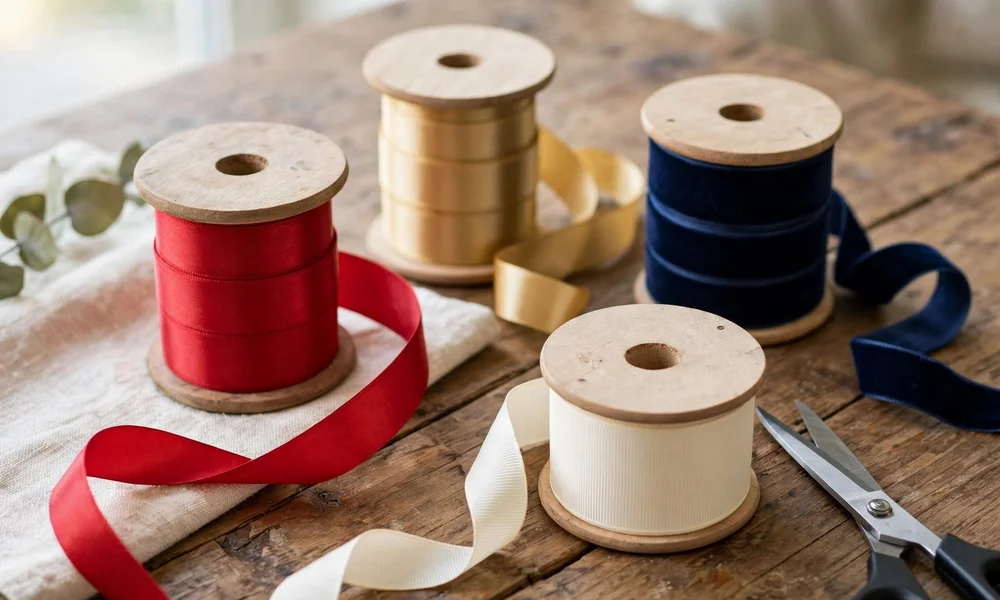
Satin ribbon is the classic. It has a smooth, glossy face that catches the light, ties into soft, full bows, and suits almost any occasion. Its weakness is slipperiness: satin slides against itself, so bows can loosen unless you pull the knot firmly, or add a tiny stitch at the centre for important gifts. Buy double-faced satin, glossy on both sides, so no dull underside shows in the bow.
Grosgrain ribbon has a ribbed texture and a matte finish, and it is the most practical all-rounder. The ribs give it grip, so knots and bows stay tied, and it holds a crease well. It looks less formal than satin, suiting everyday gifts, children’s birthdays, and rustic kraft wrapping. It also frays less than satin at the cut end, which makes it forgiving for beginners.
Velvet ribbon is the luxurious choice. It is soft to the touch, deep in colour, and makes even a plain box look expensive. It is thicker than satin or grosgrain, suits larger gifts and wider widths, and holds a bow shape beautifully because the pile grips itself. The trade-off is cost: velvet costs more per metre and shows dust and fingerprints, so save it for gifts where the presentation really counts.
Wired ribbon has a thin wire along each edge, letting you shape loops and curls that hold their form. It is the ribbon for big, showy bows on large gifts, wreaths, and hampers. It is harder to tie neatly, and the wire ends can poke out if you cut carelessly, so fold the wire back at the cut end. It is also the hardest ribbon to reuse, since the wire kinks permanently once bent.
Width, Length, and Choosing the Right Ribbon
Width matters more than most people think: too narrow disappears against a large box, too wide overwhelms a small one. As a rule, the ribbon should be no wider than about a third of the box face. Narrow ribbon of 6 to 10 millimetres suits small boxes, jewellery gifts, and tags. Medium ribbon of 15 to 25 millimetres is the all-rounder. Wide ribbon of 38 millimetres and above suits large boxes, hampers, and statement bows, where the ribbon itself is part of the decoration.
Length is easier to get wrong than width. For a cross-and-bow, allow four times the length plus four times the width, plus about 30 centimetres for the bow. Most people underestimate and end up with a bow too small to shape properly. Buying by the spool solves this: a standard spool holds 20 to 25 metres and costs far less per metre than the small rolls sold at the till. Keep one spool each of a neutral and an accent colour, and you will rarely need to buy ribbon at the last minute.
How to Tie a Bow That Stays Put
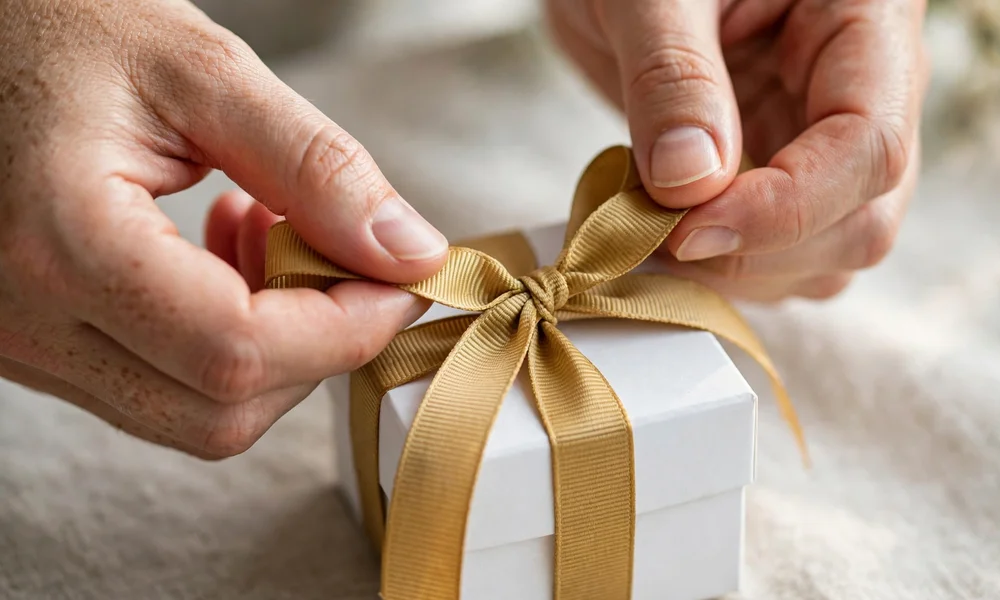
Cross the ribbon under the box, bring both ends up, cross them over, and pull snug, not tight. Pulling too hard crushes the paper and distorts the box; snug is enough. Cross the ribbon the other way for the classic cross on all four sides, or keep it to one direction for a simpler look.
Form the bow with two loops, one in each hand, crossing them like the first step of tying a shoelace. Pull gently until the loops are even, then shape them: pull the loops outwards to make them full, and tug the tails to lengthen them. The bow should sit in the centre of the box top, loops and tails roughly equal. Uneven loops are the most common flaw, and the fix is simple: remake the smaller loop rather than stretching it.
Finish by cutting the tails at an angle or in a V shape, which stops fraying and looks far smarter than a straight cut. For satin, seal the cut end near a flame, which melts the fibres and stops fraying, but never near the gift. For grosgrain and velvet, an angled cut is enough. Finally, fluff the loops with your fingertips, and the bow will look like it was tied by somebody who does this every day.
The Best Ribbons Compared in 2026
| Type | Best for | Feel | Bow hold | Weakness |
|---|---|---|---|---|
| Satin | Formal gifts, weddings | Smooth, glossy | Fair, can slip | Slippery, frays |
| Grosgrain | Everyday gifts, kraft | Ribbed, matte | Good, grips well | Less formal look |
| Velvet | Luxury gifts, large boxes | Soft, rich | Excellent | Costs more, shows dust |
| Wired | Big bows, hampers | Stiff, shaped | Excellent, holds form | Hard to tie, kinks |
What to Look For When You Buy
Check the edges first. Good ribbon has finished edges, woven or heat-sealed, that resist fraying, while cheap ribbon has raw cut edges that fray the moment you handle it. A clean, even edge means a well-made ribbon; a ragged edge means it will look tired before the gift is opened. Double-faced ribbon, the same finish on both sides, is worth paying a little more for, since the underside shows in every bow.
Think about storage. Ribbon stored loose in a drawer tangles, kinks, and picks up dust. Keep spools on a dowel or in a box with the ends tucked in, away from sunlight, which fades colours. Three spools, a neutral, an accent, and a metallic, cover almost every occasion in the year. Our guide to gift bags that carry presents in style covers the carrier that ribbon often finishes, since a neat bow tied on a bag handle lifts the whole present.
Common Mistakes That Spoil the Finish
The most common mistake is cutting the ribbon too short. A bow tied with too little ribbon ends up small, tight, and lopsided, with no fix but starting again. Measure generously: four times the length plus four times the width, plus 30 centimetres. Ribbon is cheap, and skimping on length is the fastest way to ruin a bow.
The second mistake is pulling the ribbon too tight. A ribbon pulled hard enough to dent the box or crush the paper looks anxious, not neat, and it can tear the paper at the corners. Pull snug, not tight. The third mistake is using too many ribbons. Two or three ribbons in different colours, plus a bow, plus a tag, plus stickers, makes a gift look busy rather than generous. One ribbon and one tag, done well, always looks better than a pile of extras.
The fourth mistake is ignoring the cut ends. Straight-cut ribbon frays within hours, and frayed ends make even a beautiful bow look unfinished. Cut the tails at an angle or in a V, and seal satin ends near a flame if safe. And never use ribbon that has already been used: once tied and untied, it keeps its creases and kinks, and no smoothing will make it look new again.
Your Ribbon Checklist
- Match the width to the gift: narrow for small boxes, wide for large ones, never wider than a third of the box face.
- Choose satin for shine, grosgrain for grip, velvet for luxury, wired for big bows.
- Measure generously: four times the length plus four times the width, plus 30 centimetres.
- Pull the ribbon snug, not tight, so the paper is not dented or torn.
- Cut the tails at an angle or in a V, and seal satin ends to stop fraying.
- Keep one neutral, one accent, and one metallic spool in stock.
Frequently Asked Questions
How much ribbon do I need to wrap one gift?
Allow four times the length of the box plus four times its width, plus about 30 centimetres for the bow. For a 20 by 15 centimetre box, that is roughly 1.7 metres. Better to cut too much than too little, since a short ribbon cannot make a proper bow.
What is the best ribbon for a beginner?
Grosgrain. Its ribbed texture grips, so knots and bows stay tied, it frays less than satin, and it is forgiving to shape. Start with 15 to 25 millimetres, and practise one bow on an empty box first.
Why does my ribbon bow keep coming undone?
Usually because slippery satin was tied too loosely, or the knot under the bow was never snug. Pull the first cross firmly, form the loops, and tug the tails. For satin, a tiny stitch or a dot of glue at the centre of the bow holds it permanently.
Can ribbon be reused?
Fabric ribbon can sometimes be reused if tied loosely and untied carefully, but in practice it keeps creases and kinks that show in the next bow. Wired ribbon almost never survives reuse, since the wire kinks permanently. Fresh ribbon is worth it.
What width of ribbon should I buy first?
Medium, 15 to 25 millimetres. It suits most gift boxes, ties into a bow that is easy to shape, and works with satin and grosgrain. Add narrow ribbon later for small boxes and tags, and wide ribbon for large boxes and hampers.
Is wired ribbon better than normal ribbon?
It is better for big, showy bows that need to hold their shape, such as on hampers and wreaths, but worse for ordinary gifts. It is harder to tie, the wire ends can poke out, and it kinks once bent. For most gifts, unwired satin or grosgrain ties a better bow.
The Bottom Line
The best ribbon ties neatly, holds its shape, and suits the gift. Keep neutral, accent, and metallic spools in stock, measure generously, and the bow will finish the gift before it is ever opened.


