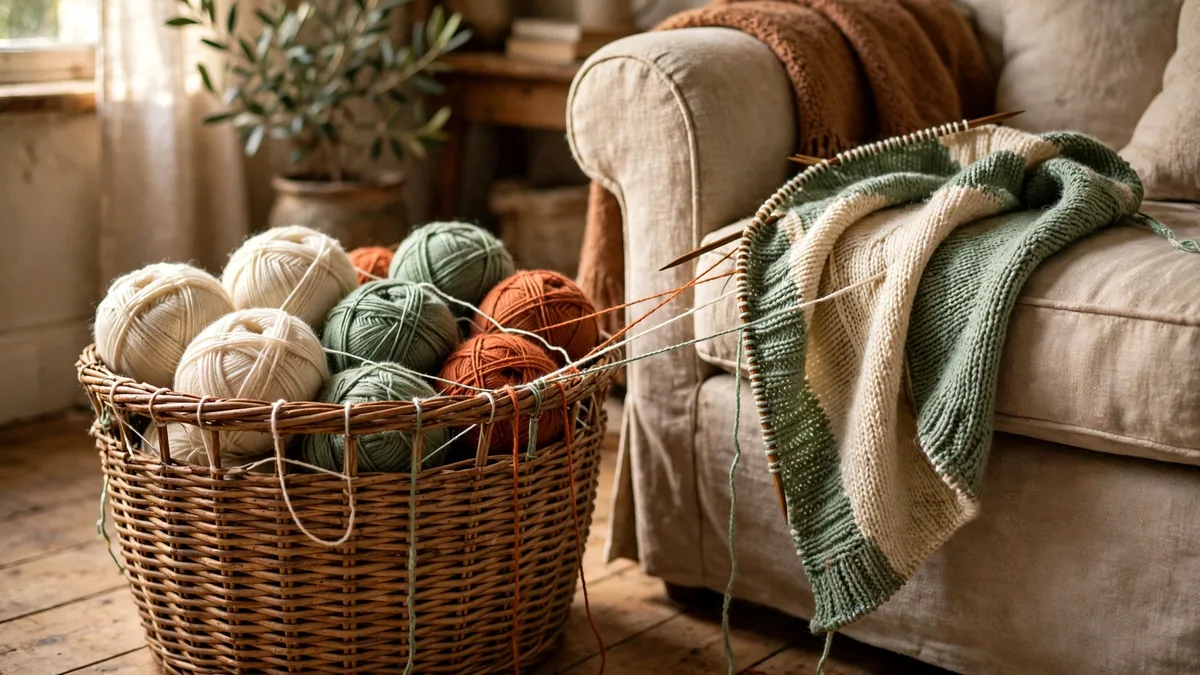
Best Yarn Baskets for Tangle-Free Knitting in 2026
The best yarn baskets in 2026 solve the problem every knitter knows by heart: the ball that rolls under the sofa, the strand that tangles around the chair leg, and the second ball that joins the first in a knot you spend twenty minutes unpicking. A good yarn basket keeps every ball you are working with in one place, feeds each strand out cleanly while you knit, and sits beside your chair looking like it belongs in the room. This guide compares the strongest yarn baskets of 2026 and helps you pick one that keeps your yarn tangle-free and ready to knit with.
Key Takeaways
- A yarn basket holds several balls at home and feeds each strand through its own hole, so balls never roll away or tangle with each other.
- Feed holes matter more than looks: smooth, rounded holes let yarn glide, while rough edges fray delicate fibres within an evening.
- Buy for the number of balls you knit with at once, not the size of your stash: two or three holes cover most colourwork, while a large basket suits blanket knitters.
- Woven wicker breathes and looks like furniture, wooden baskets with drilled holes feed most smoothly, and fabric baskets fold away when empty.
- A yarn basket is not a yarn bowl, which holds one ball, and not a knitting bag, which carries a project out of the house.
What a Yarn Basket Actually Is
A yarn basket is built around the way yarn behaves. The working balls sit inside it, each strand passes out through its own hole in the rim or side, and the basket stays put beside your chair while you knit. When you stop, the balls stay inside, the strands stay separated, and the project is ready to pick up where you left it. An ordinary basket does it badly: balls roll out, strands cross, and a ball that escapes onto the floor picks up dust and pet hair.
The distinction that matters most is between a basket, a bowl and a bag. A yarn bowl holds one working ball while you knit at home, feeding the strand through a slot, and it carries nothing anywhere. A knitting bag carries a project in progress, with the working yarn, the needles and the pattern together, and it is built to travel. A yarn basket sits at home and holds several balls at once, feeding them side by side without tangling. If you knit with one colour at a time and never leave the armchair, a bowl is enough. If your project travels, you need a bag. If you knit stripes, colourwork or blankets with two or three balls on the go, a basket is the tool made for the job. Our guide to the best yarn bowls for tangle-free knitting explains the single-ball option, and our guide to the best knitting bags for your projects covers the portable side of the same craft.
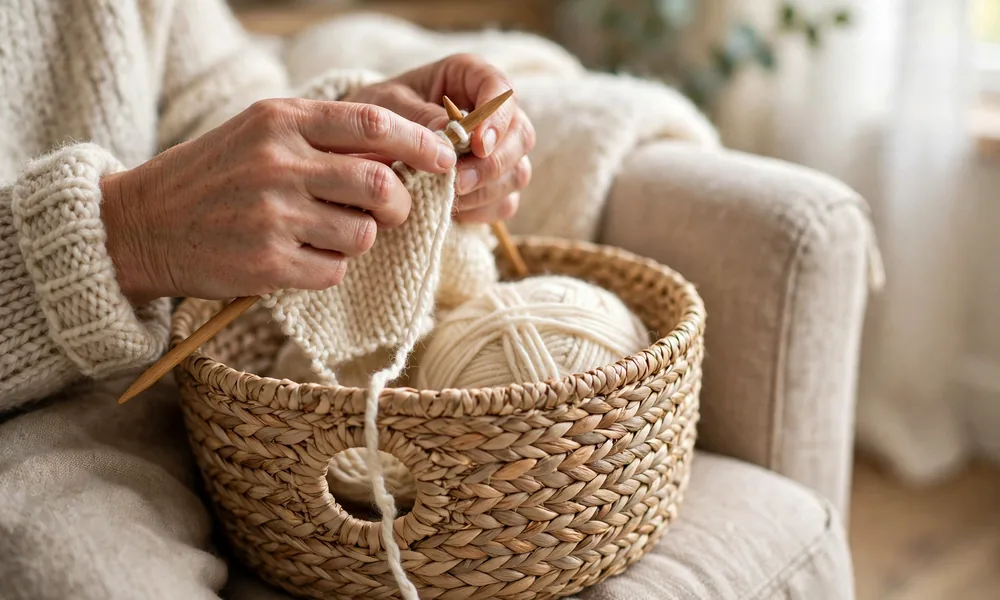
The Main Types of Yarn Basket Compared
Most yarn baskets fall into four types, and the right one depends on how many balls you use at once and where the basket will live.
| Type | Best For | Watch Out For |
|---|---|---|
| Woven wicker or seagrass | Everyday knitting beside a chair | Rough weave can snag delicate yarn |
| Wooden with feed holes | Colourwork with two or three balls | Heavier, and holes must be sanded smooth |
| Fabric basket | Small spaces, folding away when empty | No rigid feed holes, balls can roll out |
| Lidded storage basket | Keeping a stash dust-free between projects | Lid must lift off easily while you knit |
Woven Wicker and Seagrass Baskets
The classic yarn basket is woven wicker, seagrass, rattan or willow. It breathes, which keeps wool fresh, and it looks like furniture rather than storage, so it can live beside the sofa permanently. The weave is also the weakness: a rough weave snags delicate yarn, and a ball that rubs an unfinished rim will pill within a few rows. Look for a smooth finish or a fabric lining; a lined woven basket is attractive outside, snag-free inside, and the lining usually washes.
Wooden Baskets With Feed Holes
Wooden yarn baskets are the most deliberate design: a solid or slatted body with two or three round holes drilled through the side, each sanded smooth, so every ball feeds through its own opening and the strands never cross. For colourwork and stripes, nothing else works as well. The trade is weight and price: a wooden basket full of wool is heavy to move, and a well-made one costs more than a woven basket. Check every hole with a fingertip, because a single rough edge will fray a fine yarn all evening, and check the base sits flat.
Fabric and Lidded Baskets
Fabric baskets are the lightest option, and the only one that folds flat when empty, which suits a small flat. Their weakness is structure: soft sides do not hold feed holes, so the balls sit loose and can roll out if the basket tips. Lidded storage baskets keep a stash dust-free between projects, but buy one only if the lid lifts with one hand, or it will simply get left off.
Feed Holes: The Feature That Matters Most
If a yarn basket has one feature worth paying for, it is the feed hole. A good feed hole is round, generous and smooth inside, large enough for a chunky yarn to pass without squeezing and small enough that the ball cannot follow the strand out. Two or three holes are the useful number: one for the working ball, a second for the contrast colour, and a third for the spare ball. More than three holes in a small basket means the strands start crossing again.
Test a feed hole before you buy: pull a strand of your usual yarn through it and feel for drag. A smooth hole lets the yarn glide, so your tension stays even. A rough hole catches the fibre, and you will feel it as a slight tug on every stitch. A basket that needs fixing on day one was not finished properly.
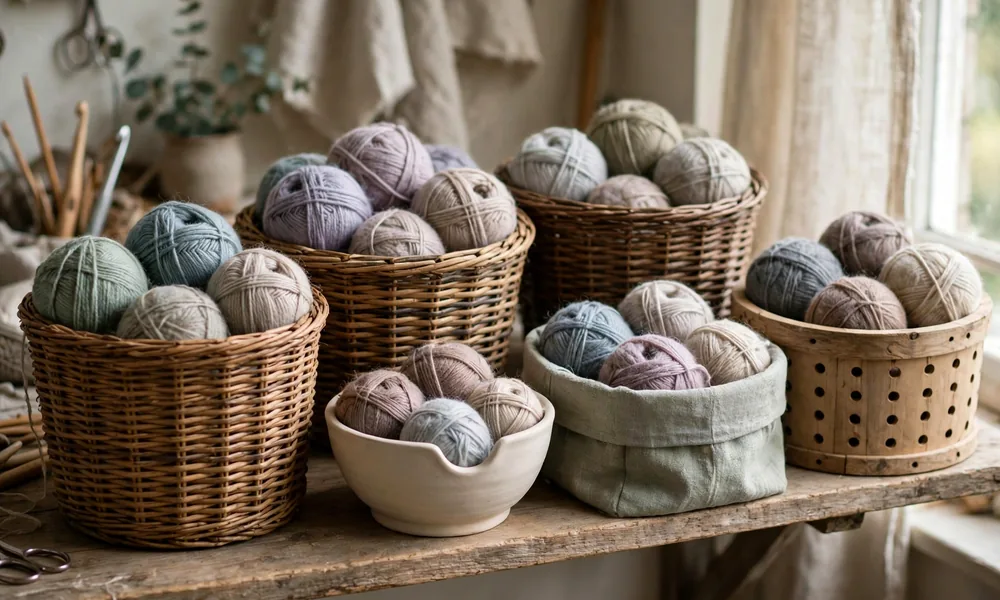
Size: How Many Balls Do You Actually Knit With?
Size is the decision most buyers get wrong, usually by buying for the stash rather than the project. A basket that holds twelve balls looks generous in the shop and becomes a tangle in the living room, because the balls at the bottom never feed cleanly. The right size holds the balls you are knitting with right now, plus one spare, and nothing else.
As a rough guide, a small basket of about twenty-five centimetres suits one or two balls and a single-colour project. A medium basket of thirty to thirty-five centimetres suits two or three balls, covering stripes, colourwork and most sweaters. A large basket of forty centimetres or more suits blankets, where four or five balls feed at once.
Our guide to the best yarn that feels soft and holds its shape explains how fibre choice affects the finished fabric, and a good basket protects that fibre from felting, tangling and dust. Chunky wool needs wide holes and a roomy basket, fine lace yarn needs smooth holes, and slippery silk blends need holes small enough that the ball cannot escape.
Materials and Build: What Lasts
The material decides how long a basket lasts and how heavy it feels. Wicker and seagrass are light and attractive, but they dry out in central heating and can crack if knocked about, so check the weave is tight and the rim is bound. Rattan is tougher and holds its shape better under weight. Wood is the most durable and the heaviest: a wooden basket can last decades, though the weight is a fair trade only when the basket mostly stays beside one chair.
Fabric baskets depend on their padding and stitching: a well-made quilted basket holds its shape and washes well, while a cheap one collapses when empty. Whatever the material, check the handle fixings before you buy, because a handle that pulls out under a full load is the most common failure on a budget basket.
Keeping Yarn Clean, Dry and Tangle-Free
A basket only earns its keep if the yarn inside it stays clean. Keep it out of direct sunlight, which fades dyed wool, and away from damp, which ruins a stash faster than moths. A basket beside a radiator will dry wool out and make it brittle. If you have pets, a basket with a lid is worth the extra money.
Between projects, empty the basket, shake out the lint, and wipe the inside. Wind your yarn into neat centre-pull balls before it goes in, because a centre-pull ball feeds from the inside out and cannot roll. Keep only the working balls in the basket: spare skeins belong in storage.
Yarn Basket Checklist: Before You Buy
- It holds the balls you knit with at once, plus one spare, with a little room to spare.
- It has two or three feed holes, each round, generous and smooth inside, with no rough edges.
- The inside is snag-free, lined if woven, and the rim will not catch delicate yarn.
- The base is wide and flat, so the basket sits level and does not tip when you pull a strand sideways.
- The handles are fixed firmly enough to lift the basket when it is full of wool.
- It fits the spot beside your usual chair, with room for the strands to feed without crossing furniture.

Frequently Asked Questions
Do I really need a yarn basket, or will any basket do?
Any basket can hold yarn, but a yarn basket is shaped for it: it feeds each strand through its own hole so balls cannot roll away or tangle. If you knit with one ball at a time at home, a yarn bowl is enough; if you knit with two or more, a proper basket earns its price quickly.
How many feed holes should a yarn basket have?
Two or three holes cover almost every knitter: one for the working ball, one for the contrast colour, and one spare. One hole is fine for single-colour knitting.
What is the difference between a yarn basket and a yarn bowl?
A yarn bowl holds one working ball and feeds it through a slot, and it is the right tool for single-colour knitting at home. A yarn basket holds several balls at once, each feeding through its own hole, and it is the right tool for stripes, colourwork and blankets.
Can I use a yarn basket for crochet as well as knitting?
Yes, and crochet is often where a basket helps most, because crochet uses more balls at once for colour changes. The same rules apply: smooth feed holes, a stable base, and only the working balls inside.
How do I stop yarn tangling inside the basket?
Feed each strand through its own hole and cover the basket when you stop, so the balls cannot roll. If it still tangles, wind the yarn into neat centre-pull balls before it goes in, because a centre-pull ball feeds from the inside and cannot roll.
How do I clean a yarn basket?
Empty it, shake out the lint, and brush or vacuum the inside once a month. Woven baskets wipe clean with a damp cloth, fabric linings usually wash on a gentle cycle, and wooden baskets need only a wipe. Never soak a woven or wooden basket, or it will warp.
The Bottom Line
The best yarn basket for your knitting in 2026 fits the way you knit: big enough for the balls you use at once, with two or three smooth holes, a wide flat base that never tips, and an inside that will not snag your yarn. A medium lined woven basket is the safest first buy, a wooden basket with drilled holes is the best choice for colourwork, and a fabric basket suits a small space. Buy for the project you knit most, and check every feed hole before you pay.


