A yoga strap is the least glamorous prop in the room and, for most people, the most useful one. It is a simple loop of woven fabric, usually cotton or nylon, with a buckle at one end — and it quietly turns poses you cannot reach into poses you can actually hold. Tight hamstrings, stiff shoulders, a back that refuses to fold forward: a strap bridges the gap between where your body is and where the pose asks it to go.
The trouble is that not all straps are equal. Some are too short to be useful, some stretch like a rubber band, and some have buckles that slip the moment you put weight on them. We tested the field on length, material, buckle security, grip when sweaty, and how the strap behaves after months of regular use. Here are the ten that earned their place in the bag — and the ones worth skipping.
What makes a good yoga strap
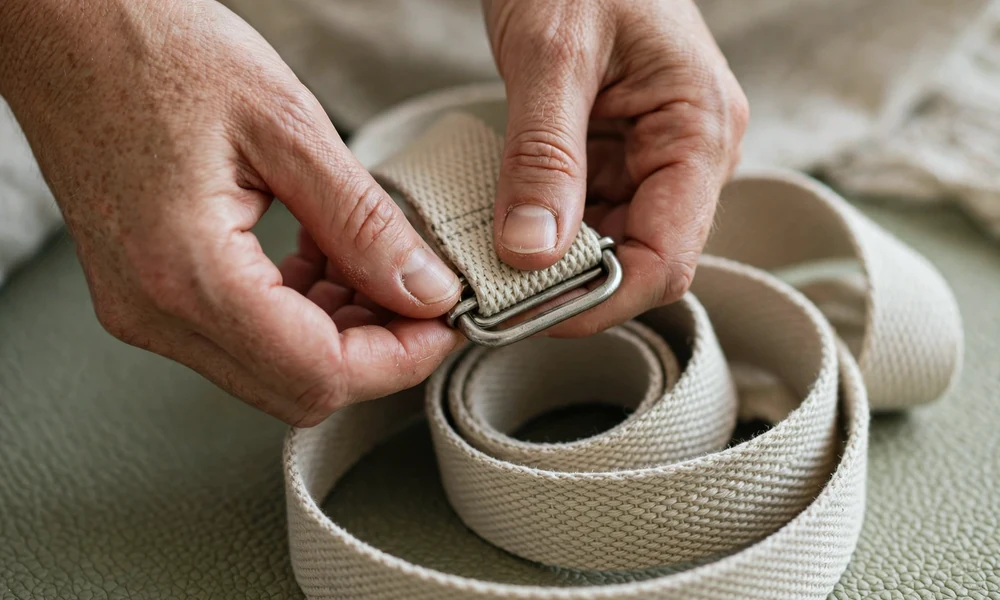
Three things matter more than anything else. First, length: six feet suits most people for basic stretches, eight feet covers taller bodies and wider binds, and ten feet is the choice for deep shoulder work and full-body loops. Second, material: cotton grips well and feels kind on skin, nylon is stronger and barely stretches, and blended weaves try to split the difference. Third, the buckle: a metal D-ring adjusts smoothly and holds under load, a cinch buckle is quick but can creep, and a plastic buckle is fine for gentle stretching and little else.

The 10 best yoga straps of 2026
1. The classic cotton D-ring strap
This is the strap most studios hand out, and there is a reason it has never gone away. A plain eight-foot cotton weave with two metal D-rings is simple, strong and predictable: thread the end through both rings, pull it back through one, and the loop locks. It grips bare feet without slipping, it softens with use instead of fraying, and it costs less than a single studio class. The only real weakness is that cotton absorbs sweat and takes a while to dry, so it is not the pick for daily hot yoga. For everyone else, this is the default — the strap to buy if you only buy one.
2. The long ten-foot cotton strap
If you are tall, broad-shouldered, or working on binds that wrap the whole torso, six or eight feet simply runs out. The ten-foot cotton strap solves that without changing anything else about the formula: same soft weave, same D-ring buckle, just more length to work with. It is the best choice for shoulder openers, seated forward folds where the feet are far away, and partner-assisted stretches. The extra fabric adds a little bulk in the bag, and beginners can find the loose tail distracting, but for anyone over six feet it is the difference between a strap that helps and one that frustrates.
3. The six-foot travel strap
Short, light and easy to roll into a corner of a suitcase, the six-foot strap is the one for people who practise on the road. It handles hamstring stretches, shoulder stretches and simple loops without fuss, and it pairs neatly with a travel mat. What it will not do is a full bind or a deep chest opener on a larger frame — that is the trade for the compact size. Pick this one if your practice travels with you; pick a longer strap if your practice mostly happens at home.
4. The heavy-duty nylon strap
Nylon is the workhorse material. It barely stretches under load, it shrugs off sweat and moisture, and it dries fast enough to use again the same day. A ten-foot nylon strap with a metal D-ring is the pick for stronger practitioners, for Iyengar-style work where the strap takes real body weight, and for anyone who practises daily and is tired of replacing worn cotton. The trade-off is feel: nylon is slicker against skin and can feel harsh on bare feet until it breaks in. If durability matters more than softness, this is your strap.
5. The cinch-buckle quick-adjust strap
Some people hate threading D-rings mid-pose. The cinch-buckle strap fixes that with a ladder-lock buckle you can tighten or loosen with one hand, even while holding a stretch. It is the fastest strap to adjust, which makes it popular in flowing classes where the strap goes on and off several times. The catch is that cinch buckles can creep under heavy load, so it suits gentle and moderate stretching better than full body-weight work. For restorative yoga and beginners who fumble with D-rings, it is the friendliest option on this list.
6. The eco cotton and hemp blend
For buyers who care about what their gear is made of, the cotton-hemp blend is the standout. Hemp adds strength and a slightly textured grip that cotton alone lacks, while the cotton keeps it soft enough for bare skin. These straps tend to be a little stiffer out of the packet and soften over a few weeks of use. They are usually undyed or naturally coloured, which suits a low-key kit. The price runs a little higher than plain cotton, and the weave can feel rough on sensitive skin at first — but it is the most sustainable strap here, and one of the toughest.
7. The extra-wide comfort strap
At two inches wide, this strap is built for people who find standard straps dig into their feet, shoulders or hands. The extra width spreads the load, which makes long-held stretches far more comfortable — especially seated forward folds and supine leg stretches where the strap presses into the arch of the foot. It is slightly bulkier to roll and store, and it is overkill for quick shoulder loops, but for anyone with sensitive feet, arthritis in the hands, or a habit of holding stretches for several minutes, the comfort is worth the bulk. Cotton is the usual material, with a D-ring buckle.
8. The loop strap with fixed sizes
Not every strap needs a buckle. A loop strap is a closed circle of fabric, sold in set lengths, that you slip around a foot, thigh or arm and pull. There is nothing to adjust and nothing to slip, which makes it the simplest strap to use and the hardest to get wrong. The downside is obvious: you cannot change the size, so you need to buy the right length, and a loop cannot do everything an adjustable strap can. It shines in restorative practice, for holding legs in place during supine poses, and for people who want a prop with zero learning curve.
9. The strap-and-block set
If you are starting from nothing, a matched strap and block set is good value. The strap is usually an eight-foot cotton D-ring model, and the block is cork or dense foam — the two props cover most of what a beginner needs, from supported bridges to seated stretches. Buying them together costs less than buying separately, and the pieces are sized to work as a pair. The compromise is that neither piece is the best in its class: the strap is a solid all-rounder rather than a specialist, and the block is standard rather than premium. For a first kit, though, it is hard to beat.
10. The premium organic cotton strap
The premium pick is an organic cotton strap with reinforced stitching, a solid brass or stainless D-ring, and a weave dense enough that it barely stretches even when wet. It feels noticeably better in the hand than budget cotton — smoother, heavier, more substantial — and the hardware will outlast the fabric. It costs roughly twice a basic strap, which is hard to justify for a casual practitioner, but for someone who practises five days a week, the durability and feel pay for themselves over a couple of years. This is the buy-once option.
How to choose the right length
Length is the decision most people get wrong, and it is the one that matters most. Stand up, hold your arms out to the sides, and measure fingertip to fingertip: that span is a good starting point. Six feet works for shorter bodies and simple stretches. Eight feet is the safe all-round choice for most adults, and it is what most studios stock. Ten feet is for taller practitioners, deep binds, and anyone who wants to loop the strap around the whole body. When in doubt, go longer — a strap that is too long is mildly annoying, but a strap that is too short is useless. A good yoga mat matters too, since a strap is only as useful as the surface you practise on.
Cotton, nylon or something else?
Cotton is the comfortable default: soft, grippy, and kind to skin, but it absorbs moisture and stretches a little when wet. Nylon is the durable choice: strong, quick-drying, and almost stretch-free, but slicker and harsher on bare feet. Blends try to give you both, and the best of them come close. Polyester straps exist too — they are cheap and colourfast, but they tend to feel plasticky and slip more than cotton. For most people the honest answer is cotton for home practice and nylon for hot yoga or daily heavy use. Whatever you choose, check the stitching at the buckle end: loose or single-row stitching is the first thing to fail.
How to use a yoga strap
Start with the simplest move: seated, loop the strap around the ball of one foot, hold the ends in both hands, and gently draw the leg up while keeping the knee soft. The strap should do the reaching so your back can stay long. For shoulders, hold the strap wide overhead and slowly narrow your grip as your shoulders allow. For a bind, loop the strap between your hands behind your back and walk them closer over weeks, not days. The rule in every case is the same: the strap extends your reach, it does not force it. If you feel sharp pain, back off. And keep the strap in your gym bag rather than at home — a strap you leave behind is a strap you never use.
Straps to skip
The worst straps share a few traits. Ultra-cheap thin straps, often sold in multi-packs, stretch under load and cut into your feet. Plastic buckles crack and slip, especially in warm rooms. Elasticated straps sound clever but defeat the point: a strap should hold a fixed length so you can measure your progress, not spring back. And novelty straps with printed patterns may look fun, but the print usually sits on a slick coating that slides against skin. None of these are dangerous, but all of them waste money and patience.
One more thing to skip: the idea that a strap is only for beginners. Experienced practitioners use straps constantly — for deeper binds, for safer backbends, for holding poses longer without strain. It is a tool for precision, not a crutch. The best strap in this guide is the one that fits your body, your practice and your bag — and the worst is the one that sits in a drawer because it was the wrong length, the wrong material, or the wrong buckle. Choose well, and a ten-pound strap will quietly improve every session you take it to. If your practice kit is growing, comfortable yoga pants that move with you are the next upgrade worth making.