Choosing between quartz vs granite worktops is one of the biggest decisions in any kitchen renovation. The surface you pick will be chopped on, spilled on, heated and wiped down thousands of times, so it needs to be tough as well as beautiful. Both look superb when new and both carry a premium price.
Quartz worktops are engineered from crushed quartz stone mixed with resin, giving a consistent pattern and a surface that never needs sealing. Granite worktops are cut from solid natural stone, so every slab is unique. That single difference shapes almost everything else, from stain resistance to heat tolerance and the way each material ages.
This guide compares quartz vs granite worktops on durability, heat and stain resistance, maintenance, appearance and cost. We look at how each behaves in a real family kitchen, so you can decide which will still look good in fifteen or twenty years.
Key takeaways
- Quartz is non-porous and never needs sealing, so it resists stains better than granite in everyday use.
- Granite tolerates hot pans far better, because the resin in quartz can be damaged by heat.
- Granite is slightly harder and more scratch resistant, while quartz is more flexible and less likely to chip at the edges.
- Granite needs resealing every one to two years; quartz needs no sealing at all.
- For most busy family kitchens, quartz lasts longer with less effort, while granite suits cooks who value natural stone and heat tolerance.
What Quartz Worktops Are Made Of
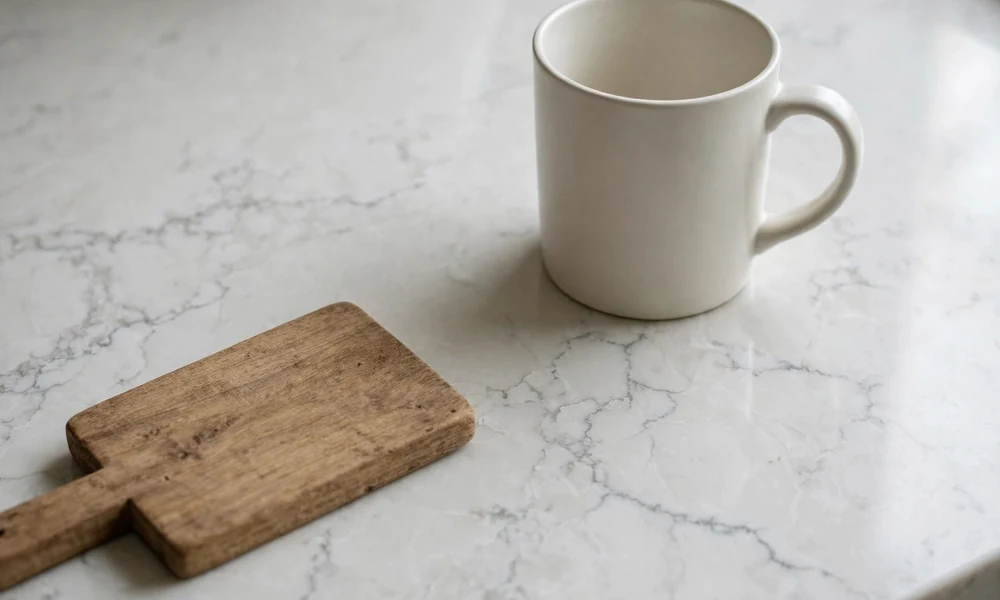
Quartz worktops are engineered stone, typically around 90 to 95 percent crushed natural quartz mixed with resins and pigments, pressed into dense, uniform slabs under vacuum. Because the process is controlled, the pattern and colour are consistent across a slab.
The resin binder gives quartz its most practical advantage: it fills the tiny pores found in natural stone, so the finished surface is non-porous. Spilled red wine, coffee and tomato sauce sit on the surface instead of soaking in, and a quick wipe with warm soapy water usually removes them. Quartz comes in a huge range of colours and patterns, from plain whites to designs that mimic marble. Its main weakness is heat: the resin can scorch if a very hot pan is placed directly on the surface, and that damage is hard to repair. It is also not recommended outdoors in strong sunlight, because UV exposure can fade some colours.
What Granite Worktops Are Made Of
Granite worktops are cut directly from blocks of natural igneous rock, formed over millions of years as molten rock cooled slowly underground. Each slab is unique, with its own pattern of crystals, veins and mineral speckles, and no other kitchen will have exactly the same worktop. That uniqueness is a large part of its appeal.
Granite is extremely hard, made mostly of quartz, feldspar and mica, scoring around six to seven on the Mohs hardness scale, harder than most kitchen knives. It can handle heavy pots and everyday knocks without showing much wear. The main weakness is porosity: granite absorbs liquids if it is not sealed, so red wine, oil and acidic foods can leave stains. Sealing solves the problem, but the seal wears away and needs renewing every one to two years, and granite can chip at a sharp edge if a heavy pan is dropped on it.
Durability Head to Head
Durability is where the quartz vs granite worktops debate is closest, because both materials are far tougher than laminate, wood or solid surface alternatives. In normal daily use, either one should last twenty years or more.
Quartz tends to age gracefully with minimal effort: its non-porous surface means stains are rare, and its slight flexibility resists cracking. Granite ages well too, but only if the sealing routine is kept up. A granite worktop resealed on schedule resists stains almost as well as quartz, while a neglected one can develop dark patches around the sink and hob. Chips are the more realistic worry for both, and quartz has a small edge.
| Feature | Quartz | Granite |
|---|---|---|
| Stain resistance | Excellent, non-porous | Good when sealed, fair when not |
| Heat resistance | Moderate, resin can scorch | Excellent, handles hot pans |
| Scratch resistance | Very good | Excellent |
| Chip resistance | Very good, slightly flexible | Good, can chip at edges |
| Sealing required | Never | Every 1 to 2 years |
| Pattern | Consistent, repeatable | Unique, natural variation |
| Outdoor use | Not recommended in sun | Suitable with sealing |
Heat, Stains and Scratches in Daily Use
Heat is the clearest win for granite. If you regularly move pans from the hob to the worktop, granite will cope with far more abuse than quartz. Manufacturers advise against placing anything hotter than around 150 degrees Celsius directly on quartz, and a scorch mark from a roasting tin cannot be polished out. Using trivets removes the risk, but it is a habit you have to build.
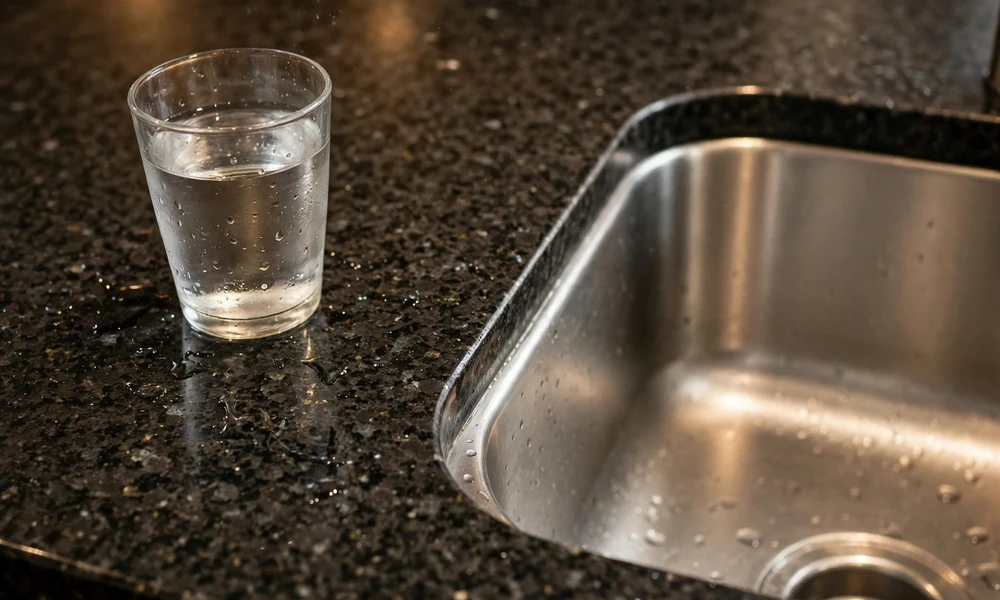
Stains are the clearest win for quartz. Coffee, turmeric and red wine are everyday hazards, and quartz shrugs them off because nothing soaks in. Granite can handle the same spills when freshly sealed, but the seal wears away with cleaning, especially around the sink and hob. Sprinkle water on the surface: if it beads up, the seal is working, and if it soaks in, it is time to reseal.
Scratches are a draw in practice. Both resist knife marks well, but neither should be used as a chopping board, since cutting on stone blunts knives quickly. Lifting rather than sliding heavy items protects both materials, and it is the easiest habit for keeping any stone worktop looking new.
Maintenance and Sealing
Maintenance is where quartz pulls ahead for most households. A quartz worktop needs nothing more than warm water, a mild detergent and a soft cloth. There is no sealing, no special cleaner and no annual routine to remember. That simplicity is a large reason quartz has become the default choice in new kitchens.
Granite asks a little more of its owner. Daily cleaning is the same, but the sealing schedule must be kept, usually every twelve to twenty-four months, and harsh cleaners should be avoided on both materials, as they dull the finish over time. The job itself is simple, a wipe-on product left to soak and then buffed off, but it is easy to forget, and the worktop quietly becomes more vulnerable. Small chips in quartz can often be filled with colour-matched resin, while chips in granite are more likely to stay visible.

Looks and Design Choices
Appearance is personal, and it is the reason many people choose granite despite the extra maintenance. Natural granite has a depth that engineered stone struggles to match, with crystals that catch the light and veins that run through the slab. In a traditional kitchen, granite often looks more at home, while in a sleek handleless kitchen, the clean consistency of quartz can look more deliberate.
Quartz has the advantage of range. Because it is manufactured, it can be made in almost any colour, including pure whites, soft greys and deep blacks that do not occur in granite. Marble-look quartz has become very popular, offering the veined appearance of marble with the toughness of quartz. Both can be finished polished, honed or leathered, and undermount sinks suit both.
Cost and Value Over Time
Quartz and granite sit in a similar price range, and in most markets there is little between them once templating, cutting, delivery and installation are included. Basic colours of both can be surprisingly affordable, while rare slabs and premium designs cost considerably more. Complex shapes and cut-outs add cost to either material.
Over the lifetime of the kitchen, quartz often works out slightly cheaper, because there is no sealing to pay for and fewer stain problems to fix. Granite carries the small recurring cost of sealant. A quality stone worktop of either type is a selling point for a home.
It is also worth thinking about the rest of the room before committing to a premium worktop. A beautiful stone surface will not rescue a kitchen with poor layout or tired cabinets. The same thinking applies elsewhere in the home, so it is worth reading about the bathroom renovations that lose money before planning any large renovation, so the budget goes where it adds the most value.
Which Lasts Longer in a Real Kitchen?
For most households, quartz lasts longer with less effort. Its non-porous surface means stains are rare, it never needs sealing, and its flexibility protects it from cracks and chips. In a busy family kitchen, quartz is most likely to look close to new after fifteen years of ordinary use, provided hot pans are kept off the surface.
Granite lasts just as long, and arguably longer where heat is the main hazard, but only if it is looked after. A granite worktop that is sealed on schedule and protected from heavy impacts can serve for thirty years or more. The catch is that the longevity depends on the owner, not just the stone.
Daily kitchen habits matter beyond the worktop too. Keeping the surface clear makes any stone last longer, and that starts with the tools you keep on it, so it is worth avoiding the kitchen gadgets that waste counter space and keeping only the items you genuinely use every day.
Checklist: Choosing Between Quartz and Granite
- Work out how you cook: frequent hot pans point to granite, while messy cooking points to quartz.
- Be honest about maintenance: if you will not reseal a worktop every year or two, choose quartz.
- See the actual slab before you buy, especially with granite.
- Check the colour in your own kitchen light, not just in the showroom.
- Ask for a full quote including templating, cutting, delivery and installation, so there are no surprises.
- Choose eased or rounded edges: they chip less than sharp square edges.
Frequently Asked Questions
Is quartz or granite better for a busy family kitchen?
Quartz is usually better for a busy family kitchen, because it resists stains without sealing and needs almost no maintenance. Granite is a strong second choice if the household will reseal it regularly and use trivets.
Does granite need sealing?
Yes, granite needs sealing when installed and then again every one to two years. If sprinkled water beads on the surface, the seal is fine; if it soaks in, resealing is due.
Can you put a hot pan on quartz?
You should not put a very hot pan directly on quartz, because the resin can scorch at high temperatures. Always use a trivet or heat pad under hot pans and roasting tins.
Which is more expensive, quartz or granite?
They are usually similar in price once installation is included. Basic colours of both are affordable, while rare slabs and premium designs cost more. Quartz can work out slightly cheaper over time, because it needs no sealing.
Does quartz look like real stone?
Modern quartz can look very close to marble and granite, but it is still a manufactured pattern that repeats across a large surface. Granite is genuinely unique, with natural variation no factory can copy.
Can granite be used outdoors?
Yes, granite can be used outdoors, including in outdoor kitchens, provided it is sealed. Quartz is not recommended outdoors, because sunlight can fade or yellow some colours.
The Bottom Line
Quartz vs granite worktops is a close contest, and both materials will serve a kitchen well for decades. Quartz wins for most households, because it resists stains, needs no sealing and asks very little of its owner. Granite wins for cooks who value natural stone and heat tolerance, and who will keep up with resealing. Choose the material that fits how you cook and clean, and either stone will still look good long after the rest of the kitchen has been replaced.
One last note: the hob you pair with your new worktop matters as much as the stone itself. Before you finalise the layout, compare the options in our guide to choosing between gas and induction hobs so the two suit each other.