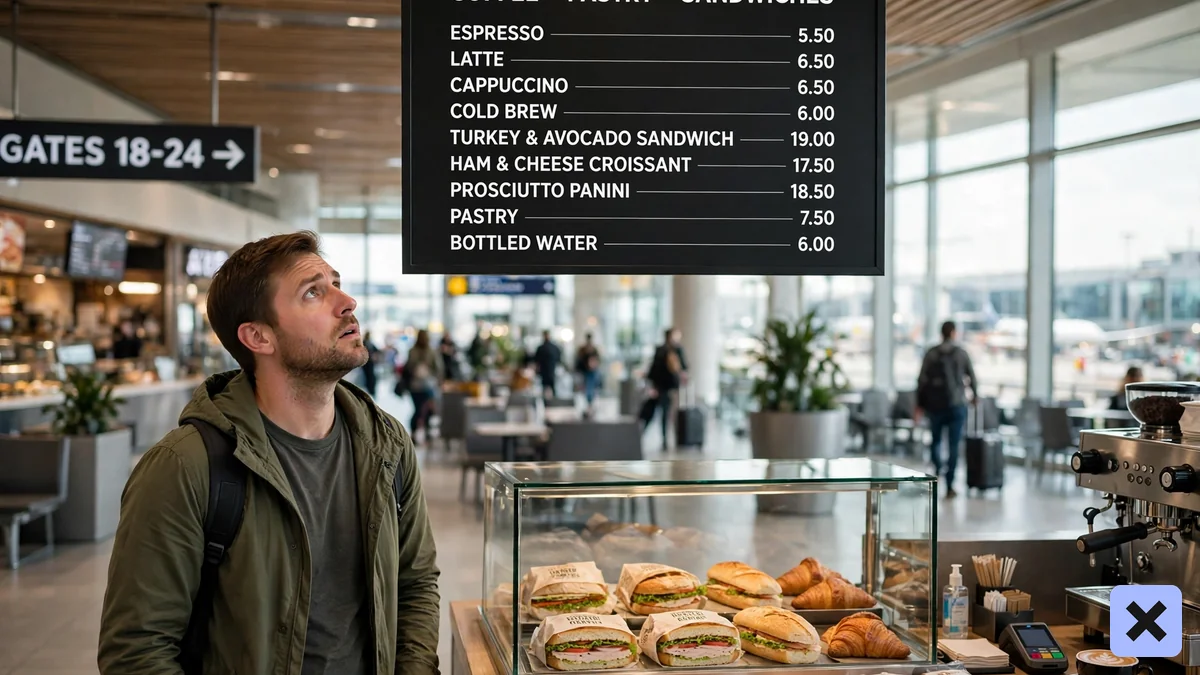
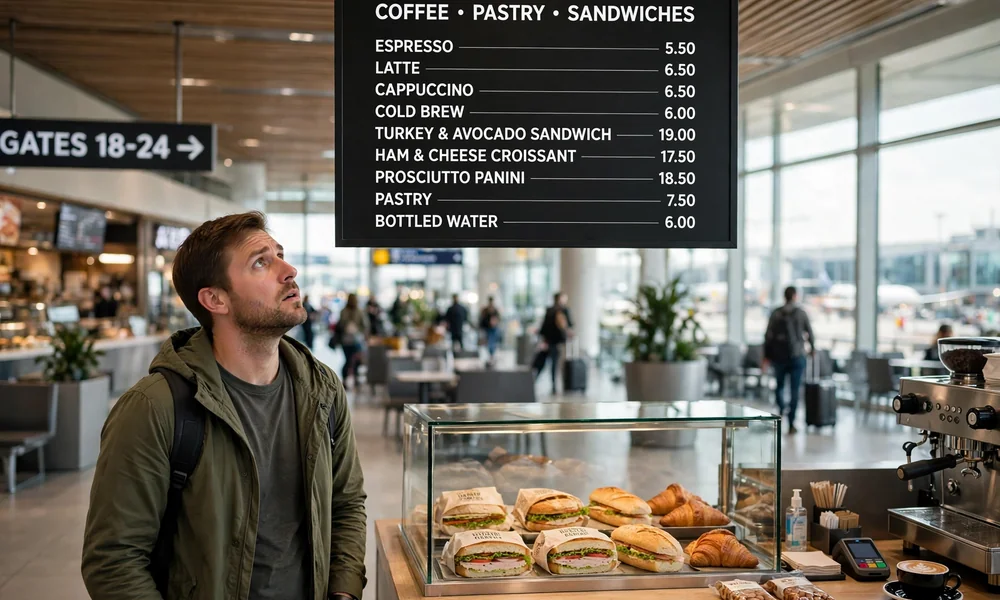
The worst airport food prices turn an ordinary meal into one of the most expensive parts of a trip. A sandwich that costs a few pounds on the high street can cost three times as much once you are past security, and a bottle of water can cost more than a full lunch elsewhere. Two coffees, two sandwiches and a couple of snacks can easily swallow fifty pounds.
It is not your imagination. Airport food prices are consistently higher than street prices in almost every country, and the gap has widened as terminals have filled up again. The reasons are real, from sky-high rents to strict security rules, but understanding them does not make the bill easier to swallow. What matters is knowing where the worst markups hide and how to dodge them.
This guide breaks down what you will actually pay, which items carry the steepest markups, and the tricks regular travellers use to eat well for less. Most of the worst airport food prices are avoidable with ten minutes of planning.
Key takeaways
- Airport food typically costs two to three times street prices, with bottled water and coffee carrying some of the steepest markups.
- Captive-audience economics, high rents and security logistics all push prices up.
- A sandwich, coffee and water can cost £25 or more.
- Small portions and service charges quietly add to the bill.
- Eating before security and packing your own food can cut airport food spending by half or more.
Why Airport Food Costs So Much
Terminals are some of the most expensive retail spaces in any city, and every plate of food carries a share of those costs. Once you understand the economics, the prices still sting, but they stop looking random.
The Captive Audience Problem
Once you pass through security, you cannot simply walk out and find a cheaper cafe. You are a captive audience, and every food outlet in the terminal knows it. There is no high street competition a few steps away and no realistic alternative except going hungry. That lack of choice removes the normal pressure that keeps prices in check on an ordinary street.
The effect is strongest at smaller airports, where only a handful of outlets serve thousands of passengers. Even at large hubs the choice is narrower than it looks: many brands are owned by the same concession company, so the apparent variety hides a single operator setting similar prices across the board. Overpriced meals and long queues are among the airport experiences travellers keep warning about, and food sits near the top of that list.
Rent, Staffing and Logistics
Terminal rents are enormous, and airport operators charge concessionaires high fees for the right to trade airside. Those fees are passed straight to the customer in the price of every coffee and sandwich. Deliveries must pass through airport screening, so every item is checked, scheduled and escorted, which adds time and cost. Outlets often operate from four in the morning until midnight and need staff cleared to work airside, which limits the labour pool and pushes wages up. Kitchens are small, storage is tight, and fresh food must arrive in small, frequent batches. Each constraint adds a little to the price, and together they explain a meaningful part of the markup.
The Worst Airport Food Prices Travellers Actually Pay
The numbers tell the story better than any complaint. Across major airports in the United Kingdom, Europe and the United States, the same everyday items appear again and again at prices that would be laughable on the high street.
Bottled Water and Soft Drinks
Bottled water is the classic airport rip-off. A 500ml bottle that costs less than a pound in a supermarket regularly sells for three to four pounds airside, and at some airports it reaches five pounds. The liquids rule is partly to blame: you cannot bring your own bottle of water through security, so you must buy one on the other side. Many airports provide free water fountains, but they are often hard to find or out of order, and a thirsty traveller will pay rather than hunt for one.
Coffee That Costs More Than Lunch
Coffee at the airport is a quiet budget killer. A flat white or latte that costs around three pounds at a good high street cafe can cost five or six pounds airside, and a large speciality drink can reach seven pounds. For a couple travelling together, two morning coffees can cost more than a takeaway lunch for two at home. The quality is not always better either; airport coffee is often made in a rush by staff serving a long queue.
Sandwiches, Salads and Hot Meals
Sandwiches are where the worst airport food prices become impossible to ignore. A basic sandwich that would cost three to four pounds in a supermarket regularly sells for eight to ten pounds airside, and a premium sandwich can reach twelve or thirteen pounds. Salads are worse: a small pre-packed salad can cost eleven to fourteen pounds, often with less food than a supermarket version at a third of the price.
Hot meals carry the biggest absolute price tags. A burger and chips can cost eighteen to twenty-five pounds, a pasta dish can reach twenty pounds, and a full English breakfast airside can cost fifteen pounds or more before drinks. For a family of four, a single airport meal can easily cost eighty to a hundred pounds. The portions are not larger and the quality is rarely better; you are paying for the location, not the cooking.
| Item | Typical high street price | Typical airport price | Markup |
|---|---|---|---|
| Bottled water (500ml) | £0.80 | £3.50 | Over 4x |
| Flat white coffee | £3.20 | £5.50 | About 1.7x |
| Pre-packed sandwich | £3.50 | £9.00 | About 2.6x |
| Pre-packed salad | £4.00 | £12.00 | 3x |
| Burger and chips | £10.00 | £20.00 | 2x |
| Glass of wine | £6.00 | £9.50 | About 1.6x |
| Can of soft drink | £1.00 | £3.00 | 3x |
The table uses typical prices at major airports. The pattern is consistent: the simplest items carry the biggest percentage markups, while hot meals carry the biggest cash cost.
Airport Lounges and the Food Equation
Airport lounges change the food maths completely, but only if you use them well. A lounge pass bought in advance can cost twenty-five to forty pounds, which sounds expensive until you compare it with buying food and drinks separately. A traveller who eats a proper meal, drinks two coffees and has a couple of soft drinks in a lounge can easily spend more than the pass price at terminal outlets. For long layovers, the lounge is often the cheaper option as well as the more comfortable one.
The trap is paying for a lounge and eating badly, or buying a pass at the door at a higher price than online. The worst airport lounges that waste money charge a premium for a quiet room and a packet of crisps, so compare the pass price with what you would realistically spend outside.
How to Eat Well at the Airport Without Overpaying
Beating airport food prices does not require going hungry. It requires a small amount of planning and a willingness to skip the first cafe you see. The travellers who spend least are the ones who arrived prepared.
Eat Before Security
The cheapest airport meal is the one you eat before security. Landside cafes and restaurants face high street competition and usually charge far less than airside outlets. Many airports have a decent landside food court, and some have branches of familiar chains at near-normal prices. Eating a proper meal before you go through security means you board the plane full, and a small snack airside is enough if you get peckish. Families save the most here: feeding four people landside can cost half what the same meal costs airside.
Pack Your Own Food
Packing your own food is the single most effective way to avoid the worst airport food prices. Sandwiches, wraps, fruit, nuts, granola bars, dried fruit and crackers all pass through security without a problem, as long as you follow the liquids rule for anything spreadable or saucy. A homemade sandwich costs a pound or two to make and replaces a nine-pound airport version. Pack food that travels well and does not need heating: wraps hold up better than sandwiches, hard fruit like apples travels better than soft fruit, and a small bag of trail mix is more filling than a bag of crisps. Bring an empty reusable bottle and fill it after security.
Choose the Right Outlet
Not every airside outlet charges the same. Familiar high street chains at the airport are often cheaper than independent terminal restaurants, and a grab-and-go outlet is usually cheaper than a sit-down restaurant serving the same food. Look at the full menu before you queue, compare two or three outlets, and be willing to walk five minutes to a cheaper one. The first cafe after security is often the most expensive because it catches the travellers who will not look further. Fast food can be the cheapest hot option airside, but the value varies wildly, and some fast-food items offer poor value even by airport standards, so check the menu rather than assuming every chain is cheap.
Your Airport Food Checklist
Use this checklist before every flight.
- Eat a proper meal before you leave home or before security, so you are not buying food out of hunger.
- Pack sandwiches, fruit, nuts and snacks in your hand luggage, and bring an empty reusable water bottle to fill airside.
- Check lounge prices online in advance and compare them with what you would spend on food and drinks separately.
- Compare two or three outlets before you buy, and walk past the first cafe after security.
- Read the bill before you pay, and question any service charge or tip prompt you did not agree to.
- Set a food budget for the trip and keep the airport spend inside it, so one meal does not eat the whole day’s budget.
Frequently Asked Questions
Why is airport food so expensive?
Terminal rents are high, deliveries must pass through security, and outlets serve a captive audience with no cheaper alternative nearby. Those costs are passed to the customer, and the lack of competition keeps prices up.
Can I bring my own food through airport security?
Yes. Solid foods such as sandwiches, wraps, fruit, nuts and crackers pass through security without a problem. Liquids, sauces and spreads over 100ml must follow the liquids rule.
Is bottled water free at airports?
Many airports have free water fountains airside, but they can be hard to find. Bringing an empty reusable bottle and filling it after security is the cheapest option.
Are airport lounges worth it for food?
For long layovers, yes: the pass price is often less than the food and drinks you would buy separately. For short waits or light eaters, they are poor value.
Which airport foods have the worst markups?
Bottled water, soft drinks and pre-packed salads carry the highest percentage markups, often three to four times the high street price. Hot meals carry the biggest cash cost.
How much should I budget for food at the airport?
Budget ten to fifteen pounds for a light meal and drink, or twenty to thirty pounds for a sit-down meal. A family of four can spend sixty to a hundred pounds on one airside meal.
The Bottom Line
The worst airport food prices are not an accident; they are the result of high rents, captive customers and a system that charges for convenience at every step. Bottled water at four times the shop price, a sandwich at nine pounds, and a family meal at a hundred pounds are the predictable outcomes. The good news is that the worst of it is avoidable. Eat before security, pack your own food, bring an empty bottle, compare outlets before you buy, and use a lounge only when the numbers work in your favour.