A balance board is a simple idea: a deck that rocks, wobbles, or rolls, teaching balance a few minutes at a time. The worst balance boards of 2026 fail at it in ways that leave a user on the floor with a bruised hip, a board cracked across the middle, or a roller that has shot out from under the deck and across the room. They are too steep, too slippery, or built from plywood that splits under weight, with no stops to catch a board that has gone too far. Owners buy them expecting a fun way to build core strength. What they get is a board that is either so unstable it cannot be used, or so badly made it cannot be trusted. A board that is either too unstable to use or too badly made to trust is a board that ends up leaning against a wall, and a board against a wall builds no balance at all.
Decks That Crack Under Weight
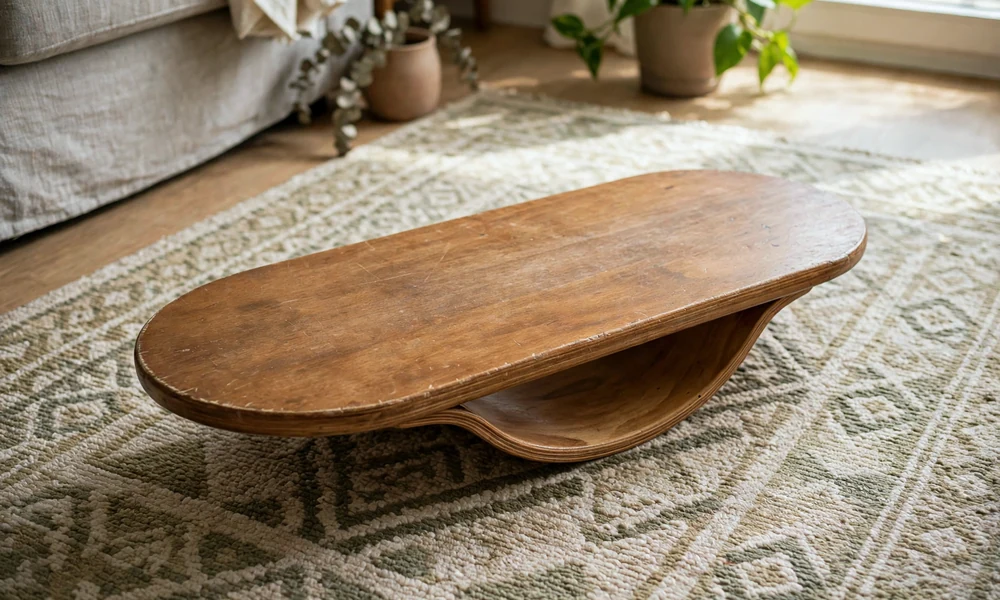
A balance board deck takes the full weight of its user, concentrated on a small rocking point, and the worst decks are not built for it. Thin plywood with too few layers splits along the grain, cheap plastic decks flex and then crack without warning, and a deck that is too narrow for the user’s feet forces the weight onto the edges, which is where cracks start. A board that breaks underfoot does not just end the workout. It can end it with an injury. A board that breaks underfoot does not just end the workout, it can end it with an injury, and a deck that cracks without warning gives no chance to step off safely.
The test takes ten seconds. Stand the board on its roller or rocker, step on with both feet, and shift the weight slowly from side to side. A good deck stays rigid and silent, while a bad one creaks, flexes visibly, or twists. Check the weight rating too, and treat it with suspicion if the board is thin: a deck rated for a hundred kilos should feel solid under eighty, not springy. Look at the layers on the edge of a wooden deck: seven or more plies is a good sign, while three thin plies is a board that will split.
Surfaces With No Grip at All
A balance board deck must grip the feet, and the worst ones are as smooth as a kitchen worktop. Bare wood slides under socks, smooth plastic slides under bare feet, and a deck with no grip tape or textured surface becomes a slide the moment the feet get damp. The failure is sudden: the feet slip, the board shoots sideways, and the user lands on the floor with no time to catch themselves. Grip is not a style choice on a board that moves. It is the only thing keeping the user on it. A deck with no grip tape becomes a slide the moment the feet get damp, and the feet slip, the board shoots sideways, and the user lands with no time to catch themselves.
Grip tape should cover the whole standing area, not just a strip down the middle, and it should feel rough enough to hold a sock without tearing it. Textured rubber is better still for bare feet, because it grips when damp and does not wear smooth in the middle where every user stands. Rub the surface hard with a damp hand: if the hand slides, the feet will slide too. A board that arrives with grip tape already peeling at a corner will be smooth within a month, and smooth is dangerous.
Rollers That Shoot Out From Under You
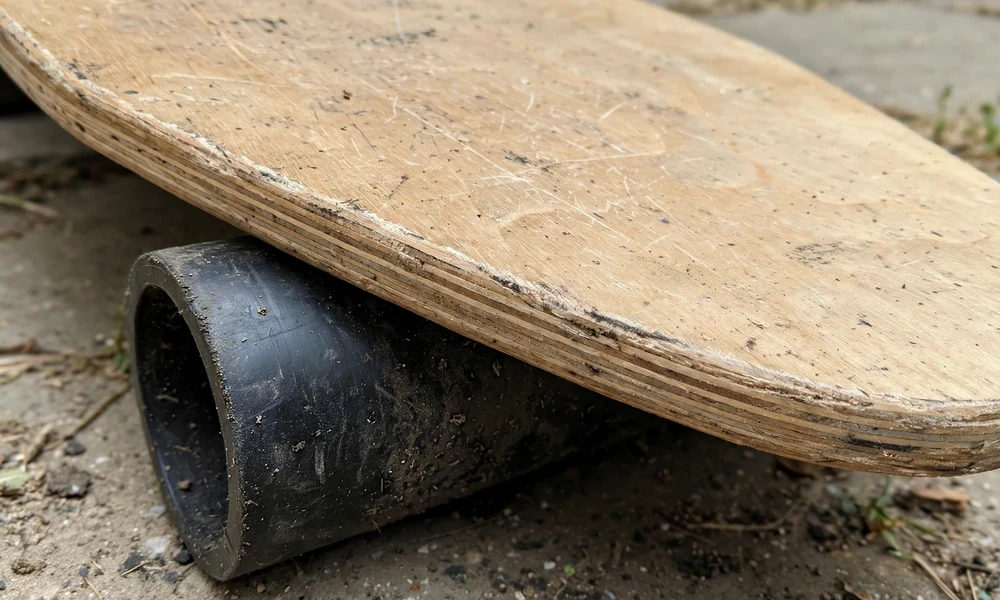
Roller boards, where a deck balances on a free cylinder, are the most unstable type, and the worst ones have no way to stop a roller that has gone too far. A roller without end stops or a track rolls straight off the end of the deck, and the deck drops to the floor with the user still on it. The failure happens at the exact moment the user is least balanced, which is the worst possible moment. A roller board without stops is not a training tool. It is a trap. A roller without end stops rolls straight off the end of the deck, and the deck drops to the floor with the user still on it, at the exact moment they are least balanced.
Rocker boards, which pivot on a fixed curve, are safer for most users, because the board cannot leave its pivot. Wobble boards, which tilt in every direction on a central dome, sit in the middle: challenging but contained. A beginner should start with a rocker board and move to a roller only when the rocker feels easy, and never without stops. Check for rubber end caps on the roller, a track or rails that keep it centred, and a deck with raised ends that catch the roller before it escapes.
Too Steep, Too Fast, Too Soon
The angle of a board decides how hard it is, and the worst boards are steep from the start. A rocker with a tight curve tips fast and far, which is thrilling for an experienced user and terrifying for a beginner, who spends every second fighting to stay upright instead of learning balance. The best boards let the difficulty grow: adjustable rockers, interchangeable fulcrums, or a wobble dome that can be flipped for a gentler tilt. A board with one steep setting has one audience, and it is not a beginner. Balance improves in small steps, and a board that offers only the hardest step teaches nothing, because a beginner who falls off every time stops trying within a week.
The mistake is buying the hardest board first, because it looks like the fastest way to improve. It is the fastest way to fall off and stop trying. Balance improves in small steps, and a board that offers only the hardest step teaches nothing. Start with a gentle tilt, practise for a few minutes a day, and move up only when the easy setting feels boring. A board that grows with its user is a board that gets used for years, while a board that is too hard on day one gets used once.
Boards With No Way to Get Off Safely
Getting on a balance board is easy, and getting off safely is the part the worst boards ignore. A board that tips suddenly leaves the user stepping onto a floor that is further away than expected, with one foot still on a moving deck, which is how ankles get twisted. A board used on a hard floor with no mat underneath turns every fall into a bruise, and a board used in a cluttered room turns a fall into a collision with furniture. A safe dismount needs space, a soft landing, and a board that does not keep moving after the user steps off. A board that is practised safely gets practised often, and a board that is practised often builds balance, which is the whole point of owning one.

Practise near a wall or a sturdy chair that can be grabbed, keep the floor clear for a metre in every direction, and put a thick mat or a rug underneath for the first few weeks. Step off by lowering one foot to the floor while the other stays on the deck, rather than jumping off, which is how most falls happen. A board that is practised safely gets practised often, and a board that is practised often builds balance, which is the whole point of owning one.
Cheap Boards That Warp in Storage
A balance board spends most of its life in storage, and the worst ones do not survive it. Thin plywood warps in a damp garage, direct sunlight dries out the glue between the layers, and a board left leaning against a radiator twists until it rocks on a flat floor even when nobody is standing on it. A warped board is a board that can never be trusted again, because it tips in ways the user cannot predict, and a board that tips unpredictably is a board that causes falls. A warped board is a board that can never be trusted again, because it tips in ways the user cannot predict, and a board that tips unpredictably causes falls.
Store a board flat, in a dry room, away from heat and damp, and never lean it against a wall for months at a time. A board with a sealed finish resists damp far better than bare wood, and a board that is wiped down after sweaty sessions lasts longer than one left damp. Check the board every month by setting it on a flat floor and pressing each corner: if it rocks when empty, it has warped, and no amount of use will straighten it again.
What to Buy Instead
The boards worth buying share a short list of features, and none of them is expensive on its own. A deck of thick, multi-ply wood or solid plastic that stays rigid and silent under weight. Grip across the whole standing area, rough enough to hold a sock. A rocker or wobble design for beginners, with a roller only when stops and tracks keep it contained. An angle that can grow with the user, and a weight rating with a real margin above the heaviest user. If a board fails any one of those checks, keep looking.
Fit matters as much as build, and the board should suit the user in front of you rather than the athlete in the photograph. A beginner needs a gentle rocker with full grip, a surfer needs a board that mimics a wave without throwing them off, and anyone with a bad ankle needs a wobble board with a low tilt and a soft landing nearby. Practise near a wall or a sturdy chair, start with a few minutes a day, and stop before the legs get tired. A board that works on day one and still works in a year is worth every penny. If you want a second balance tool for the same routine, our comparison of the best vs worst roller skates of 2026 covers the skates that teach balance on wheels.
The Bottom Line
The worst balance boards of 2026 share a pattern: decks that crack, surfaces with no grip, rollers that shoot out from under the user, and angles too steep for anyone learning. Avoid those four failures and you avoid almost every balance board regret. Step on it slowly, check the grip with a damp hand, and make sure the roller cannot escape. Do that, and the board you buy will be the one that builds balance a few minutes at a time, without ever throwing you off. And if you want the rest of your kit to match, our guide to the best gym essentials of 2026 covers the basics that earn their place in every home gym. For a board that works on water rather than land, our guide to the best paddle boards of 2026 covers the boards that hold their shape on a lake.