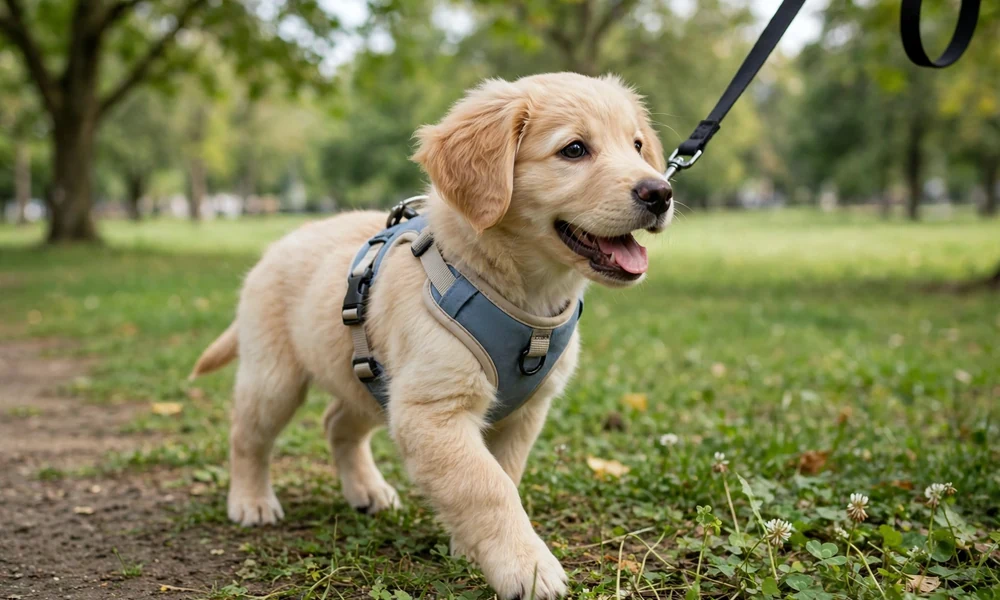
A puppy harness has one job: to keep a young dog safe and comfortable on the lead while it learns to walk. The worst dog harnesses for puppies of 2026 fail at it in ways that leave a puppy chafed, frightened, or slipping out of the harness entirely on a busy pavement. They are too stiff for a growing body, too tight across the shoulders, or made from straps that rub raw skin in a single walk. Owners buy them expecting a gentle, secure harness for a small, wriggling puppy, something that spreads the pressure and lets the puppy learn. What they get is a harness that pinches, a buckle that slips loose, or a fit so wrong the puppy backs out of it at the first loud noise. A puppy grows fast, and a harness that ignores that is not a bargain. It is a risk.

What Makes a Puppy Harness Bad
A good harness for a puppy does three things: it fits a growing body, it spreads pressure away from the neck, and it stays on when the puppy wriggles. The worst ones fail all three. The most common failure is fit. Harnesses sold for puppies are often just smaller versions of an adult harness, with the same stiff straps and the same fixed proportions, so they sit wrong on a puppy’s narrow chest and short back. A puppy’s body changes every few weeks, and a harness with only one adjustment point cannot keep up, which means it is either too loose to hold or too tight to wear. A growing puppy needs a harness that adjusts at the neck and the chest, and a harness that cannot adjust is a harness that will be wrong within a month.
The second failure is chafing. A puppy’s skin is thinner and more sensitive than an adult dog’s, and a strap that rubs the same spot for a whole walk leaves a raw patch that the puppy then refuses to have touched again. Cheap webbing has rough, unfinished edges, and narrow straps concentrate all the pulling force on a thin line across the chest and behind the front legs. Padded straps spread the load and protect the skin, but the worst harnesses skip the padding to save cost, and the puppy pays for it with every step. If a strap leaves a red mark after a short walk, the harness is doing damage, not teaching walking.
Buckles That Slip and Break
Buckles are where most puppy harnesses fail first, because every pull a puppy makes ends at the buckle. Thin plastic buckles bend and pop open under a sudden lunge, small clips stick half-closed and then release without warning, and buckles placed where the puppy can chew them get gnawed until they no longer hold. A puppy that slips its harness on a pavement is in immediate danger, and a buckle that cannot be trusted is the reason it happens. Metal buckles with a strong, positive click are worth paying for, because a harness is only as safe as the buckle that holds it shut.
Adjustment sliders are the quieter version of the same problem. A slider that slips lets the harness loosen a little on every walk, so a fit that was snug in the morning is loose by the afternoon, and the puppy backs out of it at the first fright. Cheap sliders have smooth teeth that grip nothing, and they creep under the constant small movements of a walking puppy. Good sliders lock firmly and stay where they are put, and they can be adjusted with one hand while the puppy wriggles. If a harness needs re-tightening halfway through every walk, the sliders are failing, and the harness is not safe to use.
Straps in the Wrong Places
Strap placement decides whether a harness helps a puppy walk or hurts it with every step. The worst designs run a strap straight across the shoulders, restricting the front legs and changing the puppy’s gait, which can cause lasting problems in a growing dog. A strap that sits too high presses on the windpipe, so the puppy coughs and gags exactly like a dog on a collar, and the whole point of the harness is lost. A strap that sits too low slides toward the belly and twists the harness sideways, so the lead pulls from the wrong angle and the puppy learns to fight the harness instead of walking with it.
Front-clip and back-clip designs suit different puppies, and the worst harnesses pretend one design fits all. A front clip gives steering for a puppy that pulls, but it tangles the lead under the front legs if the harness twists. A back clip is simpler and suits a calm puppy, but it gives no steering at all for a puller, and a strong puppy on a back clip can drag its owner along. The right choice depends on the puppy in front of you, and a harness that offers only one clip point with no guidance is leaving the owner to guess. A well-fitted lead clipped to the right ring makes the difference between a walk that teaches and a walk that frustrates.
How Puppies Slip Out of Bad Harnesses
Escaping is the failure owners fear most, and it happens because a bad harness gives a frightened puppy exactly the gap it needs. A puppy that is startled by a loud noise will pull backwards, and a harness that is loose around the chest lets the puppy reverse out of it in a single movement, front legs first, leaving the owner holding an empty harness while the puppy runs. The danger is worst on a busy pavement or near a road, where a loose puppy has seconds before it is in traffic. A harness that fits properly, with a snug chest strap and a secure belly strap, gives the puppy no room to back out, but a harness with a single loose strap is an escape waiting for a loud noise.
The shape of the harness matters as much as the fit. Step-in harnesses are easy to put on, but a puppy that has learned the trick can lift one leg and step out of them, and a harness with a wide neck opening lets a small puppy duck its head out entirely. H-style harnesses hold better, but only if both straps are adjusted correctly, and a harness with a strap that rides up toward the ears is a harness that is already halfway off. Owners should test the escape risk at home, in a safe room, by gently pulling backwards on the lead and watching whether the harness holds or slips. If it slips in the living room, it will slip on the street, and the street is the wrong place to discover it.
Materials That Hurt Growing Skin
Cheap materials are the quietest failure in a puppy harness, because they look fine until the puppy wears them. Rough nylon webbing with unfinished edges rubs the skin raw behind the front legs, where the coat is thinnest and the strap moves most. Stiff mesh that does not breathe traps heat and sweat against the body, and a puppy in a hot, scratchy harness learns to hate the sight of it. Dye that bleeds in rain stains the coat and irritates the skin, and a harness that smells of chemicals when new is a harness that has not been made with a puppy in mind.
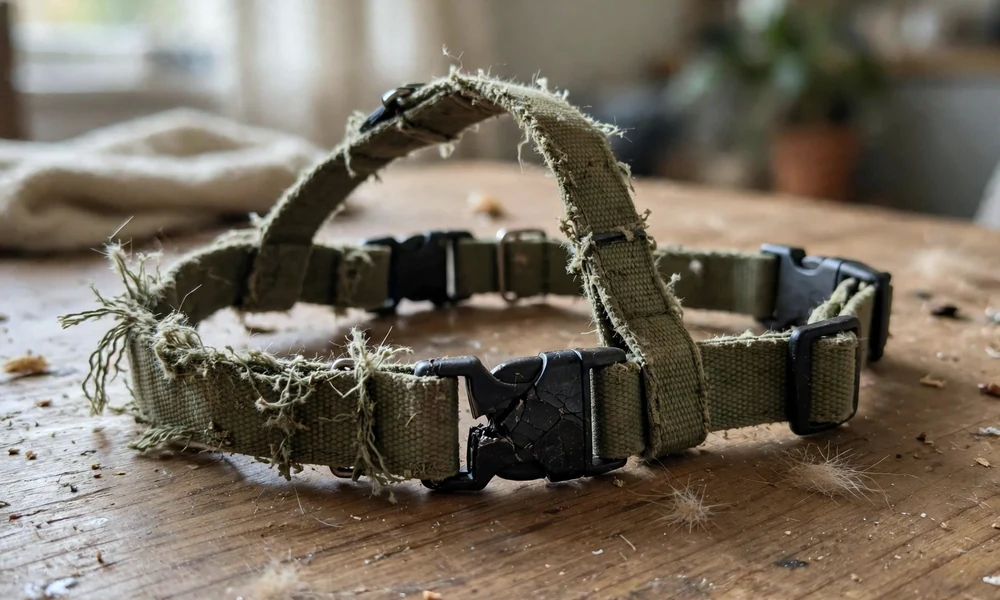
Weight matters more for a puppy than for an adult dog, and the worst harnesses are far too heavy for the animal wearing them. Thick webbing, oversized buckles, and heavy metal rings add up to a harness that pulls a small puppy sideways and tires it out within minutes. A puppy harness should feel light in the hand, with slim buckles and thin, strong straps, because a puppy that is exhausted by its harness is not learning to walk. It is learning to dread the walk, and that lesson is hard to undo once it has been learned.
How to Spot a Bad Harness Before You Buy
The fitting test takes a minute and saves a season of regret. Put the harness on the puppy and check that you can fit two fingers flat under every strap, with no strap pressing on the throat or restricting the front legs. Watch the puppy walk for a few minutes and look for chafing, twisting, or any sign that the harness is sliding out of place. Pull the buckles hard and check that they click shut crisply and cannot be prised open with a fingernail. If the harness twists, slips, or leaves a mark after a short indoor test, it will be worse on a real walk, not better.
Size is the other check, and it is the one most owners get wrong with puppies. A harness should be measured on the puppy, not bought by age or breed, because puppies of the same age vary enormously. Measure the chest behind the front legs and the neck at the base, then check the harness against those numbers rather than the label. Our guide to dog harnesses that stop pulling without choking covers fits, clips, and materials in detail, and it is worth reading before spending anything, because the right harness is the difference between a puppy that loves its walks and a puppy that dreads them.
What to Buy Instead
The harnesses worth buying share a short list of features, and none of them is expensive on its own. Soft, padded straps with finished edges, a metal buckle that clicks shut firmly, adjustment points at the neck and the chest, and a design that leaves the shoulders free to move. A harness with those four things will fit a growing puppy, stay comfortable on a long walk, and hold when the puppy lunges at a pigeon. A harness missing any one of them will fail at exactly that weak point, and the puppy will be the one that suffers for it.
Fit matters as much as build, and the harness should suit the puppy in front of you rather than the puppy on the packet. A calm puppy that walks well can use a simple back-clip harness, while a puller needs a front clip and a shorter lead. Measure every few weeks and size up promptly, because a puppy outgrows a harness faster than any other piece of kit. A collar has its place for identification, but for walking a puppy it concentrates force on the neck, while a harness spreads it across the chest, and that difference matters most when the dog is still growing.
The Bottom Line
The worst dog harnesses for puppies of 2026 share a pattern: stiff straps that chafe, buckles that slip, sliders that creep loose, and a fit that cannot keep up with a growing body. None of those failures is hard to spot before buying, and none of them is worth the saving, because a harness is the one piece of kit that stands between a young dog and a road. Buy soft, buy adjustable, check the buckles and the fit, and replace a harness the moment the puppy outgrows it rather than the moment it fails. A puppy deserves a harness built for its body, and an owner deserves a walk that teaches rather than frightens.