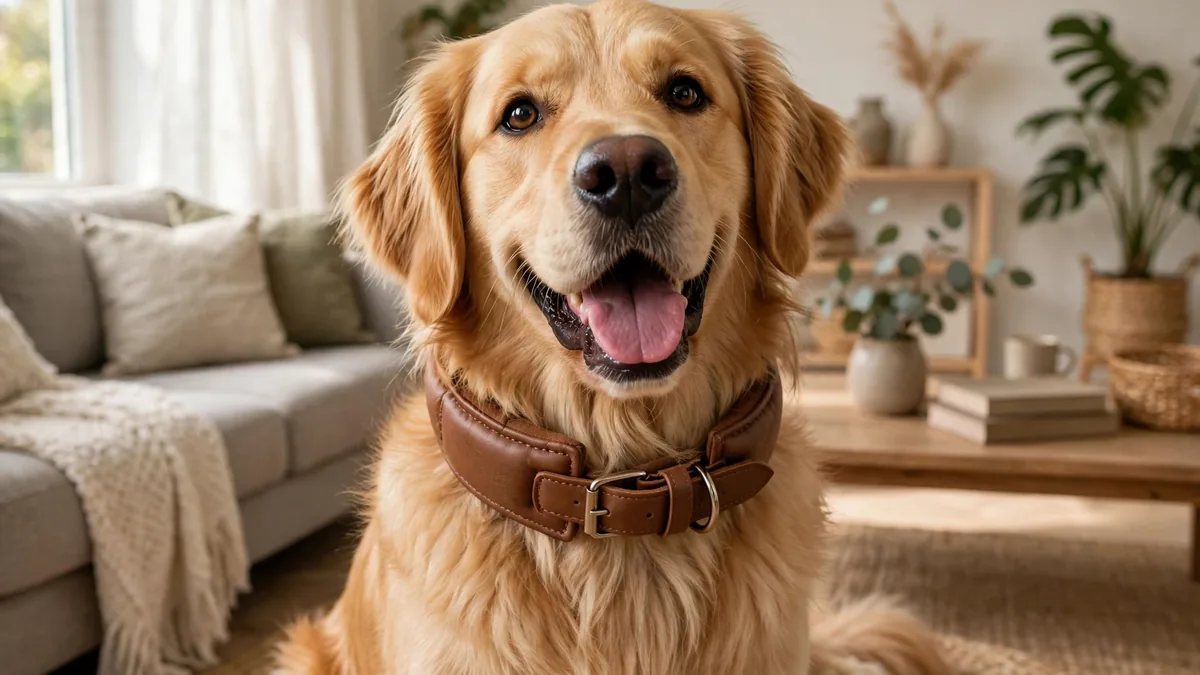
Top Dog Collars for Comfort and Control in 2026
The top dog collars for comfort and control in 2026 are the ones your dog forgets it is wearing. A collar is the one thing a dog wears every day, so it has to fit well, feel soft against the neck, and hold firm when it matters. A good collar keeps a dog safe on walks, carries its identity tag, and gives you control without hurting its throat.
Collars vary enormously. A collar that is too tight rubs the skin raw, one that is too loose slips over the head at the worst moment, and a stiff, narrow collar digs into the neck when a strong dog pulls. This guide compares the main types and explains how to fit one properly for dogs of every size.
Key Takeaways
- Fit every collar with the two-finger rule: two fingers should slide snugly between collar and neck.
- Choose a wide, padded collar for strong pullers and a light, flat collar for small or short-haired dogs.
- Pick a martingale collar for dogs with narrow heads, such as greyhounds and whippets.
- Use a reflective or light-up collar for evening and early-morning walks.
- Check the fit every month, because puppies grow fast and adult dogs gain and lose weight.
Why the Right Collar Matters So Much
A dog’s collar sits against its neck all day, and the neck is a sensitive place. The windpipe, the thyroid, and the nerves that run to the legs all sit close to the surface, so pressure in the wrong place can cause coughing, choking, and long-term damage. A wide, padded collar spreads that pressure across a larger area, which is why strong pullers do far better in a wide collar than in a thin one.
Control matters just as much as comfort. A collar that slips off at a busy road is a danger to the dog and everyone around it, while a collar that holds firm lets you guide a nervous dog past other dogs and traffic. A good collar also carries the dog’s identity tag, the fastest way home if a dog ever gets lost. If you already have a dog house in the garden, think of the collar as the dog’s everyday kit: the house is where it rests, the collar is what keeps it safe when it is out in the world.
The Main Types of Dog Collar
Flat Buckle Collars
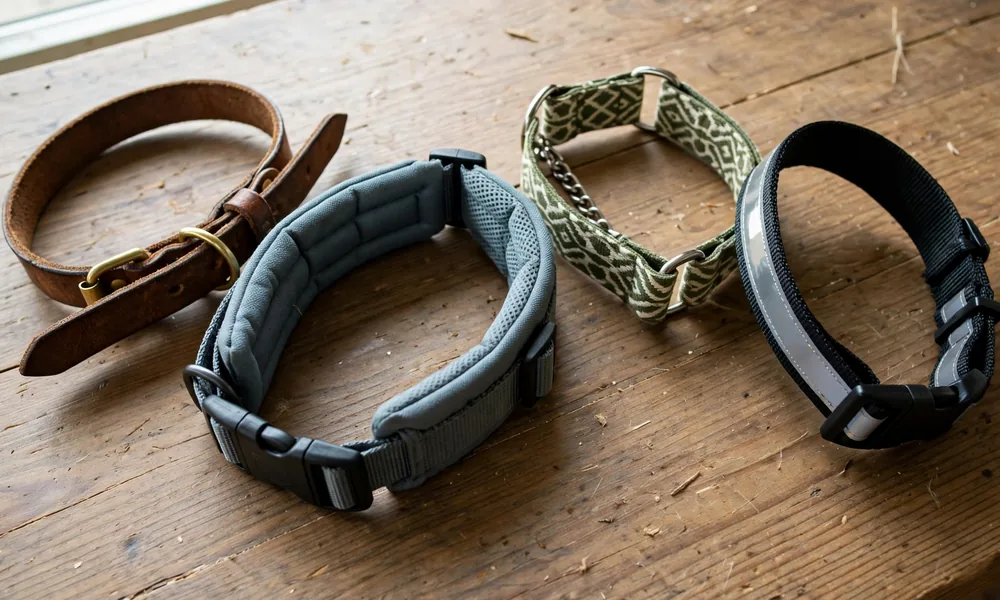
Flat buckle collars are the classic choice, and they suit most dogs. A flat band of leather or nylon fastens with a buckle or a quick-release clip, and the lead attaches to a metal D-ring. Good ones have rounded edges, strong stitching, and a buckle that will not slip under load.
The weakness is that a flat collar can slip over the head of a dog with a narrow skull, and a thin one can dig into the neck of a strong puller. Flat collars suit calm dogs that walk well on a lead, and they are the best everyday collar for dogs that wear one all day at home.
Padded Nylon Collars
Padded nylon collars have a soft neoprene or foam lining under a tough nylon outer, which makes them the most comfortable option for many dogs. They dry quickly after rain or a swim, and the wide versions spread pressure well across the neck.
The catch is that padding holds water and can smell if it is not washed regularly, and cheap padding flattens quickly and stops protecting the neck. Padded collars suit active dogs, strong pullers, and short-haired breeds whose skin is easily rubbed by a bare strap.
Leather Collars
Leather collars are the smartest and longest-lasting option. Good leather softens with wear until it moulds to the dog’s neck, and a well-made leather collar can last for years. Leather suits dogs that wear a collar every day, and it looks better with age rather than worse.
The trade-off is care and cost. Leather costs more than nylon, needs occasional cleaning and conditioning, and is a poor choice for dogs that swim every day, because wet leather stretches and can crack. Leather collars suit calm, medium and large dogs, and owners who want one collar that lasts.
Martingale Collars
Martingale collars have a loop that tightens gently when a dog pulls, then loosens again when the dog relaxes. They were designed for greyhounds and whippets, whose heads are narrower than their necks, and they stop a dog slipping out without choking it.
The compromise is that a martingale collar must be fitted carefully, with the loop adjusted so it tightens only a little, and it should never be left on an unsupervised dog, because the loop can catch on things. Martingale collars suit narrow-headed breeds, nervous dogs that back out of flat collars, and any dog that has slipped a collar before.
Reflective and Light-Up Collars
Reflective collars have a shiny strip that catches headlights, while light-up collars have a built-in LED that glows in the dark. Both make a dog visible to drivers and cyclists on evening and early-morning walks.
Dog Collars Compared
| Type | Comfort | Control | Durability | Best for |
|---|---|---|---|---|
| Flat buckle | Good | Good | Excellent | Everyday, calm dogs |
| Padded nylon | Excellent | Good | Good | Pullers, active dogs |
| Leather | Excellent | Good | Best | Daily wear, large dogs |
| Martingale | Good | Best | Good | Narrow heads, escapers |
| Reflective | Good | Good | Fair | Evening and winter walks |
Fitting a Collar Properly
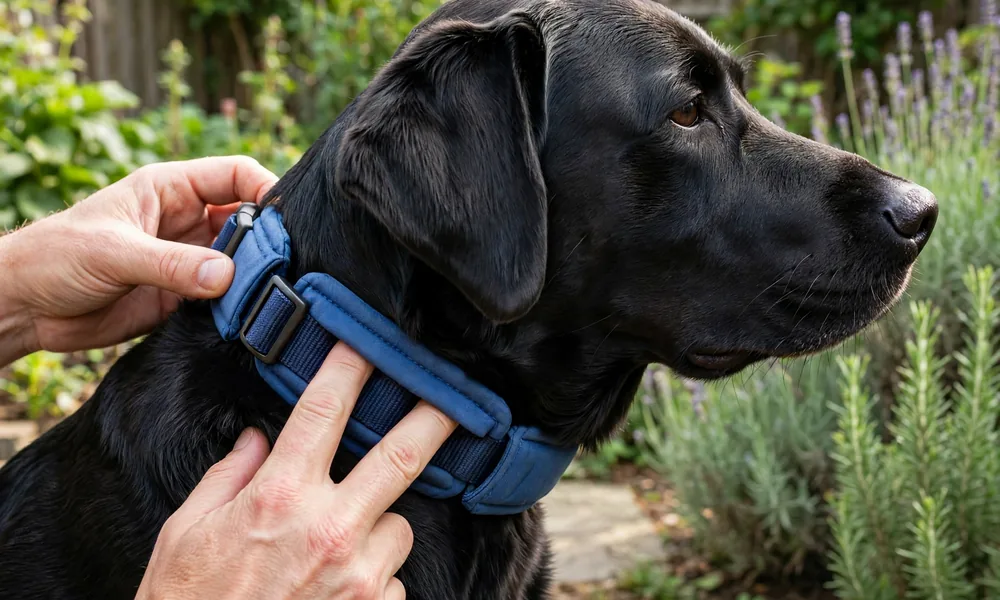
Fitting is where most collar purchases go wrong. Slide two fingers flat between the collar and the dog’s neck. If two fingers fit snugly, the collar is right. If you cannot get two fingers in, it is too tight; if you can fit three or four, it is too loose and the dog can slip out.
Measure the dog before you buy, with a soft tape around the middle of the neck, and add about two centimetres for comfort. Measure again if the dog is a puppy, because puppies grow fast and a collar that fits this month may be tight next month. Check the fit every month for adult dogs too, because weight changes with the seasons.
Place the collar high on the neck, just behind the ears, for the best control on walks, and slide it down a little when the dog is resting at home. The D-ring should sit on top of the neck, not underneath, so the lead pulls evenly. Always attach the identity tag to the D-ring, not to a separate ring that can snag, so the tag stays with the dog if the lead comes off.
Collars for Puppies, Pullers, and Small Dogs
Puppies need a light, soft collar they can grow into, with plenty of adjustment. Start with a flat nylon collar, let the puppy wear it for short periods at home, and increase the time as it gets used to it. Check the fit every week, because a puppy’s neck can grow visibly in a fortnight.
Strong pullers need a wide, padded collar that spreads pressure, and they need training as well as kit. No collar fixes pulling on its own. Use the collar to guide the dog, reward loose-lead walking, and consider a harness for training walks. A dog crate at home gives a strong, excitable dog a calm place to rest between walks.
Small dogs need a light collar that does not weigh down the neck. A wide, heavy leather collar suits a large dog but overwhelms a chihuahua or a dachshund, whose necks are delicate. Choose a narrow, soft, light collar for small breeds, and never attach a heavy lead to it. For travel days, a pet carrier is often kinder than a collar and lead for a very small dog.

Cleaning and Looking After a Collar
A collar picks up dirt, sweat, and smells faster than most owners expect, and a dirty collar can irritate the skin underneath. Wash a nylon collar in warm soapy water once a month, or more often if the dog swims or rolls in mud, and let it dry fully. Clean a leather collar with a damp cloth and a little leather conditioner, and never soak leather in water.
Check the collar as you clean it. Look for frayed stitching, a buckle that slips, a bent D-ring, and a clip that no longer clicks shut. Any of these means the collar is no longer safe and should be replaced before the next walk. Keep a spare collar in the house.
The Worst Collars to Avoid
The worst collars look smart in the shop and fail on the first real walk. Very cheap collars with thin stitching and plastic buckles are the classic trap: the buckle snaps under a sudden pull, and the dog is loose. Very narrow collars are worse, because they concentrate all the pulling force on a thin strip of the neck.
Avoid collars with sharp studs or decorations that can catch on things, collars that are stiff and unyielding when new, and any collar with a choke chain or prong design, which can injure a dog’s neck. Avoid second-hand collars with worn stitching or a bent D-ring, and avoid any collar you cannot adjust in small steps, because one that jumps from too tight to too loose is no use at all.
Checklist: Buying a Dog Collar
- Measure your dog’s neck with a soft tape and add about two centimetres for comfort.
- Use the two-finger rule: two fingers should slide snugly between collar and neck.
- Choose a wide, padded collar for pullers and a light, flat collar for small dogs.
- Pick a martingale collar for narrow-headed breeds that slip out of flat collars.
- Check the buckle, stitching, and D-ring for strength, and choose a reflective collar for dark walks.
- Check the fit every month, clean the collar regularly, and replace it at the first sign of wear.
Frequently Asked Questions
How tight should a dog collar be?
Two fingers should slide snugly between the collar and your dog’s neck. If you cannot fit two fingers, it is too tight; if you can fit three or four, it is too loose and your dog could slip out.
What is the best collar for a dog that pulls?
A wide, padded nylon collar is best for a strong puller, because it spreads pressure across the neck instead of digging in. Pair it with loose-lead training, and consider a harness for training walks.
Are martingale collars safe for dogs?
Yes, when fitted properly. It tightens gently when a dog pulls and loosens when it relaxes, and it stops narrow-headed dogs slipping out. Never leave one on an unsupervised dog, because the loop can catch.
Should my dog wear a collar all the time?
Most dogs can wear a flat collar during the day, but take it off at night and when the dog is alone in a crate, because a collar can catch on furniture or a crate door. Always put it back on for walks.
How often should I replace a dog collar?
Replace it at the first sign of frayed stitching, a slipping buckle, a bent D-ring, or a clip that no longer clicks shut. Puppies need a new collar every few months as they grow, while a good leather collar can last years.
Are reflective collars worth it?
Yes, if you walk your dog in the evening or early morning. A reflective or light-up collar makes your dog visible to drivers and cyclists. Check the strip and any lights regularly, because they wear out.
The Bottom Line
The top dog collars for comfort and control in 2026 fit well, feel soft, and hold firm when it matters. A padded nylon collar is the most comfortable choice for pullers, leather lasts longest for daily wear, a martingale collar is the best control for narrow-headed dogs, and a reflective collar is safest after dark. Measure the neck, use the two-finger rule, check the fit every month, and replace the collar at the first sign of wear.


