The worst motorcycle gloves for grip do not fail in an obvious way. They feel fine when you first pull them on in the shop, the leather looks convincing, and the price seems like a bargain. The problem only shows up at speed, in the rain, or on a long ride, when your hands start to slip on the bars and every small adjustment takes more effort than it should.
Bad grip gloves usually share the same flaws. The palms are too smooth, too thick, or made from a material that turns slippery when it gets wet or sweaty. The fingers bunch up inside, the seams sit in the wrong places, and the cuff pulls tight in a way that cuts off circulation on a longer ride. None of these problems is dramatic on its own, which is why so many riders keep wearing gloves that are quietly working against them.
This guide looks at the worst motorcycle gloves for grip in detail, so you can recognise them before you buy, spot the warning signs in gloves you already own, and understand what actually makes a glove hold the bars properly. If your hands have ever ached, cramped, or slipped at the wrong moment, the answer may be sitting on your hands right now.
Key takeaways
- Smooth, shiny palms and thick, stiff leather are the most common causes of poor grip on motorcycle gloves.
- Gloves that fit loosely bunch up inside and slide against the bars, while gloves that are too tight cut off circulation and cause cramping.
- Wet weather exposes bad gloves fast, because cheap materials lose friction the moment they get damp.
- Fashion gloves, work gloves, and oversized winter gloves are among the worst choices for real riding.
- The right glove balances thin, grippy palms with protection, so you can feel the controls without your hands slipping.
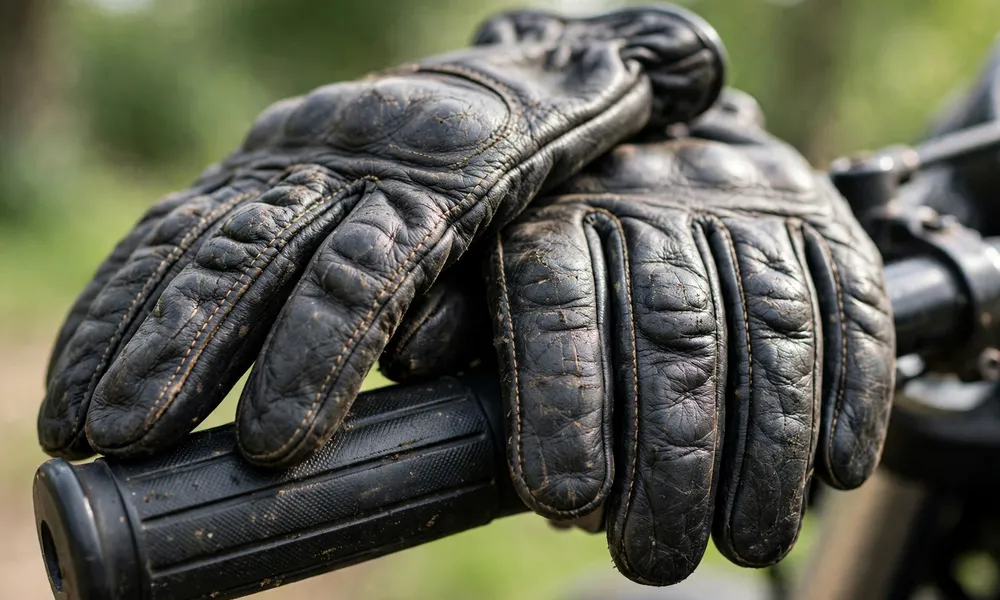
Why Grip Fails First
Grip is the first thing to go wrong with a bad glove because it depends on so many small details working together. The palm material, the thickness of the leather, the placement of the seams, and the fit around the fingers all affect how well your hand holds the bar. A glove can look protective and still be terrible at its most basic job, which is keeping your hand firmly connected to the controls.
The Palm Is the Contact Point
Almost all of your grip comes from the palm and the inside of your fingers, so that is where a glove succeeds or fails. A good palm is thin enough to let you feel the bar, textured enough to hold it, and made from a material that keeps its friction when it gets warm or damp. The worst motorcycle gloves for grip get this wrong. Their palms are polished smooth, padded with thick foam that dulls your sense of touch, or covered in decorative stitching that sits between your hand and the bar.
Stiffness Versus Feel
New leather gloves are always a little stiff, and that is normal. The problem is when stiffness never goes away, or when it is so severe that you cannot operate the levers smoothly. A glove that fights your fingers on every gear change and every brake application is stealing your attention from the road, and that split attention is exactly what you do not need in a busy junction or a sudden stop.
The Worst Types of Motorcycle Gloves for Grip
Not all bad gloves fail in the same way. Some are dangerous because they are too smooth, others because they are too bulky, and others because they were never designed for riding in the first place. The types below show up again and again in rider complaints, and they are worth knowing by name so you can avoid them in a shop or in an online listing. Many of these problems overlap with the broader pattern of worst motorcycle gear failures, where a single weak item undermines the rest of your kit.
Cheap Fashion Gloves
Fashion gloves are made to look good in a photograph, not to hold a handlebar at seventy miles an hour. They often have smooth, untextured palms, decorative buckles and studs, and leather chosen for its colour rather than its grip. The fingers are usually cut long and loose, so the material bunches up when you close your hand, and the seams sit right where your fingers press against the bar.
Oversized Winter Gloves
Winter gloves face a genuine trade-off between warmth and feel, and the worst ones resolve it entirely in favour of warmth. They are stuffed with thick insulation, lined with bulky fleece, and cut so generously that your hand swims inside them. The result is a glove that keeps your fingers warm and makes them almost useless for precise control.
Thin Summer Mesh Gloves
Summer mesh gloves are popular for good reason, but the worst ones are little more than a net with a palm panel that was clearly an afterthought. The mesh stretches and moves against your hand, the palm is a thin sheet of slippery synthetic, and the glove slides around every time you twist the throttle. In hot, sweaty conditions, that sliding gets worse, not better.
Work Gloves and Fingerless Gloves
Work gloves are designed for lifting and handling tools, not for riding a motorcycle. They are often too loose, too thick, or made from materials that grip a wooden handle well and a rubber motorcycle grip badly. Some have hard knuckle guards that dig into your fingers when you close your hand, and others have cuffs that catch on the levers. They are a false economy that costs more in control than it saves in money.
Fingerless gloves have a similar problem in reverse. They offer good grip in dry weather, but they give up protection exactly where you need it most. In wet weather, bare fingertips on a wet grip are slippery, and in cold weather, numb fingertips cannot judge grip at all. For a short, slow ride on a warm day they are a personal choice. For anything longer, faster, or wetter, they are among the worst motorcycle gloves for grip.
How Bad Gloves Compare
| Glove type | Main grip problem | Worst condition | What to check instead |
|---|---|---|---|
| Cheap fashion gloves | Smooth, shiny palms with no texture | Wet roads and long rides | Textured leather or suede palm |
| Oversized winter gloves | Thick insulation kills feel and control | Cold, technical riding | Thin insulation with a snug fit |
| Thin mesh gloves | Palm slides against sweaty hands | Hot, humid weather | Anchored fit and grippy palm panel |
| Work gloves | Loose fit and wrong palm material | Emergency braking | Riding-specific palm and seams |
| Fingerless gloves | Bare fingertips slip when wet or cold | Rain and cold mornings | Full-finger coverage |
Signs Your Gloves Are Killing Your Grip
Many riders wear bad gloves for years without realising it, because the symptoms are easy to blame on something else. Tired hands, aching wrists, and a vague feeling that the bike is hard to control are all classic signs of a glove problem. Run the six checks below with the gloves on, gripping a handlebar or a similar round object, and pay attention to what your hands are doing.
The Six-Point Grip Checklist
- The twist test: Grip a bar and twist your wrist as if opening the throttle. If the glove slides before your hand moves, the palm is too smooth or the fit is too loose.
- The finger test: Try to operate a small switch or pick up a coin. If you cannot feel what you are touching, the palms are too thick for precise control.
- The bunch test: Close your hand tightly and look at the inside of your fingers. If the material folds and bunches, those folds will press into your hand on a long ride.
- The wet test: Dampen the palm lightly and grip the bar again. If the grip gets noticeably worse, the material will fail you in real rain.
- The cramp test: Hold a firm grip for sixty seconds. If your hands cramp or your fingers tingle, the glove is forcing you to squeeze too hard.
- The lever test: Mime pulling a brake lever and a clutch lever. If the glove catches or binds, it will slow your reactions.
What to Look For Instead
Once you know what makes a glove bad, the good ones become easier to spot. They have thin, textured palms made from leather or a proven synthetic, seams placed away from the main contact areas, and a fit that is snug without being tight. They let you feel the controls, they stay in place when you twist the throttle, and they keep working when the weather turns. The same rule applies to the rest of your kit, and the worst motorcycle jackets for safety show how the wrong gear can fail when it matters most.
Palm material is the second factor to check. Leather remains the standard, because it grips well, breaks in nicely, and lasts for years. Goatskin is popular because it is thin, soft, and grippy, while kangaroo leather is thinner still and very durable. Modern synthetics can work well too, provided they are designed for motorcycle use and have a textured surface. Avoid any palm that feels smooth, shiny, or plasticky, because that is the material that will slide when it matters most. The same thinking applies from head to toe, and the worst motorcycle boots for safety are a reminder that footwear matters just as much as hand protection.
Frequently Asked Questions
How can I tell if my motorcycle gloves are too slippery?
Run the twist test. Grip a handlebar, twist as if opening the throttle, and watch whether the glove moves before your hand does. Dampen the palm and repeat the test, because many gloves grip well when dry and fail when wet.
Do expensive motorcycle gloves always grip better?
No, price is a poor guide to grip. Some expensive fashion gloves have smooth, slippery palms, while some mid-priced riding gloves grip very well. What matters is the palm material, the texture, the fit, and the seam placement.
Can I improve the grip of gloves I already own?
You can improve it slightly by cleaning the palms properly and keeping them free of oil and polish, but you cannot fix a fundamentally bad palm material or the wrong size. If your gloves fail the checklist above, replacement is the honest answer.
Are leather gloves better than synthetic gloves for grip?
Leather is usually better, because it offers a natural combination of grip, feel, and durability, and it breaks in to fit your hand over time. Modern synthetics can be excellent too, but only when designed specifically for motorcycle use.
How tight should motorcycle gloves fit?
They should be snug without being tight. Your fingertips should reach the end of the glove, your palm should be in full contact with the material, and you should be able to close your hand without folds forming inside.
When should I replace my motorcycle gloves?
Replace them when they fail the grip checklist, when the palms have gone smooth and shiny, when the stitching is coming apart, or when they no longer fit properly. Gloves used regularly last roughly one to two seasons.
The Bottom Line
The worst motorcycle gloves for grip are the ones that look fine and feel acceptable until the moment you actually need them. Smooth palms, stiff leather, loose fits, and wrong materials all steal control in small, quiet ways, and the cost is paid in tired hands, slow reactions, and riding that is harder than it needs to be. Test your gloves properly, replace the ones that fail, and choose the next pair for its palm, its fit, and its feel, not its looks or its price.