
The worst pickup trucks for winter driving in 2026 are the ones that look tough in a showroom and then struggle the moment the road turns white. The trucks below fall short where it matters: base models sold with two-wheel drive, no low-range gearing for deep snow, cabins that take an age to heat, and light rear ends that skate on ice when the bed is empty.
We compared the weakest pickups on drivetrain, ground clearance, cold-weather behaviour, cabin heating time from cold, traction control on packed snow and ice, and how much winter kit costs extra. The contrast with summer is sharp: our best pickup trucks for summer driving rank the same class on cooling, towing boats and fuel economy in the heat, and the winners there are chosen for very different reasons.
Key Takeaways
- The Ford Maverick in its base two-wheel-drive form is the worst pickup truck for winter driving overall in 2026, with front-wheel drive only, no low-range gearing and a light rear end that struggles for grip on ice.
- Two-wheel drive is the single biggest winter weakness in a pickup: an empty bed over light rear wheels makes even a modern truck nervous on snow, and four-wheel drive costs extra on most of the trucks on this list.
- The Jeep Gladiator is the worst pickup for cabin warmth, with a draughty removable roof, slow heating and a cabin that never feels properly sealed against a freezing wind.
- Car-based pickups such as the Hyundai Santa Cruz and Honda Ridgeline have no low-range gearing, so deep snow and steep icy tracks are beyond them even with all-wheel drive.
- Winter tyres matter more than the badge: every truck on this list needs proper winter tyres, and a load in the bed, before it earns even a passable winter rating.
The Worst Pickup Trucks for Winter Driving of 2026 at a Glance
Six pickups, six different ways to struggle in the snow.
| Pickup | Worst For | Drive | Winter Weakness | Key Problem |
|---|---|---|---|---|
| Ford Maverick 2WD | Worst overall | Front-wheel drive | No low range, light rear | Base model has no 4WD at all |
| Hyundai Santa Cruz | Worst for deep snow | All-wheel drive | Car-based, no low range | Low clearance, small bed |
| Jeep Gladiator | Worst for cabin warmth | Part-time 4WD | Draughty cabin, slow heat | Removable roof seals poorly |
| Honda Ridgeline | Worst for winter towing | All-wheel drive | No low range, low clearance | Unibody, modest towing |
| Nissan Frontier 2WD | Worst base truck | Rear-wheel drive | 4WD costs extra, slow defrost | Older cabin, thin winter kit |
| Chevrolet Colorado 2WD | Worst winter value | Rear-wheel drive | Light rear, winter kit extra | Heated seats cost extra |
How We Ranked the Worst Pickup Trucks for Winter Driving
Winter driving has its own test, and it starts before the truck moves. We gave the most weight to drivetrain and grip: whether four-wheel drive is standard or an expensive option, whether there is a low-range transfer case for deep snow, and how the traction control behaves when the wheels start to slip on packed snow and ice. We also weighed cold-weather behaviour, cabin heating, and ground clearance.
1. Ford Maverick 2WD — Worst Pickup Truck for Winter Driving Overall
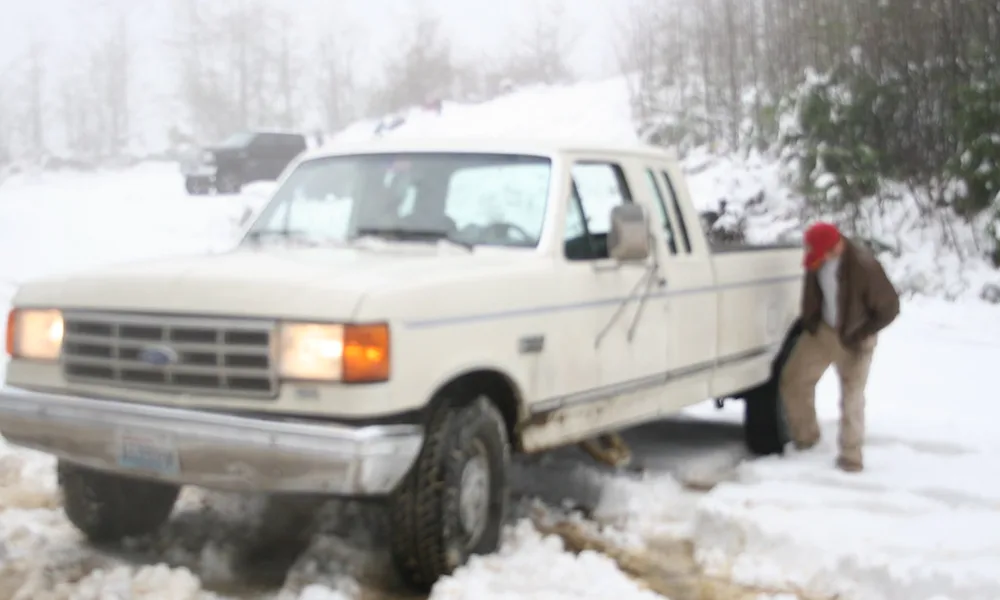
The Ford Maverick in its base two-wheel-drive form is the worst pickup truck for winter driving in 2026 because it has the one thing a winter pickup must never have: front-wheel drive only, with no four-wheel-drive system at all. In a dry summer it makes a lot of sense, but on a snowy morning it is a front-wheel-drive car with an open bed.
The problem is physics as much as engineering. A pickup carries most of its weight over the front axle, and when the bed is empty there is almost nothing pressing the rear wheels down. The Maverick spins its front wheels on a snowy slope, and without a low-range gear it has no way to crawl through deep snow at a steady pace. Four-wheel drive is available on higher trims, but the base model is the one most buyers will find.
2. Hyundai Santa Cruz — Worst Pickup Truck for Winter Driving in Deep Snow
The Hyundai Santa Cruz is the winter pickup for drivers who never leave a ploughed road, because that is where its ability ends. It is a car underneath, built on the same platform as a family SUV, and it drives like one: comfortable, quiet and easy to park. But a car platform brings car limitations.
There is no low-range gearing, so when the snow is deeper than the bumper the Santa Cruz has no crawl mode and no way to keep the wheels turning slowly without spinning. The all-wheel-drive system is reactive rather than proactive, waiting for slip before it sends power rearwards, and on ice that delay is enough to lose momentum on a slope. Ground clearance is modest, and the short bed holds little ballast.
3. Jeep Gladiator — Worst Pickup Truck for Winter Driving for Cabin Warmth
The Jeep Gladiator is the winter pickup for drivers who enjoy being cold, because the cabin never quite warms up. The removable roof and doors that make the Gladiator so much fun in summer are a liability in winter: the seals are never as tight as a fixed roof, cold air leaks in around the panels,
On a freezing morning the windscreen takes an age to clear, the heated seats are slow to warm, and road noise through the soft top makes a long winter drive tiring. The four-wheel-drive system itself is capable, with a proper low-range transfer case, and the ground clearance is good, which makes the cabin problem all the more frustrating: the truck can get you there, but you will arrive cold and tired.
4. Honda Ridgeline — Worst Pickup Truck for Winter Driving When Towing
The Honda Ridgeline is the winter pickup for drivers who never tow, because towing in winter is where it falls behind every rival here. The Ridgeline is a unibody truck, built like a car rather than on a separate chassis, and that gives it a smooth ride and a clever lockable boot under the bed. But it also means modest towing capacity, no low-range gearing and under 200 millimetres of ground clearance.
On a snowy road the all-wheel-drive system works well, sending power to the rear before slip becomes a problem, and the cabin heats quickly. The trouble starts when you hitch a trailer: the Ridgeline tows less than its rivals, the lack of low range makes pulling a loaded trailer up an icy slope a slow, wheel-spinning affair

5. Nissan Frontier 2WD — Worst Base Pickup Truck for Winter Driving
The Nissan Frontier in its base two-wheel-drive form is the worst base pickup truck for winter driving in 2026 because the winter-ready version costs so much more than the truck in the advert. The base model is rear-wheel drive: the drive wheels sit under an empty bed, the rear is light, and the first icy slope will have the wheels spinning while the truck goes nowhere.
Four-wheel drive is available, but it is an expensive option, and even then the Frontier shows its age. The cabin is an older design, the heater is slow from cold, the windscreen takes longer to clear than rivals, and the heated seats and steering wheel are reserved for higher trims.
6. Chevrolet Colorado 2WD — Worst Pickup Truck for Winter Driving Value
The Chevrolet Colorado in its base two-wheel-drive form is the worst pickup truck for winter driving value in 2026 because everything that makes a pickup winter-ready costs extra. The base truck is rear-wheel drive with a light rear end, no heated seats and no heated steering wheel, and the winter tyres it desperately needs are not included in the price.
Add four-wheel drive, the winter package, heated seats and a set of winter tyres, and the price climbs by thousands, at which point a rival that includes the same kit as standard is better value. The Colorado is a good truck in its higher trims, but the base model is a summer truck wearing a winter price tag.
Winter Tyres, Weight and the Tricks That Actually Work
The most important winter lesson is that the truck matters less than the tyres. A two-wheel-drive pickup on proper winter tyres will out-grip a four-wheel-drive pickup on summer tyres on snow and ice, and the difference is not small: winter tyres can cut braking distances on snow by a third
The second lesson is weight. A pickup with an empty bed is light over the rear axle, which is exactly where the drive wheels are in two-wheel drive, and even in four-wheel drive the rear can feel nervous on ice. Carry 150 to 200 kilograms of sandbags, gravel or firewood directly over the rear axle, secured so it cannot slide, and the truck will grip far better. The best SUVs for winter driving face the same tyre and weight questions in a different body style, and the worst pickup trucks for summer driving show that several of these trucks struggle in the heat as well as in the cold.
Winter Pickup Buying Checklist
- Choose four-wheel drive with low range for deep snow and icy hills, and walk away from a base two-wheel-drive truck if your winter is serious.
- Budget for winter tyres immediately: a full set of four matters more than any option on the truck.
- Check the heater from cold and time how long the windscreen takes to clear.
- Test the heated seats and steering wheel: they should warm up in under two minutes
- Measure ground clearance with the truck loaded, when clearance drops.
- Carry weight over the rear axle: 150 to 200 kilograms of secured sandbags transform winter grip
Frequently Asked Questions
Are pickup trucks good in snow?
Yes, with four-wheel drive and winter tyres. A pickup has high ground clearance and a bed you can load for traction. The weakness is an empty bed, which makes the rear light, so avoid base two-wheel-drive models.
Do I need winter tyres on a four-wheel-drive pickup?
Yes. Four-wheel drive helps you move off, but it does not help you stop or steer. Winter tyres cut braking distances by about a third.
How much weight should I put in the bed in winter?
About 150 to 200 kilograms, placed directly over the rear axle and secured so it cannot slide. Sandbags are ideal because they are heavy, cheap and useful if you get stuck.
Which pickup is worst for towing in winter?
The Honda Ridgeline, because its unibody construction, modest towing capacity and lack of low-range gearing make pulling a loaded trailer up an icy slope harder than in any body-on-frame rival.
Can a car-based pickup handle a hard winter?
Only on ploughed roads. The Hyundai Santa Cruz and Honda Ridgeline have no low-range gearing, so deep snow and steep icy tracks are beyond them even with all-wheel drive.
What should I check before buying a winter pickup?
Check that four-wheel drive is standard, test the heater from cold, inspect the underside for rust, and confirm the service history covers the transfer case and differentials.
The Bottom Line
The worst pickup truck for winter driving in 2026 is the base two-wheel-drive Ford Maverick, because it has no four-wheel drive at all, no low-range gearing, a light rear end and a slow heater, which is every winter weakness in one cheap package. If your winter involves real snow, buy a four-wheel-drive truck with low range, fit winter tyres, and carry weight in the bed


