The worst shower curtains for mould are the ones that stay damp long after the shower ends. A curtain that traps water in its folds, holds it in a thick hem, or pools at the bottom creates exactly the warm, humid conditions mould needs. It may look fine when new, but within weeks the lower edge turns pink, then grey, then black.
Mould on a shower curtain is not only ugly. It smells musty, spreads to grout and sealant, and means the curtain holds moisture against the wall every day. Many blame the ventilation, when the real problem is the curtain itself: a poor material, a bad fit, or a design that never dries.
This guide looks at the curtains most likely to grow mould, why each one fails, and what to choose instead, so you can pick one that dries quickly and lasts far longer than the cheapest option.
Key takeaways
- Thin, unlined vinyl and cheap plastic curtains trap water in their folds and grow mould fastest at the hem.
- Plain cotton and linen curtains absorb water and dry slowly, making them a poor choice without a proper waterproof liner.
- Dark, heavy, textured, and overlong curtains stay damp longest and hide mould until it is well established.
- A smooth, quick-drying curtain with a separate washable liner, good airflow, and the right length resists mould far better.
- Daily habits matter as much as material: spread the curtain after showering, ventilate the room, and wash or replace it before mould takes hold.
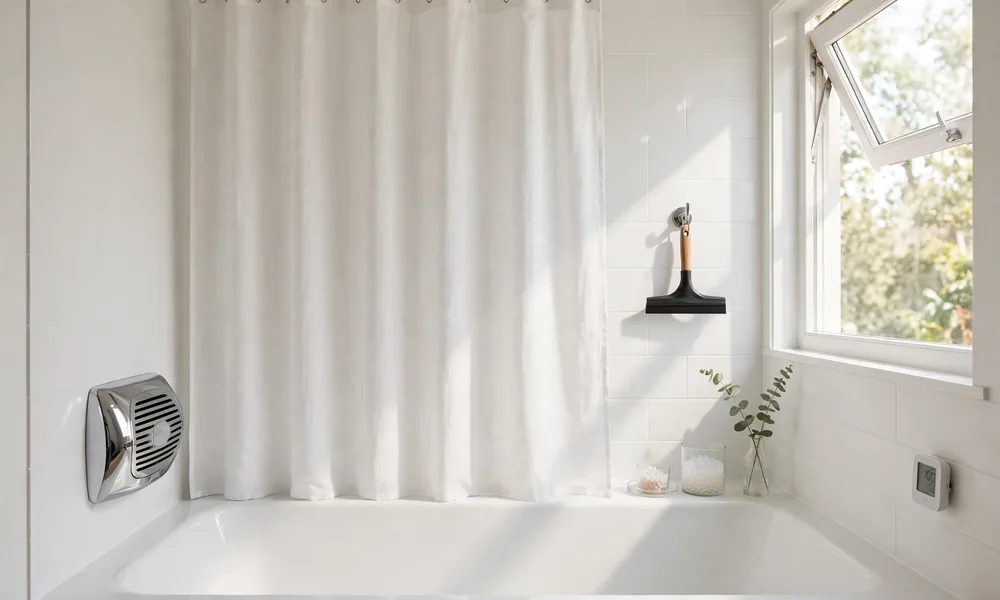
Why shower curtains grow mould so easily
A bathroom is one of the dampest rooms in a home. Every hot shower fills the air with steam and raises the humidity for an hour or more. A shower curtain sits in the middle of that moisture, splashed directly and often hanging in folds where air cannot reach. If it holds water instead of shedding it, mould has both food and shelter.
Mould needs moisture, warmth, a surface, and time, and a shower curtain supplies all four: the bathroom stays warm, the curtain stays wet, and soap residue provides nutrients. That is why the bottom third, where water collects, is usually the first place mould appears.
Ventilation helps, but it cannot rescue a bad curtain. A thick fabric hem can stay wet for a full day after the room feels dry, and a curtain pressed against the wall or bunched at one end will dry slowly no matter how good the fan is.
The signs that a curtain is failing
The earliest sign is usually a faint pink or orange film along the bottom edge. Grey or black spots follow, especially in the folds and around the hem. A musty smell that remains after cleaning is another warning, as is a curtain that feels slimy or stiff. Once black spots appear, they are hard to remove, and bleaching often weakens the material and makes mould return faster.
The worst shower curtains for mould
Not all shower curtains fail in the same way. Some absorb water; others fail because of shape, weight, or fit. The worst combine several problems: a slow-drying material, a design that traps water, and a fit that keeps the curtain damp all day.
Thin, cheap vinyl and PEVA curtains
Thin vinyl and PEVA curtains are the most common mould problem, mainly because they are cheap and widely sold. The material is waterproof, but the thin sheet clings to itself when wet, trapping water between the layers where air cannot dry it. Cheap vinyl also creases easily, collecting soap scum, and over time its surface becomes cloudy and rough, giving mould more places to grip.
Plain cotton and linen curtains with no liner
Cotton and linen curtains look soft and natural, but used alone they are among the worst shower curtains for mould. Natural fibres absorb water, and cotton can stay damp for many hours. Mould often starts in the folds at the bottom, hidden from view. Cotton can work, but only with a separate waterproof liner.
Heavy, dark, and textured curtains
Heavy curtains dry slowly because there is more material to dry. A thick fabric or heavy hem holds water far longer than a light, smooth one. Dark colours hide early mould, so it is often advanced before anyone notices. Textured curtains are another trap: waffle weave and pleats hold water and soap in every ridge, where a cloth cannot reach.
Curtains that are too long and pool at the bottom
A shower curtain should hang just above the bath or shower tray, long enough to keep water inside but not so long that it pools. One that is too long folds over at the bottom, creating a damp pocket where water collects and air cannot reach — often the first place mould appears. Measure from the rail to the top of the bath before buying.
Curtains with fabric pockets, trims, and decorative hems
Decorative details are a common cause of mould. A fabric pocket at the bottom, designed to hold a weight, traps water and never dries. A ruffled trim or layered hem does the same on a smaller scale. Mould often starts inside the pocket or behind the trim, out of sight. A plain, smooth hem dries quickly, can be wiped in seconds, and gives water nowhere to hide.
Single-layer curtains used without a liner in a busy bathroom
A single-layer curtain can work in a lightly used bathroom, but in a busy household it is often the worst choice. With several showers a day, each one rewets it before the last has dried, so it stays damp almost continuously. A separate liner takes the direct spray and dries quickly, while the outer curtain stays mostly dry.
What actually helps: materials compared
Choosing a better curtain is mostly about choosing a material that sheds water and dries quickly. Smooth, light, water-resistant fabrics perform far better than absorbent fibres or thin, clingy vinyl.
| Material | Dries quickly | Mould risk | Best use |
|---|---|---|---|
| Thin cheap vinyl or PEVA | No, folds cling together | High | Short-term use only |
| Plain cotton or linen, no liner | No, absorbs water | High | Not recommended alone |
| Polyester with water-resistant coating | Yes, smooth surface | Low to medium | Good everyday choice |
| Polyester with separate liner | Yes, liner dries fast | Low | Best for busy bathrooms |
| Heavy textured fabric | No, holds water in texture | High | Avoid in damp bathrooms |
| Good-quality EVA, thicker gauge | Yes, if hung to dry | Medium | Budget option with care |
Polyester is the most reliable everyday choice. It is light, sheds water, dries quickly, and can be machine washed, and with a separate liner it is even better, because the liner can be washed or replaced cheaply. Look for a smooth surface, a plain hem, and a light weight.
How to spot mould early
Early mould is easy to miss, especially on a patterned or dark curtain. Check the bottom edge and folds once a week, in good light, pulling the folds apart to see inside. Look for pink, orange, grey, or black spots. A musty smell that remains after the bathroom has aired also suggests mould, even if you cannot see it.
A cleaning routine that keeps mould away
A good curtain still needs regular care. Spread it fully after every shower, so air can reach both sides. Leave the extractor fan running for twenty minutes, or open a window. Wash it regularly: polyester can usually be machine washed on a gentle cycle, then hung straight away to dry.
Weekly checklist
- Spread the curtain and liner fully after every shower so both sides can dry.
- Run the extractor fan or open a window for at least twenty minutes after showering.
- Wipe the bottom edge and hem with a clean cloth once a week to remove soap residue.
- Check inside the folds for pink, grey, or black spots before they spread.
- Machine wash the curtain and liner regularly, and hang them straight away to dry.
- Replace the liner at the first sign of mould that will not wash out.
If mould appears, act quickly. A small patch can often be removed by washing and drying thoroughly. A large patch, or mould that returns within days, means the material is holding moisture and the curtain should be replaced. The same thinking applies to larger projects, where bathroom renovations that waste money often repeat the same mistake: spending on looks while ignoring ventilation and drying.
When to replace a shower curtain
Even a good curtain will not last forever. Replace it when mould returns quickly after washing, when the material feels permanently stiff or slimy, or when the hem is discoloured through the fabric. Replace the liner first if the outer curtain is still in good condition. Do not try to save a badly mouldy curtain with strong chemicals: harsh bleach can damage the material and leave it rougher and more prone to mould.
Common mistakes that make mould worse
The most common mistake is bunching the curtain at one end of the rail after showering. That keeps the folds wet and airless for hours, and it is the fastest way to grow mould on an otherwise good curtain. Another mistake is choosing for looks alone, without checking material or length. A beautiful curtain that absorbs water or pools at the bottom will look worse within months than a plain one that dries properly. The same is true of curtain choices that cause regret in rooms, where pattern is chosen first and practical problems are discovered later. Finally, many people ignore the liner: one that is never washed will grow mould even if the outer curtain is perfect.
Frequently asked questions
How often should a shower curtain be washed?
Most shower curtains benefit from a wash every two to four weeks, and a busy family bathroom may need one every two weeks. Wash sooner if you see spots, smell mustiness, or notice soap residue along the hem.
Can mould on a shower curtain be removed completely?
Small, recent patches can often be removed by washing, but established black mould is harder to shift. If spots remain after washing, or return within days, the mould has grown into the material, and replacing the curtain is the cleaner option.
Is a fabric or plastic shower curtain better for mould?
A smooth, water-resistant fabric such as polyester usually performs better than thin plastic, because it dries quickly and can be machine washed. Plain cotton is worse unless used with a separate liner. The best setup is a polyester outer curtain with a washable liner.
Does a shower liner stop mould?
A liner helps a great deal, but it does not stop mould on its own. It takes the direct spray and protects the outer curtain, yet it still needs to be spread out to dry, washed regularly, and replaced when stained or stiff.
Why does mould always start at the bottom of the curtain?
The bottom edge gets the most water, collects soap and dirt as water runs down, and often sits in folds against the bath. It also dries last, being lowest and least exposed to air.
Are expensive shower curtains less likely to grow mould?
Price alone is not a reliable guide. An expensive heavy fabric curtain can grow mould faster than a modest polyester one if it dries slowly. What matters is material, weight, surface, and fit. The same is true of cleaning products that waste money — spending more does not help if the product is wrong for the job.
The bottom line
The worst shower curtains for mould are thin, clingy vinyl, plain cotton with no liner, heavy dark textured designs, overlong curtains that pool, and any curtain with pockets or decorative hems that trap water. They stay damp, hide early mould, and are hard to clean. Choose a light, smooth, quick-drying curtain in the right length, use a separate washable liner in a busy bathroom, spread it out after every shower, ventilate the room, and wash it regularly.