
A whiteboard for a home office has one job: to hold the week in plain sight, erase cleanly at the end of the day, and still look white a year later. The worst whiteboards for home office use in 2026 fail at it in ways that leave a spare room with a grey, ghosted rectangle nobody looks at. They stain within months, arrive too small to hold a real plan, or fall off the wall the first time they are leaned on. People buy them hoping for a planning wall that organises the working day. What they get is a board that ghosts, a board that wobbles, or a board that quietly becomes decoration. A board that is bought for a home office should be judged after a year of daily use, not on the day it is hung, because the day it is hung is the day every board still looks white.

Surfaces That Ghost Within Months
The surface decides everything about a whiteboard, and the worst boards use a coating that gives up within months. Cheap painted steel writes well for the first few weeks, then the ink starts to sink into the thin lacquer and every erased line leaves a faint grey shadow behind. After a few months of daily use the board looks permanently dirty, however hard it is cleaned, and the weekly plan has to compete with the ghost of last month’s plan. A board that cannot be erased cleanly is a board that stops being useful, because nobody trusts a surface they cannot read. A surface that stains is a surface that was never meant for daily use, and a board that is used every day needs a surface that was made for it.
The fix is to buy the surface first and the size second. Porcelain enamel and tempered glass erase completely for years, while painted steel and melamine start to stain within months of daily use. Test a board in the shop if you can: write on it, leave it for ten minutes, erase it, and look at it in a raking light. If a shadow remains, walk away. A board that ghosts on day one will be unreadable by spring, and no cleaner will save it. Our guide to the best whiteboards for home offices in 2026 explains which surfaces stay white and which ones give up. A board that erases cleanly after a hundred uses is a board that will still be white in a year, while a board that ghosts after a month will be grey by spring.
Boards Too Small for Real Work
Size is where most home-office whiteboard purchases go wrong, and almost always in the same direction: too small. A board that looks generous in a product photograph looks tiny on a real wall, and a board that is too small gets used less, because there is never enough room for what actually needs writing. A weekly plan, a running to-do list and a problem to think through will not fit on a board the size of a noticeboard, so the board ends up holding one list and the rest of the work stays on scraps of paper. A board that cannot hold the week is a board that does not organise anything.
Measure the wall before ordering, and leave at least fifteen centimetres of clear wall around the board on every side. For most home offices a board around ninety by sixty centimetres is the practical sweet spot: large enough for a weekly plan with room to spare, small enough to fit above a desk without dominating a spare room. Anything smaller than sixty by forty-five centimetres is really a notice board, not a planning surface, and buying it for planning work is buying the wrong tool. A board that fits the wall and the week is a board that gets used every day.
Mounting That Fails on the Wall
A whiteboard is only as good as its mounting, and the worst boards fail here before the first marker is uncapped. The fixings in the box are often plastic plugs meant for solid walls, which pull straight out of plasterboard, or brackets that flex under the board’s weight until the whole thing hangs crooked. A porcelain board at a hundred and twenty by ninety centimetres can weigh eight to ten kilos, and a glass board of the same size twelve to fifteen, which is far more than a pair of cheap plugs can hold. A board that falls off the wall damages the plaster, the board and anything underneath it. A board that falls off the wall in the night is a board that was mounted on hope, and hope is not a fixing.
Check the wall type and the fixings before you drill anything. On a solid wall ordinary plugs are fine, but on plasterboard you need proper cavity fixings, the expanding metal kind, and you should find a stud if you can. If you rent, a peel-and-stick film or a leaning board avoids holes entirely, though neither feels as solid as a mounted board. A board that is mounted properly stays put for years, and a board that is mounted on hope ends up on the floor. Weigh the board, buy the right fixings, and test the mount before you trust it with a glass panel. A glass board needs proper fixings more than any other, because a glass board that falls is a board that shatters.
Markers That Stain Permanently
A whiteboard is only as good as its markers, and the worst boards are sold with markers that ruin the surface they came with. Cheap unbranded markers lay down ink that sinks into the coating and refuses to come out, and the free markers in the box are often the worst of all. Permanent markers end up on a whiteboard more often than anyone admits, usually when a child or a visitor grabs the wrong pen, and on a cheap surface a single permanent mark is there for good. A board ruined by its own markers is a board that was sold with the wrong tools.

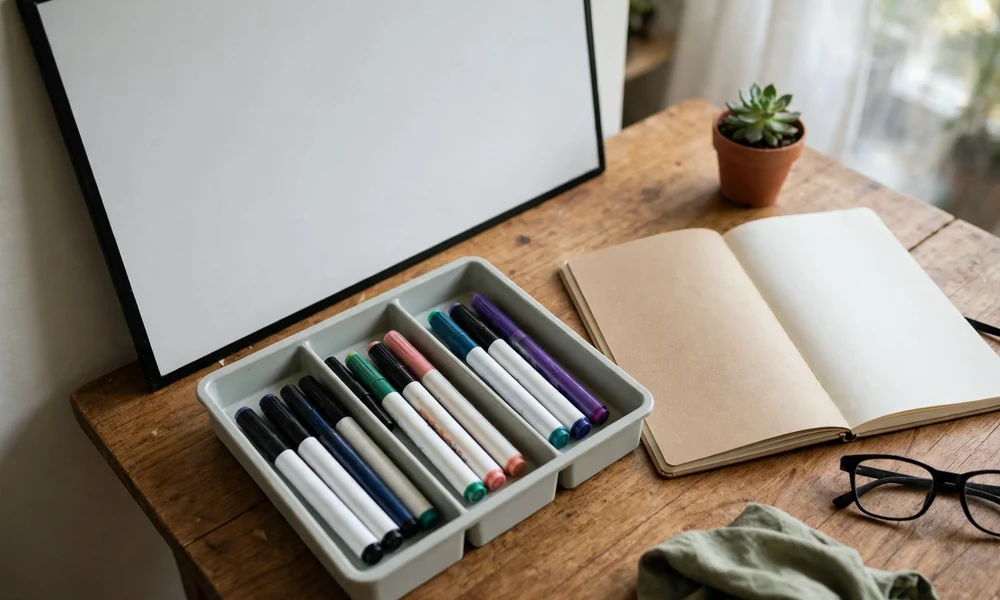
Buy proper dry-erase markers from a known brand, and keep them in the tray, not in a drawer where a permanent marker can be grabbed by mistake. Erase at the end of each day, because ink left on for days, especially in a warm room or in sunlight, bonds to the surface and becomes far harder to remove. When ghosting does appear, a whiteboard cleaner or a little isopropyl alcohol on a soft cloth usually removes it from a good surface. On cheap painted steel it is often permanent, and no amount of scrubbing will bring the white back. If you need markers that work properly, our guide to the best markers of 2026 covers the ones that write cleanly and erase fully. A marker that is left uncapped will dry out in a day, so the tray should hold the markers with their caps on.
Frames and Trays That Fall Apart
The frame and the marker tray look like afterthoughts, and on the worst boards they are. A thin aluminium frame bends when the board is lifted, a plastic corner joint cracks the first time the board is moved, and a marker tray that is held on by a single screw slides off the moment a marker is put down. A tray that cannot hold a marker is a small failure that causes a daily irritation, because the markers and the eraser end up lost in a drawer and the board sits unused. A board that falls apart at the edges is a board that was built to a price, not to a standard.
Look for a frame that feels rigid when you lift the board by one corner, with corner joints that are screwed or welded rather than glued. The tray should be part of the frame, not an accessory clipped on as an afterthought, and it should hold two markers and an eraser without tipping. A frameless glass board looks smarter and suits a room that doubles as living space, but it shows every fingerprint and needs more careful mounting. A board whose frame survives the first move is a board that will survive years on the wall, and a board whose tray falls off in week one will annoy you every day.
Boards That Are Not Really Magnetic
A magnetic board does two jobs at once, holding notes and printouts as well as marker, and the worst boards promise magnetism they do not deliver. Melamine boards are usually not magnetic at all, some glass boards have no magnetic layer, and cheap painted-steel boards hold a magnet so weakly that a single sheet of paper slides to the floor. A buyer who planned a planning wall of pinned notes discovers the board holds nothing, and the board becomes a writing surface only, which is half the board they paid for. Magnetism that is advertised and absent is a board sold on a promise it cannot keep.
Check the specification for magnetism before you buy, and test it in the shop with a real magnet and a sheet of paper. Porcelain and painted-steel boards are magnetic, glass boards usually are not, though some have a magnetic backing layer that must be checked separately. If pinning things up matters to you, a magnetic board is worth paying for, because a board that holds paper turns a writing surface into a planning wall. A board that claims to be magnetic and is not is a board that should go back to the shop, and a board that holds a note firmly is one that earns its place on the wall.
What to Buy Instead
The whiteboards worth buying share a short list of features, and none of them is expensive on its own. A porcelain or glass surface that erases cleanly for years, in a size around ninety by sixty centimetres for a typical home office. Proper fixings for your wall type, a rigid frame with a tray that holds its markers, and magnetism if you pin paper up. Decent dry-erase markers and a microfibre eraser, and a habit of erasing at the end of each day. If a board fails any one of those checks, keep looking.
Fit matters as much as build, and the board should suit the room in front of you rather than the room in the photograph. A board above the desk should be visible from the chair and reachable with a half-turn, while a board behind you is a board you will forget. Measure the wall, check the fixings, and test the surface before you commit. If you want the rest of the desk organised too, our guide to the best desk organizers of 2026 covers the trays and boxes that keep a home office tidy.
The Bottom Line
The worst whiteboards for home office use in 2026 share a pattern: surfaces that ghost within months, boards too small for real work, mounting that fails on the wall, markers that stain permanently, frames and trays that fall apart, and boards that are not really magnetic. Avoid those six failures and you avoid almost every whiteboard regret. Buy the surface first, the size second, and the mounting third, and then write the week on it. Do that, and the board you buy will be the one that organises your working day for years, not a grey rectangle you stop looking at within months.