
Best Markers 2026
A good marker is one of the smallest tools in a home, an office or a classroom, and one of the most used. It labels the freezer box, signs the birthday card, sketches the idea on the whiteboard, marks the plant pot and writes the reminder on the fridge. When it works, nobody notices it. When it does not, the line skips, the ink bleeds through the page, the cap dries out, or the colour fades before the week is over. Choosing well is less about finding one perfect pen and more about matching the right type of marker to the job in front of you.
This guide covers the whole general marker family: permanent markers, dry-erase markers, fine-tip markers, chisel-tip markers, brush-tip markers and the highlighter-style markers that sit alongside them. It explains how each type behaves, what surfaces it suits, where it goes wrong, and how to keep a set working for a long time. There are no miracle products here, only practical differences that matter once a marker is in your hand.
Start with the job, not the colour
Most marker disappointment comes from using the wrong type for the surface. A marker that writes beautifully on paper can smear hopelessly on plastic. A marker that survives rain on a garden label can ruin a whiteboard in one afternoon. Before looking at colours or tip sizes, ask three questions: what am I writing on, how long does it need to last, and does it ever need to come off?
Permanent markers: the workhorse
Permanent markers use a fast-drying ink, usually alcohol-based, that bonds to the surface instead of sitting on top of it. That is why they write on plastic, glass, metal, wood, stone, leather and coated card where ordinary pens fail. They are the right choice for labelling storage boxes, garden pots, cables, tools, luggage tags and anything that will be handled, rained on or wiped.
The trade-off is that permanent means permanent. On skin it wears off over a day or two, on fabric it usually survives washing, and on a whiteboard it is the classic expensive mistake: permanent ink on a whiteboard often needs solvent or a great deal of scrubbing to remove, and it can leave a ghost behind. Keep permanent markers away from whiteboards entirely, and keep them away from young children unless the caps are ventilated and the use is supervised.
Dry-erase markers: made to disappear
Dry-erase markers are built for whiteboards, glass boards and other smooth, non-porous surfaces. Their ink dries into a thin film that an eraser or cloth lifts away, which makes them ideal for planning walls, teaching, brainstorming, weekly menus and anything that changes often. They come in the same tip shapes as permanent markers, but the ink is entirely different, and the two types should never be mixed up.
Dry-erase markers dry out faster than other types because their caps are removed and replaced constantly during a working session. Store them horizontally if you can, with the cap clicked firmly shut, and replace a marker that starts skipping rather than pressing harder. Pressing harder does not revive the ink; it damages the tip and can scratch the board. For more on choosing the surface itself, see our guide to the best whiteboards for home offices in 2026.

Fine-tip markers: small lines, clear writing
Fine-tip markers have a narrow nib, usually around half a millimetre to one millimetre, and they are the best choice when writing needs to be small, neat and readable. They suit planners, journals, notebooks, labels, forms, diagrams and detailed drawing. Where a broad marker turns a label into a smudge, a fine tip keeps every letter legible.
The main weakness of a fine tip is bleed on thin paper. Because the nib is narrow, the ink is concentrated in a small area, and cheap thin paper can soak it through to the other side. Thicker notebook paper, card and quality journal paper handle fine tips well. If your notebook shows ghosting on the reverse of each page, try a finer tip, a lighter hand, or heavier paper rather than blaming the marker alone.
Fine-tip markers also dry out if left uncapped, and the fine nib is easier to damage than a broad one. A dropped marker that lands nib-first may never write smoothly again. Keep the cap on between uses, store them tip-down for a few minutes if a marker starts skipping, and retire any nib that has gone soft or splayed. A fine-tip marker is a precision tool, and it rewards gentle handling.
Chisel tips and brush tips: two useful shapes
A chisel tip is a flat, angled nib that writes thick in one direction and thin in the other. Turn it one way for a bold heading, turn it the other for a neat underline. It is the classic labelling tip, and it is also the standard tip for highlighter-style markers, where the broad edge covers a line of text evenly. If you only own one marker for boxes and headings, a chisel tip is the most versatile choice.
A brush tip is a flexible nib that changes width with pressure: light pressure gives a hairline, firm pressure gives a broad stroke. It suits lettering, sketching, colouring and calligraphy-style writing. It is less useful for labelling or forms, where a steady line matters more than expression. Brush-tip markers need a little practice, and beginners often press too hard at first, so a scrap of paper for warming up is a good idea.
Highlighter-style markers and the wider family
Highlighters are markers too, even if they are sold separately. They use translucent ink that lets the printed text show through while marking it in a bright colour, which makes them the right tool for studying, revising and picking key lines out of a document. A highlighter that is too dark defeats its own purpose, so the best ones stay light enough to read through.
Choosing by surface: paper, board and everything else
Paper rewards water-based ink. It dries fast enough, it does not smell, and it rarely bleeds on decent-weight paper. Sketchbooks and journals with heavier pages handle markers far better than thin office paper, and the difference between a 90 gsm page and a 140 gsm page is visible the moment a broad tip touches it. If your drawings or notes matter to you, the paper matters as much as the marker. Our guide to sketchbooks for daily drawing in 2026 explains what to look for in a book that will take ink well.

Plastic, glass, metal and coated surfaces reward permanent ink. Write slowly, let the ink dry for a few seconds before touching it, and remember that glossy surfaces take longer to dry than matt ones. On very smooth glass, even permanent ink can be rubbed off with effort, so for a label that must survive handling, a printed label or a piece of tape under the ink is more reliable than ink alone.
Bleed and fade: two ink problems
Bleed is ink soaking through paper to the other side. It is worst with broad tips, alcohol-based ink and thin paper, and it is the reason double-sided notebooks and cheap pads frustrate marker users. The fixes are simple: finer tips, heavier paper, and a lighter hand. Writing on only one side of a thin page is a reasonable compromise if you like the notebook too much to change it.
Fade is ink losing colour over weeks or months. Sunlight is the main cause, so anything displayed in a window will fade faster than anything kept in a drawer. Permanent markers resist fading better than water-based ones, and black ink usually outlasts bright colours. For labels that live in sunlight, such as garden markers, choose a dark permanent marker and expect to rewrite it once a season.
Storage, caps and making markers last
Markers die from air, not from use. Every minute uncapped shortens a marker’s life, and a marker left open overnight is often a marker thrown away. Make capping a reflex: click the cap on the moment you stop writing, even if you will pick the marker up again in a minute. Listen for the click; a cap that is not fully closed is barely better than no cap at all.
Heat is a quiet killer. A car dashboard in summer, a radiator shelf or a sunny windowsill will dry markers out and can make the barrels leak. Keep markers at room temperature, away from direct sun. Cold is less harmful, but a marker that has been in a cold garage may write poorly until it warms up, so bring it inside and wait before deciding it is dead.
Markers at home, at work and in art
At home, markers earn their keep on labels. Freezer boxes, storage tubs, spice jars, cables, chargers and school kit all become easier to find when they are labelled clearly. A permanent marker on a strip of masking tape is a label that can be peeled off and replaced, which is often better than writing directly on the object. Keep one permanent marker in the kitchen drawer and one in the toolbox, and they will be there when you need them.
At work, dry-erase markers and fine-tip markers split the load. Dry-erase markers run the whiteboard during meetings and planning sessions. Fine-tip markers run the notebook, the planner and the forms. A chisel-tip marker handles the flip chart and the heading on the poster. The common thread is reliability: a marker that skips in the middle of a meeting is worse than no marker at all, so keep spares.
For artists and hobbyists, markers are a medium in their own right. Alcohol-based art markers blend on the page and layer well, brush tips handle lettering, and fine tips handle detail. The range of art supplies around markers is wide, and if you are building a kit from scratch, our guide to the best art supplies in 2026 is a useful starting point for the paper, pens and tools that go with them.
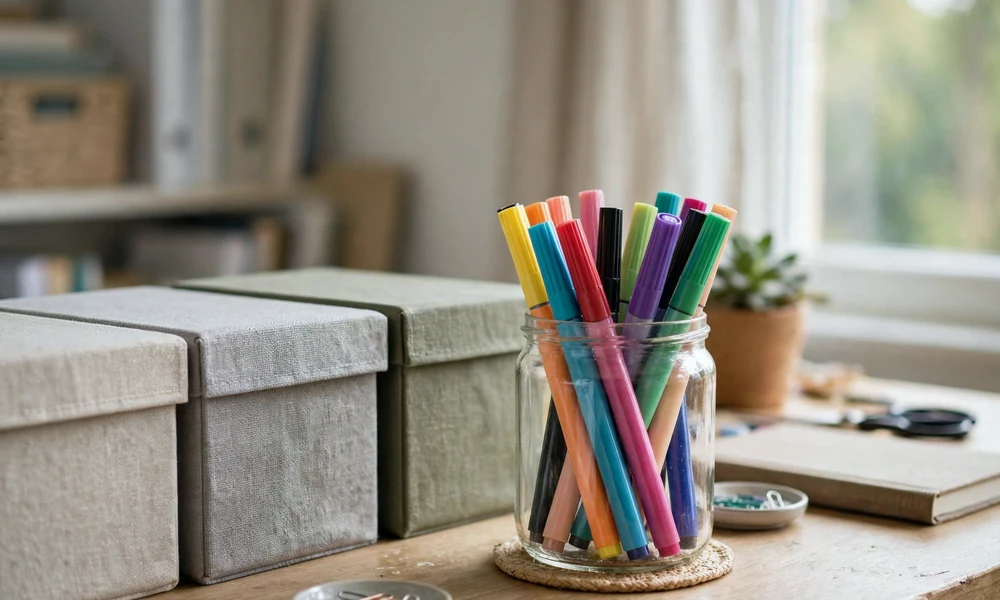
Mistakes worth avoiding
The most expensive mistake is the permanent marker on the whiteboard. It happens in a hurry, in a shared office, when someone grabs the wrong pen. The fix is prevention: keep dry-erase markers in a tray on the board and permanent markers in a different room or a different pot, and label the tray if the office is shared.
What to buy first
If you are starting from nothing, buy a small set and use it before buying more. Two permanent markers, one chisel and one fine; two dry-erase markers in black and one colour; three fine-tip markers in black, blue and one colour you like; and one chisel-tip highlighter. That is eight markers, and it covers labelling, whiteboards, notes, planners and headings.
There is no single best marker, because there is no single job a marker does. The best marker for a whiteboard would ruin a notebook. The best marker for a garden label would ruin a whiteboard. The best marker for a sketchbook would smear on a freezer box. Choose by surface, by permanence and by tip, keep the caps on, and a small set will serve you well for a long time.


