Best Whiteboards for Home Offices in 2026
The best whiteboards for home offices in 2026 fit the way you actually work: big enough to hold a week of thinking, smooth enough to erase cleanly after a hundred uses, and sturdy enough to survive daily use. Buy too small and it becomes decoration. Buy a cheap painted-steel surface and within months it ghosts, stains and refuses to erase. Buy the right board, in the right size, with the right surface, and it quietly becomes the centre of your working day — the place where plans get made, problems get untangled and the week gets organised.
This guide explains the surfaces, sizes and mounting options that matter, and how to choose a board that will still look new in a year.
Key takeaways
- Surface quality matters more than size or brand: a porcelain or glass board erases cleanly for years, while a cheap painted-steel board starts ghosting within months.
- For a home office, a board around 90 x 60 cm is the sweet spot — large enough for a weekly plan, small enough for a spare room wall.
- Magnetic boards earn their keep: they hold notes, printouts and photos as well as marker, which turns a writing surface into a planning wall.
- Mounting is half the purchase. Check the wall type, the fixings in the box and the weight before you drill anything.
- A good whiteboard needs almost no maintenance — but the wrong markers, the wrong cleaner and leaving ink on for weeks will ruin even a good surface.
Why a whiteboard still beats a screen
Home offices are full of screens, and screens are very good at holding information. They are much worse at holding attention. A whiteboard keeps the important thing visible all day, at a size your eyes cannot ignore, without a notification attached to it. The weekly plan stays up while you work, and the problem you are stuck on stays up while you make coffee.
The surfaces, compared
Every whiteboard looks the same in a product photo: a white rectangle in a silver frame. The difference is what is underneath the white coating, and it decides everything about how the board behaves after the first month. Painted steel is the cheapest surface and the most common in budget boards — a sheet of steel coated with white lacquer. It writes well at first and it is magnetic, but the lacquer is thin, it scratches easily, and marker ink slowly sinks into it. Within a few months of daily use, the board starts to ghost: faint grey shadows of old writing that no erasing will shift.
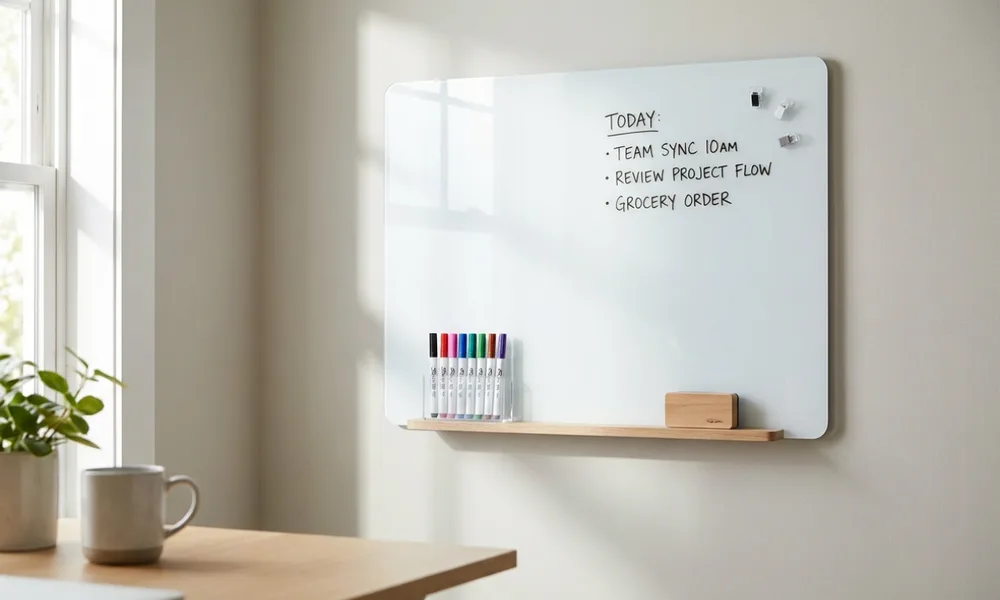
Melamine is a resin-coated surface, smoother than painted steel but still a coating that wears. Porcelain, also called enamelled steel, is the professional standard: a ceramic coating fired onto steel at high temperature. It is hard, non-porous and almost impossible to stain, and marker wipes away completely even after weeks. Glass is the newest option: a sheet of tempered glass, usually with a white backing, that never stains, never ghosts and looks far smarter on a home-office wall. It is heavier, needs proper fixings and usually costs the most — but for a board you will look at every day, that matters.
| Surface | Erase quality | Magnetic | Durability | Best for |
|---|---|---|---|---|
| Painted steel | Good at first, ghosts within months | Yes | 1–2 years of daily use | Occasional use, tight budgets |
| Melamine | Good, stains over time | Usually no | 2–3 years | Light use, children’s rooms |
| Porcelain enamel | Excellent, wipes clean for years | Yes | 10+ years | Daily use, the buy-once choice |
| Tempered glass | Excellent, never ghosts | No (usually) | 10+ years | Home offices where looks matter |
| Peel-and-stick film | Fair, depends on the wall | No | 6–12 months | Renters, temporary setups |
| Portable / easel boards | Varies by surface | Sometimes | Several years | Small spaces, moving between rooms |
The honest rule is simple: if you will use the board every day, buy porcelain or glass. If you will use it once a week, painted steel is fine. Melamine rarely makes sense: it costs more than painted steel without lasting like porcelain.
What size should you buy?
Size is where most whiteboard purchases go wrong, and almost always in the same direction: too small. A board that looks generous in a product photo looks tiny on a real wall, and a board that is too small gets used less, because there is never enough room for what you actually want to write. Measure the wall first, and leave at least 15 cm of clear wall around the board on every side.
For most home offices, a board around 90 x 60 cm is the practical sweet spot: it holds a weekly plan with room to spare, fits above a desk without dominating the room, and is light enough to mount on a plasterboard wall with the right fixings. A 120 x 90 cm board is better if you keep several things up at once, but it needs a solid wall or proper cavity fixings. Anything smaller than 60 x 45 cm is really a notice board, not a planning surface.
Magnetic or not, framed or frameless?
A magnetic board does two jobs at once: printouts, photographs and notes can be held up with magnets, so the board carries information that would never be written out by hand. If your working style involves paper at all, magnetism is worth having. Porcelain and painted-steel boards are magnetic; glass boards usually are not, though some have a magnetic backing layer — check before you buy.
An aluminium frame protects the edges of the board, gives the marker tray somewhere to live, and makes the board look finished on the wall. Frameless glass boards look smarter and suit a home office that doubles as a living space, but they show every fingerprint and need more careful mounting. A marker tray is a small thing that makes a real difference: without one, markers and the eraser end up lost in a drawer.
Markers, erasers and the ghosting problem
Ghosting — the faint grey shadow of old writing — is the most common complaint about whiteboards, and it is almost always preventable. First, use proper dry-erase markers, never permanent markers or the cheap unbranded ones that come free with a board: low-quality inks sink into the surface and refuse to come out. Second, erase promptly: ink left on for days, especially in a warm room or sunlight, bonds to the surface. Erase at the end of each day and the board will stay white for years.
When ghosting does appear, a whiteboard cleaner or a little isopropyl alcohol on a soft cloth usually removes it from a good surface. On cheap painted steel it is often permanent — the ink has gone into the coating. A microfibre eraser beats the felt blocks that come in the box, and a board with no working marker is a blank wall, so keep a spare set in the tray.
Where to put it, and how to mount it
Placement decides whether the board gets used. The best spot is the wall you face when you sit at your desk — close enough to reach without standing, visible enough to catch your eye all day. A board behind you is a board you will forget. The wall beside the desk is often the best compromise in a small room: visible from the chair and reachable with a half-turn.
Mounting deserves ten minutes of thought before you drill. A porcelain board at 120 x 90 cm can weigh 8–10 kg, and a glass board of the same size 12–15 kg. On a solid wall, ordinary plugs are fine; on plasterboard, you need proper cavity fixings — the expanding metal kind, not the plastic plugs in the box — and you should find a stud if you can. If you rent, a peel-and-stick film or a leaning board avoids holes entirely, though neither feels as solid as a mounted board.
Getting the most out of it
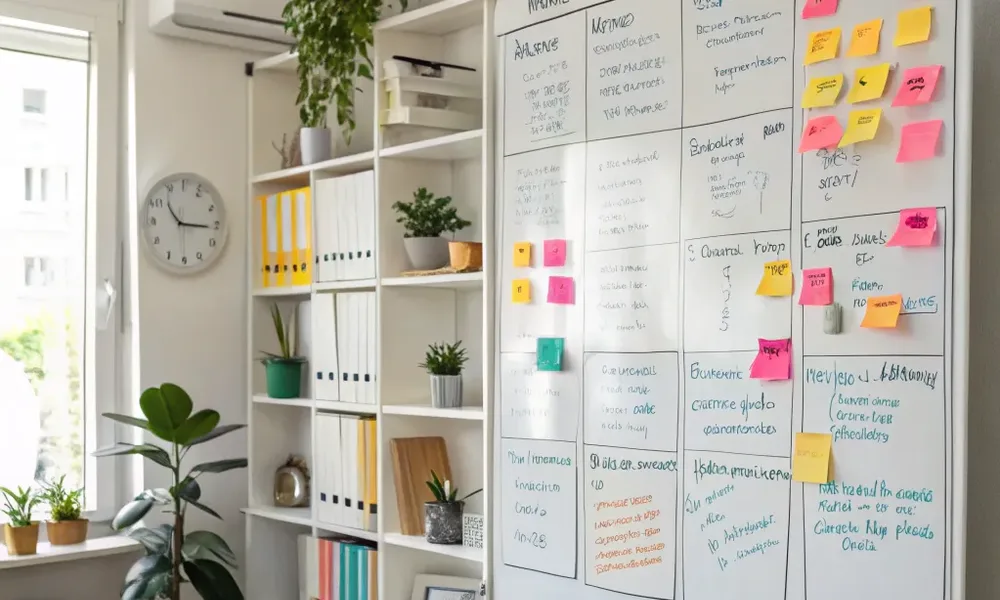
A whiteboard works best with a system: three zones — a weekly plan across the top, a running to-do list down one side, and a free space for the problem of the day. Erase the plan at the end of each week and write the next one; five minutes keeps the board current, and a board still showing last month’s plan has stopped being useful.
Colour helps only if it means something: pick a simple code — black for plans, blue for ideas, red for deadlines — and stick to it. And if you share the house, agree the rules: who can erase what. Nothing kills a whiteboard faster than someone erasing your week’s plan to write a shopping list on it.
A well-chosen board earns its place alongside the rest of the desk setup. It pairs naturally with desk shelves that keep reference books within reach, and it works best with a chair you can sit in all day — which is why choosing the right ergonomic office chair matters as much as choosing the board itself. A tidy desk mat underneath it all keeps the whole setup feeling deliberate.
Choosing well: a quick checklist
- Pick porcelain or glass if you will use the board daily; painted steel is fine for occasional use only.
- Measure the wall first and leave 15 cm of clear space around the board on every side.
- Choose around 90 x 60 cm for a typical home office, larger only if the wall and the mounting can take it.
- Decide whether you need magnetism — if you pin up paper, you do — and check the surface is magnetic before buying.
- Check the fixings in the box against your wall type, and buy proper cavity fixings for plasterboard.
- Buy decent dry-erase markers, a microfibre eraser and a spare marker, and erase the board at the end of each day.
Frequently asked questions
What is the best whiteboard surface for daily use?
Porcelain enamel or tempered glass. Both erase completely for years without ghosting, while painted steel and melamine start to stain within months of daily use.
What size whiteboard should I buy for a home office?
Around 90 x 60 cm suits most home offices: large enough for a weekly plan, small enough for a spare-room wall. Go to 120 x 90 cm only if you keep several plans up at once and the wall can take the weight.
Why does my whiteboard ghost, and can I fix it?
Ghosting happens when marker ink sinks into a worn or cheap coating, usually because ink was left on for days or low-quality markers were used. Whiteboard cleaner or isopropyl alcohol removes it from good surfaces; on cheap painted steel it is often permanent.
Are glass whiteboards magnetic?
Usually not. Most glass boards have no magnetic layer, so they cannot hold notes with magnets. Some models add a magnetic backing — check the specification if pinning things up matters to you.
Can I mount a whiteboard on a plasterboard wall?
Yes, with proper cavity fixings — the expanding metal kind — and ideally into a stud. Do not rely on the plastic plugs supplied in the box, and check the board’s weight before you drill.
Do I need special markers for a whiteboard?
Yes — proper dry-erase markers from a known brand. Cheap unbranded markers and permanent markers are the fastest way to stain a board, and they are rarely worth the saving.

The bottom line
The best whiteboard for a home office is a porcelain or glass board around 90 x 60 cm, mounted at eye level on the wall you face, with decent markers and a daily erase. It costs more than the cheapest board on the shelf, but it is the difference between a tool you use every day for years and a grey, ghosted rectangle you stop looking at within months. Buy the surface first, the size second, and the mounting third — and then write the week on it.