Why a Good Thermometer Matters More Than You Think in 2026
A good thermometer is one of those household tools you barely think about until the moment you need it. A child wakes up hot at 2 a.m. or a roast needs to reach a safe temperature before dinner, and suddenly the little device in the drawer is the most important thing in the house. A good thermometer matters more than you think in 2026 because the reading it gives shapes real decisions: whether to call a doctor, whether food is safe to eat, and whether a fever is getting better or worse.
Key takeaways
- Accuracy matters more than speed: a fast reading you cannot trust is worse than a slow one you can.
- Different jobs need different thermometers: body, kitchen, and room readings are not interchangeable.
- Forehead and ear thermometers are quick and practical for children, while a digital stick thermometer is the most accurate for most adults.
- A kitchen probe thermometer is the only reliable way to know whether meat is cooked safely through.
- Keep spare batteries and clean the probe after every use.
Why accuracy matters more than you think
Body temperature is a narrow range, and small differences mean a lot. Normal body temperature sits around 36.5 to 37.5 degrees Celsius, and a fever usually starts at 38 degrees. A thermometer that reads half a degree low can make a real fever look like nothing, while one that reads half a degree high can send a healthy person to the doctor for no reason. That margin is the whole job of a thermometer, and it is why the cheapest option is not always the best one.
The same logic applies in the kitchen. Chicken is safe at 74 degrees Celsius through the thickest part, but only if the reading is taken in the right place. A thermometer that reads the temperature of the pan instead of the meat will mislead you. Accuracy also matters over time: a series of readings tells you whether a fever is rising or falling, and that trend is what doctors ask about.
The main types of thermometer, and what each is for
Digital stick thermometers are the simplest and most accurate type for body temperature. They take a reading under the tongue, under the arm, or rectally, and most give a result in 10 to 60 seconds. They are cheap, reliable, and easy to clean, which is why they remain the standard in most homes. Their main drawback is that they need a cooperative patient, which makes them hard to use on a wriggling toddler at 2 a.m.
Infrared forehead thermometers measure the heat radiating from the forehead, and they give a reading in about a second without touching the skin. They are the most practical choice for children, for checking a sleeping baby, and for anyone who needs repeated readings through the night. They are slightly less accurate than a stick thermometer, and they can be thrown off by sweat, a cold room, or a reading taken too soon after coming in from outside.
Ear thermometers work the same way, measuring infrared heat from inside the ear canal. They are fast and convenient, but they need correct placement to be accurate, and earwax can skew the result. Smart thermometers, which send readings to a phone app and keep a history, are useful for parents tracking a child’s illness, but the sensor is the same as a standard digital thermometer, so the app adds convenience rather than accuracy.

Kitchen probe thermometers
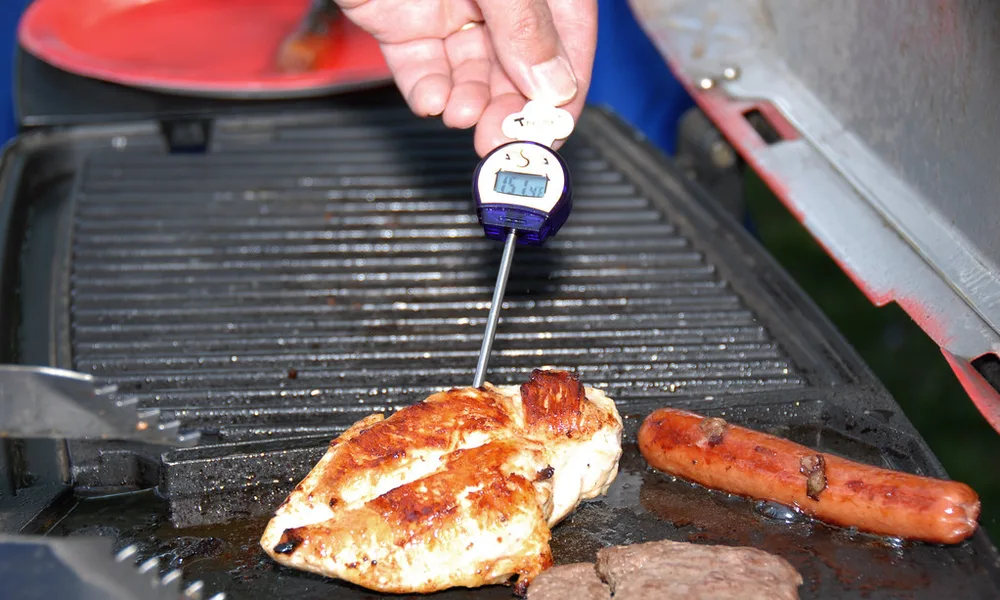
Kitchen thermometers are a separate category, and they matter just as much. A probe thermometer with a thin metal stem is pushed into the thickest part of the meat, away from bone, and gives a reading in a few seconds. Instant-read models are the most useful for everyday cooking: you check, you adjust, and you move on. Leave-in probes, which stay in the roast while it cooks and beep when it reaches the target, suit slow roasts. Either way, the probe is the only way to know what is happening inside the food, because colour and juices are unreliable guides.
Room and fridge thermometers
Room thermometers and fridge thermometers are the quiet members of the family. A room thermometer helps you keep a baby’s bedroom between 16 and 20 degrees Celsius, the recommended range for safe sleep. A fridge thermometer tells you whether the fridge is holding 4 degrees or below. Both are cheap and last for years.
Thermometers compared at a glance
| Type | Speed | Best for | Watch out for |
|---|---|---|---|
| Digital stick | 10 to 60 seconds | Accurate body readings | Needs a still patient |
| Infrared forehead | About 1 second | Children, night checks | Sweat and cold rooms skew readings |
| Ear infrared | About 1 second | Older children, adults | Needs correct placement |
| Kitchen probe | 2 to 5 seconds | Meat, roasts, baking | Must avoid bone and pan |
| Smart thermometer | 10 to 60 seconds | Tracking fevers over days | App adds no accuracy |
One household usually needs two: a body thermometer for people and a probe thermometer for the kitchen. A forehead model earns its place as a third if there are young children in the house.
Choosing a thermometer for babies and children
Children are where a good thermometer earns its keep. A feverish child cannot tell you how they feel, and parents end up making decisions at night, in the dark, with a child who will not sit still. That is exactly the situation a forehead thermometer is made for: a quick sweep across the forehead, no waking the child, and a reading you can trust enough to decide whether to wait or call a doctor.
For babies under three months, accuracy matters most of all, because a fever at that age always needs a doctor’s call. A digital stick thermometer used rectally is the most accurate method for a young baby, and it is what most paediatric guidance recommends. For older babies and toddlers, a forehead thermometer is the practical everyday choice, with a stick thermometer kept as a backup for readings that need confirming.
Whatever type you choose, learn the normal range for your child when they are well, because normal varies from child to child. Keep the thermometer where you can find it in the dark, keep spare batteries with it, and keep it with the rest of your home health supplies, in a well-stocked first-aid kit for 2026. Parents of newborns often keep it near the nursery, alongside the other essentials in the best cribs of 2026, where it is always within reach at night.
Kitchen thermometers and food safety
In the kitchen, a thermometer is a safety tool, not a gadget. Poultry needs to reach 74 degrees Celsius through the thickest part, minced meat needs the same, and whole cuts of beef and lamb are safe at lower temperatures because bacteria live on the surface rather than inside. Reheated leftovers need to reach 74 degrees throughout, and a fridge should hold at 4 degrees or below. These numbers are only useful if you can measure them, and a probe thermometer is the only tool that can.
Technique matters as much as the device. Push the probe into the thickest part of the meat, away from bone and away from the pan, and wait for the reading to settle. For thin food like burgers, push the probe in from the side. For a roast, check in two or three places, because ovens heat unevenly. Clean the probe with hot soapy water after every use, and never put a probe that has touched raw meat into cooked food without washing it first. Calibration is worth a minute of your time: fill a glass with ice and water, stir, and push the probe in. It should read close to 0 degrees Celsius, and if it is out by more than a degree or two, replace it. A thermometer that drifts is worse than no thermometer at all, because it gives you confidence in a wrong number. That same care applies to comfort items like the best heating pads of 2026 for aches and cold evenings.
How to take a reading properly
Most inaccurate readings are not the thermometer’s fault. They come from how the reading was taken. For a stick thermometer under the tongue, keep the mouth closed and wait for the beep; talking, drinking, or eating in the previous 15 minutes will skew the result. For a forehead thermometer, wipe away sweat, wait a few minutes after coming in from the cold, and hold the device at the distance the instructions specify. For an ear thermometer, pull the ear gently back to straighten the canal and make sure the probe is pointing at the eardrum.
Take the reading twice when it matters. If the first reading looks surprising, wait a minute and take it again. Two readings that agree are trustworthy; two that disagree mean you should check your technique and take a third. Write down the number and the time, especially during an illness, because the trend over hours is more informative than any single reading. For babies under three months, any temperature of 38 degrees or above needs a prompt call to the doctor. For older children and adults, a fever above 39.5 degrees, a fever lasting more than three days, or a fever with difficulty breathing, a stiff neck, or confusion needs medical advice.

Checklist: buying a thermometer in 2026
- Decide the job first: body, kitchen, or both, and buy a thermometer made for that job.
- Choose a digital stick thermometer for accuracy, and add a forehead model if there are young children in the house.
- Check the display: large, backlit numbers matter at 2 a.m.
- Look for a model that is easy to clean, with a waterproof tip or a wipe-clean surface.
- Buy spare batteries at the same time and keep them with the thermometer.
- Test a new thermometer against a known temperature, like ice water at 0 degrees, before you rely on it.
Frequently asked questions
What is the most accurate type of thermometer?
A digital stick thermometer used correctly is the most accurate type for body temperature in most homes.
How accurate are forehead thermometers?
Forehead thermometers are usually accurate to within about 0.3 to 0.5 degrees when used correctly. Sweat, a cold room, or taking a reading too soon after coming indoors can skew the result.
When should I call a doctor about a fever?
For babies under three months, call promptly for any temperature of 38 degrees or above. For older children and adults, seek advice for a fever above 39.5 degrees, a fever lasting more than three days, or a fever with breathing difficulty, a stiff neck, or confusion.
Can I use a kitchen thermometer for body temperature?
No. Kitchen probe thermometers are designed for food and are not accurate or hygienic for body use. Keep one thermometer for people and one for the kitchen.
How often should I replace a thermometer?
Replace a thermometer when it gives inconsistent readings, when the display fades, or when it cannot be calibrated. Check it against ice water occasionally.
What temperature should a fridge be?
A fridge should hold at 4 degrees Celsius or below, and a freezer at minus 18 degrees or below. A fridge thermometer is the only way to know for sure.
The bottom line
A good thermometer matters more than you think because it turns worry into information. A reliable reading tells you whether a fever is rising or falling, whether dinner is safe to serve, and whether the baby’s room is warm enough to sleep in. One accurate body thermometer and one good kitchen probe cover almost every household need, with a forehead model as a useful third if there are children in the house. Buy for accuracy first, learn to use it properly, and replace it when it starts to drift.