A good wine cooler does one quiet job: it holds your bottles at the temperature they were meant to be drunk at, every day, without you thinking about it. Most wine is ruined long before it is opened, not by age or a bad vintage, but by a kitchen that swings between 24 degrees in the afternoon and 18 at night, by a fridge that is far too cold, and by light and vibration that slowly flatten flavour. A dedicated wine cooler fixes all of that in one appliance, and in 2026 the models worth buying are quieter, steadier and better built than the ones that came before them.
This guide explains how to choose a wine cooler that fits your home, your collection and your budget: the real differences between single-zone and dual-zone models, compressor and thermoelectric cooling, and the sizes that make sense for different households.
Key takeaways
- Serve reds at 15 to 18 degrees, whites at 7 to 10, and sparkling wine at 5 to 7; a cooler that cannot hold those ranges steadily is not doing its job.
- Dual-zone cooling matters only if you store reds and whites together; otherwise a single-zone model saves money and space.
- Compressor coolers hold temperature better in warm rooms and come in larger sizes, while thermoelectric models run quieter but struggle above 25 degrees.
- Capacity is measured in standard Bordeaux bottles, so wide Burgundy bottles and Champagne will cut real capacity by a fifth or more.
- UV-protected glass, low vibration and humidity of 50 to 70 percent matter more than a touchscreen or a Wi-Fi app.
Why temperature matters more than the bottle
Wine is a living product. Heat speeds up the chemical reactions inside the bottle, cold slows them down, and swings between the two age a wine unevenly. A bottle kept at a steady 16 degrees will outlast the same bottle kept in a kitchen that drifts between 20 and 28 degrees across the seasons, Stability matters as much as the exact temperature: a constant 18 degrees is far better than a range that averages 18 but swings five degrees either way.
The ordinary fridge is the worst common option. It runs at 3 to 5 degrees, which is too cold for serving and too dry for storage, and its humidity sits around 20 to 30 percent, low enough to dry out corks over months. It also vibrates every time the compressor cycles. A wine cooler, by contrast, is built around a narrow band of 5 to 18 degrees and humidity in the 50 to 70 percent range, with a cooling system tuned for small, gentle corrections rather than the hard chilling a food fridge needs.
Single-zone vs dual-zone: the comparison that decides most purchases
The first choice is the number of temperature zones, and it is also the choice most buyers get wrong. A single-zone cooler holds one temperature throughout. A dual-zone cooler splits the cabinet into two compartments, each with its own thermostat, so reds can sit at 16 degrees while whites chill at 8. Whether it is worth it depends entirely on what you drink.

| Feature | Single-zone cooler | Dual-zone cooler |
|---|---|---|
| Temperature control | One setting, 5 to 18 degrees | Two independent settings |
| Best for | Mostly red or mostly white drinkers | Mixed collections, red and white together |
| Typical capacity | 12 to 46 bottles | 18 to 46 bottles |
| Price range | Lower for the same size | 20 to 40 percent more |
| Energy use | Lower, one cooling circuit | Higher, two circuits |
| Downside | One serving temperature at a time | Divider eats shelf space |
If your rack is 80 percent red, buy a single-zone cooler, set it to 16 degrees, and chill white bottles in the kitchen fridge for an hour before serving. If you genuinely keep both reds and whites on hand every week, the dual-zone earns its premium, because it removes the daily juggling of bottles between the cooler and the fridge.
What size actually makes sense
Manufacturers quote capacity in standard 750 millilitre Bordeaux bottles, the slim straight-sided shape. Real collections are messier. Burgundy bottles are wider, Champagne bottles are wider still, and a cooler rated for 24 bottles will hold 18 to 20 once a few of those are mixed in. Buy one size up: a full cooler has no airflow between bottles and cools unevenly.
| Capacity | Realistic bottle count | Suits | Typical footprint |
|---|---|---|---|
| 8 to 12 bottles | 8 to 10 mixed bottles | Countertop, occasional drinkers | About 25 cm wide |
| 18 to 24 bottles | 15 to 20 mixed bottles | Weekly drinkers, small kitchens | About 30 to 40 cm wide |
| 32 to 46 bottles | 26 to 38 mixed bottles | Collectors, dinner-party hosts | About 50 to 60 cm wide |
| 100 bottles and up | 80 to 100 mixed bottles | Serious cellaring | Full-height cabinet |
Measure twice before you buy. Freestanding coolers need 5 to 10 centimetres of clearance at the back and sides for ventilation, and a built-in model needs a front-venting design or it will overheat in its cabinet.
Compressor vs thermoelectric cooling
Every wine cooler cools in one of two ways. Compressor models work like a small fridge: a refrigerant circuit cycles on and off, holds temperature precisely, and keeps working in rooms up to 30 degrees or more. Thermoelectric models use a Peltier chip with no moving parts except a fan: they are almost silent and vibration-free, but they can only cool about 12 to 15 degrees below the room temperature, so a thermoelectric cooler in a 28-degree kitchen cannot hold whites at 8 degrees.
For most homes, the compressor wins. It handles summer, it comes in every size from 12 to 200 bottles, and modern inverter compressors are far quieter than the rattling units of a decade ago, often rated at 35 to 42 decibels, roughly the level of a quiet library. Thermoelectric still has a place: a small 8 to 18 bottle model in a bedroom or study where silence matters is a good buy, provided the room stays below 25 degrees.
Where to put it
Placement decides performance more than most buyers expect. A wine cooler in a garage that hits 35 degrees in summer will run constantly and still struggle, while the same cooler in a 20-degree kitchen will sip electricity and hold temperature without effort. Keep the cooler out of direct sunlight, away from ovens and radiators, and in a room that stays between 15 and 25 degrees for most of the year.

Ventilation is the second rule. Freestanding coolers vent from the back and sides, so they need that 5 to 10 centimetre gap on all sides. Built-in models vent from the front, at the plinth, and can sit flush in cabinetry, but only if the model is actually rated as built-in. Putting a freestanding cooler into a tight cabinet is the most common installation mistake, and it shows up as a compressor that never stops and a cooler that dies years early.
Noise and vibration in real homes
A cooler rated at 38 decibels is inaudible in a normal kitchen; a cooler rated at 45 decibels hums audibly in a quiet flat at night. If the cooler will sit in an open-plan living space, look for models under 40 decibels and read owner reports rather than trusting the brochure.
The mistakes that ruin good wine
The most expensive mistake is buying for the collection you imagine rather than the one you have. Count the bottles you actually buy in a typical month, multiply by the longest you keep a bottle, and add a third for growth. That is your size.
The second mistake is ignoring humidity. Corks dry out below 50 percent humidity and let air into the bottle, which oxidises the wine. Most coolers hold 50 to 70 percent without any effort, but a cooler in a very dry, heated room can drop lower.
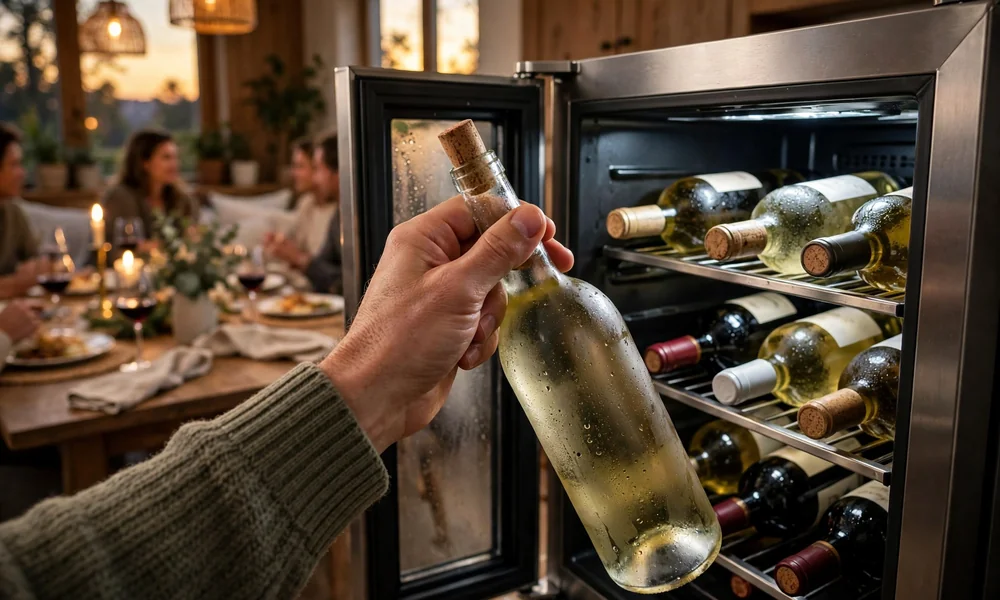
The third mistake is storing bottles upright for months. Corks need contact with the wine to stay swollen and sealed, so bottles should lie horizontally whenever they will sit for more than a few weeks. Finally, do not over-chill: serving a red at 10 degrees mutes its aromas just as surely as serving it at 24 flattens them. A cooler set to 16 degrees with a one-hour chill for whites in the fridge covers almost every bottle you will ever open.
How wine coolers compare with the rest of the kitchen
A wine cooler is a specialist, and specialists only make sense when the generalist fails. The kitchen fridge fails at wine storage on temperature, humidity and vibration all at once, which is why even a small cooler is a genuine upgrade. The right wine glasses make a measurable difference to how a bottle tastes, and they cost far less than a cooler, so they are the first upgrade for anyone starting out. Once the glasses are sorted, a cooler is the next step, and the wines you choose matter more than either. Even the humble electric kettle carries the same lesson: a single-purpose appliance earns its place only when it does its one job properly.
Buyer checklist
- Count your real monthly bottle habit and buy one size up; wide bottles cut stated capacity by a fifth.
- Choose dual-zone only if you store reds and whites together every week; otherwise a single-zone model is cheaper and roomier.
- Pick compressor cooling for rooms that pass 25 degrees in summer, and thermoelectric only for small, quiet, cool rooms.
- Check the noise rating and aim under 40 decibels if the cooler will sit in a living space.
- Confirm UV-protected glass, wooden or soft-close shelves, and a door seal that closes firmly.
- Measure the space with ventilation clearance included, and confirm freestanding or built-in before ordering.
Frequently asked questions
Do I need a wine cooler if I drink wine within a few weeks?
Not necessarily. Wine bought and drunk within a few weeks survives in a cool, dark cupboard, provided the room stays under 22 degrees. A cooler is worth it when bottles sit for months or your kitchen runs warm.
What temperature should I set a single-zone cooler to?
Set it to 15 or 16 degrees. That is close to ideal for reds, and whites only need an hour in the kitchen fridge before serving.
Can a wine cooler go in the garage?
Only if the garage stays between 10 and 25 degrees most of the year. Garages that freeze in winter or pass 30 degrees in summer will make a cooler work too hard, and most manufacturers void the warranty outside that range.
How long do wine coolers last?
A good compressor cooler lasts 8 to 12 years with basic care: clean the condenser coils once a year, keep the vents clear, and do not overload it.
Do wine coolers use much electricity?
A typical 24-bottle compressor cooler uses 100 to 150 kilowatt-hours a year, roughly the same as a small fridge. A thermoelectric model uses less, but only because it cools less.
Is a wine fridge the same thing as a wine cooler?
The terms are used interchangeably, and they mean the same appliance. A beverage cooler is different: it runs colder, down to 2 or 3 degrees, and is built for cans, not wine.
The bottom line
The wine coolers worth making room for in 2026 are the ones that hold a steady temperature in a real kitchen, not the ones with the longest feature list. Buy the size your actual drinking habit needs, choose dual-zone only if you genuinely store reds and whites together, pick compressor cooling for warm rooms and thermoelectric for small quiet ones, and put the cooler somewhere cool, dark and ventilated. Do that, and every bottle will taste the way the winemaker intended.