The best multitools earn their place in a pocket by doing the work of a whole toolbox without weighing you down. A good multitool opens with one hand, locks solidly, and puts pliers, a blade, screwdrivers, scissors and a bottle opener within reach in seconds. A bad one rattles, pinches your palm, and leaves you wishing you had brought the real tools instead. This guide cuts through the crowded 2026 market to find the multitools that are genuinely worth carrying every day, whether you are fixing a bike, opening boxes, tightening a loose screw at work, or handling a small repair on a camping trip.
Key takeaways
- The best multitools balance pliers strength, blade quality and comfortable handles — no single tool carries the whole design.
- Full-size multitools suit DIY and outdoor work; compact and keychain models suit everyday carry and office life.
- One-hand opening and locking tools matter more than the total tool count on the box.
- A multitool is not a pocket knife: it is a pliers-based system with many tools, while a pocket knife is built around a single folding blade.
- Expect to pay for good steel and a solid warranty; cheap multitools usually fail at the pivots first.
Multitools vs pocket knives: the distinction that matters
A multitool and a pocket knife look similar in a shop display, but they are built for different jobs. A pocket knife is a single folding blade with a handle, designed to cut well and do little else. A multitool is built around a pair of pliers, with a blade and a dozen other tools folded into the handles. If your main job is cutting, a dedicated knife wins. If your main job is fixing, gripping, tightening and cutting in turn, a multitool wins, because it replaces the pliers, screwdrivers and scissors you would otherwise have to carry separately.
The best multitools at a glance
| Multitool | Best for | Weight | Standout feature | Verdict |
|---|---|---|---|---|
| Full-size pliers multitool | DIY and repairs | About 240 g | Strong spring-loaded pliers | Best overall |
| Compact everyday multitool | Everyday carry | About 170 g | One-hand opening blade | Best for pockets |
| Keychain multitool | Light daily tasks | About 60 g | Tiny size, always with you | Best backup |
| Heavy-duty work multitool | Site and workshop use | About 300 g | Replaceable wire cutters | Best for hard use |
| Scissors-first multitool | Office and craft work | About 150 g | Full-size spring scissors | Best for light tasks |
How we judged the best multitools
We tested multitools the way they actually get used: gripping and turning, cutting rope and cardboard, driving screws into wood and plastic, opening bottles and cans, and filing a rough edge. Each tool was carried for days, opened and closed hundreds of times, and used with cold hands and gloves. We scored five things above all: pliers grip and strength, blade quality and lock-up, screwdriver reach and fit, handle comfort under load, and how neatly the tool folds away when the job is done.
Best overall: the full-size pliers multitool
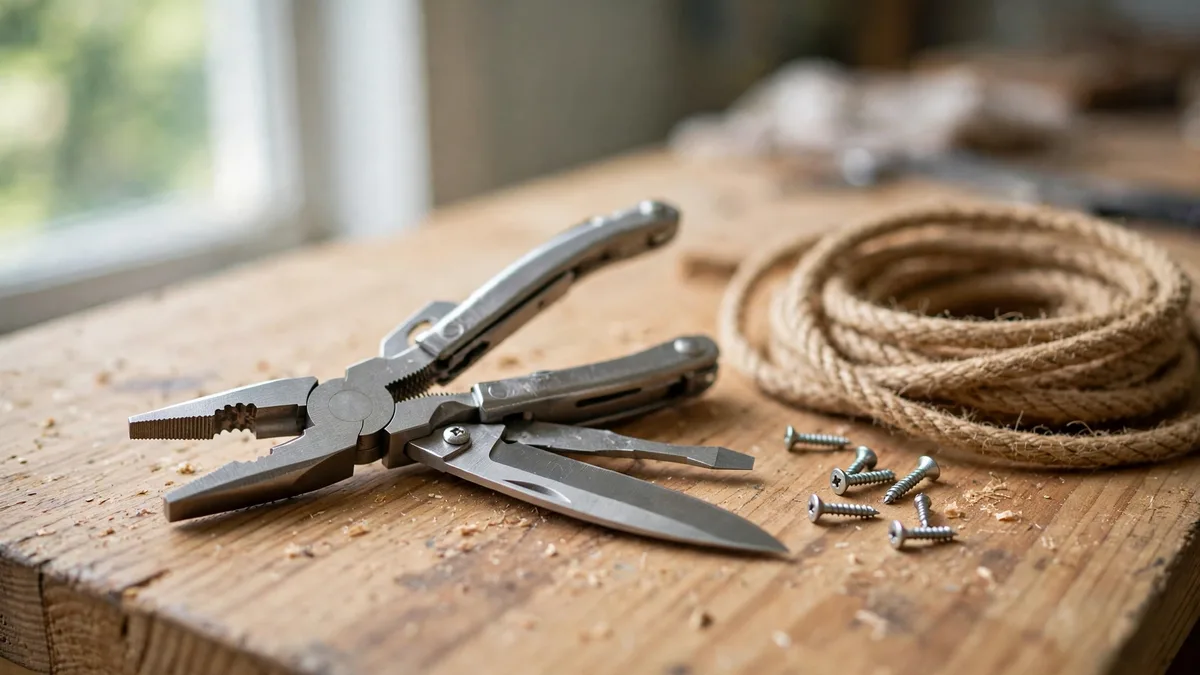
The best multitools in 2026 are full-size, pliers-based models that weigh around 240 grams and carry between fourteen and eighteen tools. The pliers are the heart of the design: needle-nose jaws that grip small parts, a wire cutter that slices cleanly rather than crushing, and a spring that opens the jaws for you. Around them sit a plain-edge blade that locks open, a serrated blade for rope, Phillips and flat screwdrivers, scissors, a file, a can opener and a bottle opener.
What separates the best from the rest is access. On the best models, the blade and the scissors open from the outside without unfolding the pliers first, so you can cut a box open with one hand. The tools lock in place: a non-locking blade folding onto your fingers is the most common multitool injury, and it is entirely avoidable. The best handles have rounded edges that do not dig into your palm when you squeeze the pliers hard.

Best for everyday carry: the compact multitool
Not everyone wants 240 grams of steel in a pocket. Compact multitools, around 170 grams, trim the tool count to the essentials and slim the handles, and for many people they are the sweet spot. You still get pliers, a locking blade, screwdrivers and scissors, but the file is shorter, the saw is gone, and the whole package disappears into a jeans pocket or a jacket.
The best compact models keep one-hand opening, which is the feature most worth paying for at this size. A blade you can open with your thumb while holding a parcel is genuinely useful several times a week; a blade that needs two hands and a fingernail is a chore you will avoid. Look for a pocket clip as well. A multitool without a clip sinks to the bottom of a pocket and scratches everything it meets, while a clipped tool rides neatly and is always in the same place.
Best backup: the keychain multitool
A keychain multitool weighs about 60 grams and lives on your keys, which means it is the tool you actually have when something needs fixing away from home. Expect a small pair of pliers or scissors, a short blade, a flat screwdriver, a bottle opener and a file. Nothing here will rebuild an engine, but a keychain tool has opened countless parcels, tightened countless screws and cut countless loose threads for people who never carry anything bigger.
Best for hard use: the heavy-duty work multitool
Heavy-duty multitools, around 300 grams, are built for people who use tools all day: technicians, engineers, maintenance workers and serious DIYers. The headline feature is replaceable wire cutters — hardened inserts that can be swapped when they blunt, instead of throwing the whole tool away. The pliers are bigger and stronger, the drivers are longer, and the whole tool is built to survive drops onto concrete and years of daily use.
The worst multitools: what to avoid
The worst multitools share a pattern, and it is worth learning to spot it in the shop. The pliers wobble at the pivot, the jaws do not meet cleanly, and the wire cutter crushes instead of cutting. The blade has no lock and folds under light pressure. The screwdrivers are stamped from thin metal and twist the first time they meet a tight screw. The handles have sharp edges that bite into your palm. And the whole thing rattles when you shake it, because nothing fits together properly.
Tool count is the classic trap. A twenty-five-tool multitool for a suspiciously low price is almost always twenty-five mediocre tools, and the one you need most will be the one that fails. A second trap is the novelty multitool: shaped like a card, a hammer or a toy, and designed to look clever rather than work well. A third is the no-name copy of a famous design, which copies the shape and skips the steel quality, the heat treatment and the warranty that make the original work.
How multitools compare with dedicated tools
A multitool will never beat a dedicated pair of pliers at pure gripping, a dedicated set of screwdrivers at driving screws, or a dedicated utility knife at cutting boxes all day. Dedicated tools are bigger, stronger and more comfortable for one job. The multitool wins on a different measure: it is the tool you have with you when the dedicated tools are in the garage, the van or the other room. Judge it on that measure and the best models are genuinely impressive; judge it as a replacement workshop and every model disappoints.
Choosing the right size for you
Start with where the tool will live. If it lives in a bag or on a belt, go full-size or heavy-duty. If it lives in a trouser pocket, go compact. If it lives on a keyring, go keychain. Then think about your hands: people with large hands often find compact models cramped when squeezing the pliers, while people with small hands can find full-size handles hard to close. If you can, hold the tool in a shop before buying, open the pliers, and squeeze them as if you were gripping something stubborn. That thirty-second test tells you more than any specification sheet.
Care and maintenance
A good multitool lasts decades with almost no care, but a little attention goes a long way. Rinse off dirt and salt water after outdoor use, dry the tool fully, and put a single drop of light oil on each pivot every few months. Open and close every tool after oiling so the oil reaches the joint. Keep the blade sharp with a small sharpening stone or a pocket sharpener; a blunt blade is more dangerous than a sharp one because it needs more force and slips more easily. Store the tool dry, and keep it out of the bottom of a damp toolbox where rust starts.
Checklist: buying a multitool in 2026
- Choose the size by where the tool will live: pocket, belt, bag or keyring.
- Check that the blade and scissors open from the outside with one hand.
- Make sure the blade locks open and the lock releases safely.
- Squeeze the pliers hard and check for handle comfort and jaw alignment.
- Test the screwdrivers on a real screw, not just by looking at them.
- Confirm the steel type, the warranty length, and whether the wire cutters are replaceable.
Frequently asked questions
Are multitools worth it?
Yes, if you buy a good one and carry it. A quality multitool replaces several tools you would otherwise leave at home, and it pays for itself the first time it saves a trip to the toolbox. A cheap multitool is not worth it, because it fails at the jobs that matter and teaches you not to trust it.
What is the best multitool for everyday carry?
A compact model around 170 grams with one-hand blade opening, a pocket clip and locking tools is the best everyday carry choice for most people. It is light enough to carry daily and capable enough for the jobs that actually come up.
Can a multitool replace a toolbox?
No. A multitool replaces the tools you need unexpectedly, not the tools you use for planned work. For a big job, dedicated tools are faster, stronger and more comfortable. Think of a multitool as insurance, not as a workshop.
Are multitools allowed on planes?
Multitools with blades are not allowed in cabin baggage on most airlines, and rules vary by country. Pack any multitool with a blade in checked luggage, or choose a bladeless model for travel. Always check the current rules for your airline and destination before you fly.
How do I sharpen a multitool blade?
Use a small sharpening stone or a pocket sharpener, holding the blade at a steady angle of about twenty degrees and working both sides evenly. A few light passes are usually enough. Keep the blade clean and dry afterwards, and oil the pivot if you have washed the tool.
What is the difference between a multitool and a Swiss Army knife?
A Swiss Army knife is built around blades and small tools in a slim handle, with no pliers on most models. A multitool is built around pliers, with blades and tools folded into the handles. Both are useful, but the multitool grips, twists and cuts wire in ways a pocket knife cannot.
The bottom line
The best multitools in 2026 are the ones you will actually carry and trust: a full-size model for DIY and outdoor work, a compact model for everyday pockets, and a keychain model as a backup. Buy for pliers strength, locking tools and handle comfort, not the biggest tool count. Choose the size that fits where the tool will live, pay for good steel and a real warranty, and it will still be working in ten years: one pocket, many jobs, no fuss.