The best bike tools turn a flat tyre, a skipping chain or a wobbling wheel from a trip to the bike shop into a twenty-minute job at home. A good bike tool fits the bolt it was made for, holds up under real force, and feels comfortable when the job gets awkward. This guide covers the tools that genuinely earn a place in a home kit in 2026.
Key takeaways
- A chain tool, tyre levers, hex keys, a torque wrench and a spoke wrench cover nearly every home repair a regular rider will face.
- Bike tools are sized for bicycle bolts, chains and spokes, and they protect parts a household tool would damage.
- Buy the chain tool and tyre levers first, then add a torque wrench before touching anything made of carbon.
- Cheap hex keys are the most common false economy in cycling: soft steel rounds off bolts.
- Keep your tools in one place, clean and dry.
What makes a bike tool different from a general tool
A bicycle is held together by small, precisely made fasteners and thin-walled tubes built to be light rather than tough. That is why bike tools exist as their own category. A household spanner can grip a pedal but will chew the flats; a standard screwdriver can reach a derailleur screw but the wrong tip will slip and scar the head. Bike tools are shaped for the exact job.
The difference is clearest against the kit most people already own. A folding multitool is brilliant on a ride, packing pliers, blades and drivers into one pocket-sized unit, but it is a compromise of short leverage and small handles. Our guide to the best multitools explains that trade-off in full. At home, where weight does not matter, dedicated bike tools win: a proper chain tool pushes a pin straighter than the one folded into a multitool, and a real torque wrench measures force a multitool can only guess at.
The essential bike tools, compared
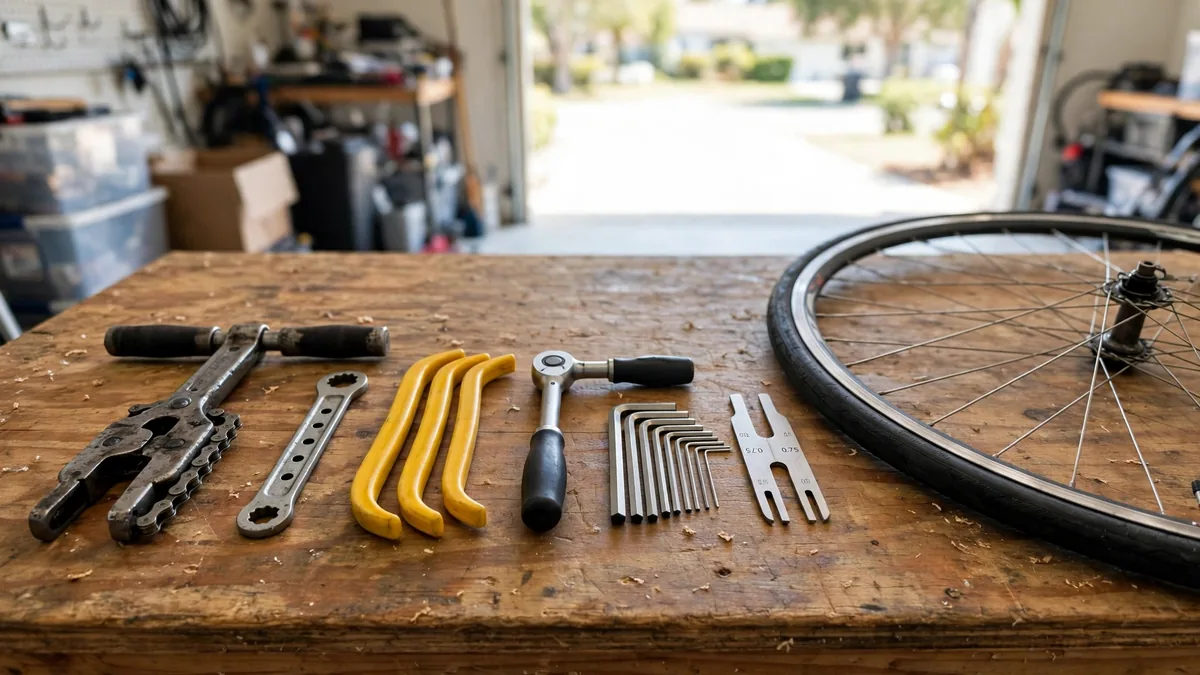
| Tool | What it does | Buy first? | What to look for |
|---|---|---|---|
| Chain tool | Pushes chain pins in and out | Yes | Steel body, replaceable pin |
| Tyre levers | Lift the tyre bead off the rim | Yes | Strong plastic, hooked end, set of three |
| Hex key set | Turns the Allen bolts on a bike | Yes | Hardened steel, ball ends, 2 to 10 mm |
| Torque wrench | Tightens bolts to an exact force | Soon after | 2 to 24 Nm range, clear click |
| Spoke wrench | Turns spoke nipples to true a wheel | Soon after | Correct size, snug fit, no play |
| Cassette lockring tool | Removes the cassette for cleaning | Later | Matching spline pattern |
The chain tool: the heart of the kit
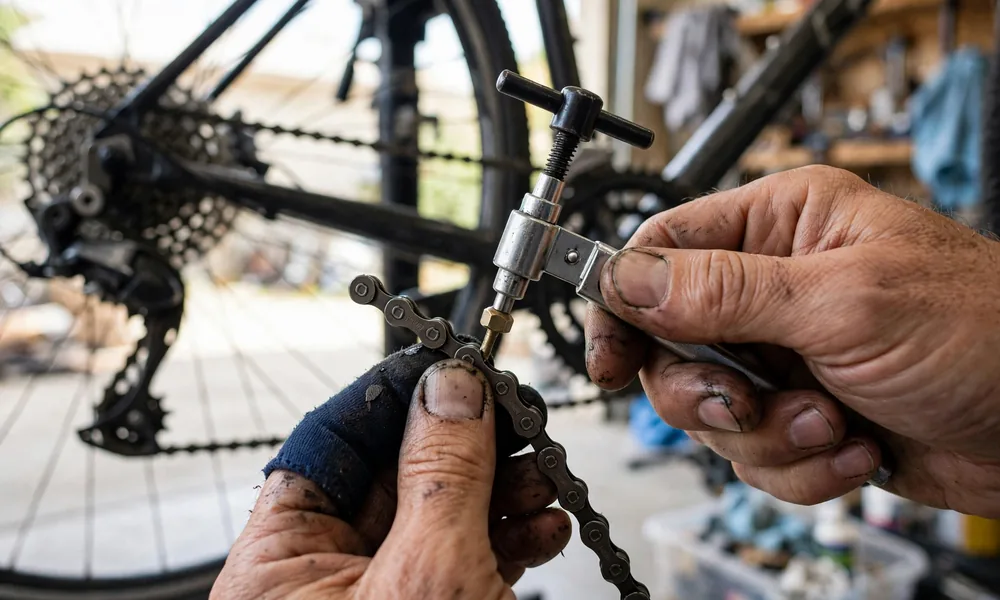
If you buy one bike-specific tool, make it the chain tool. Chains wear, stretch and eventually snap, and every chain job starts with pushing a pin out or joining a new link. A chain tool holds the chain steady while a threaded pin drives the rivet through the link plates. Done well, the chain comes apart cleanly and goes back together just as smoothly.
A good chain tool has a solid steel body that does not flex, a pin that stays straight under load, and a handle long enough to give leverage without hurting your palm. Cheap models fail at the pin first, so look for a replaceable one. Check compatibility too: modern chains run from 8 to 12 speed, and the links get narrower as speeds go up, so a tool made for older chains may not seat a 12-speed link.
Tyre levers and the puncture kit
Tyre levers are the simplest tools in the kit and the ones you will reach for most often. They lift the tyre bead over the rim edge so you can reach the inner tube, then help seat the bead again when the repair is done. A set of three is standard: two to hold the bead off the rim and one to work around the rest of the tyre. Plastic levers suit most riders: strong enough for the job, kind to rims, and light enough to carry on every ride.
Levers belong with a puncture kit, not on their own. A spare tube, a small pump, self-adhesive patches and a way to find the hole are the rest of the system. Keep a roadside kit on the bike and a fuller set at home. Our guide to the best bike pumps covers which type suits which rider.
Torque wrench: the tool that stops expensive mistakes
A torque wrench is the least glamorous tool here and the one that saves the most money. Modern bikes, especially those with carbon frames, forks, seatposts and handlebars, have bolts that must be tightened to a specific force, measured in newton-metres. Too loose and a part slips or works free while you ride. Too tight and you can crack a carbon tube, crush a seatpost or strip a thread.
A bicycle torque wrench usually covers 2 to 24 newton-metres, spanning almost every bolt on a bike, from 4 Nm stem bolts to 20 Nm crank bolts. The best ones click clearly at the set value and come with the hex and Torx bits a bike uses. Set the value, tighten steadily until you feel and hear the click, then stop. Never use a torque wrench to loosen bolts, and always return the setting to its lowest value before putting it away.
Spoke wrench and wheel truing
A wheel that wobbles or rubs the brake pads usually has uneven spoke tension, and a spoke wrench is the tool that fixes it. The wrench grips the small nipple where each spoke meets the rim, and turning it tightens or loosens that spoke, pulling the rim back towards true. It is a small, cheap tool that does a job nothing else can do.
The catch is sizing. Spoke nipples come in several sizes, and a wrench even slightly too large will round the nipple off, turning a small adjustment into a wheel rebuild. Many wrenches cover three or four common sizes, which is the sensible buy for a home kit. Truing rewards small moves: turn a nipple a quarter of a turn, spin the wheel, check the wobble, and repeat.
Hex keys, screwdrivers and the home workstand
Hex keys, also called Allen keys, are the fasteners of the modern bicycle. Stem bolts, seat clamps, brake callipers, derailleur clamps, bottle cages and most accessories are all held on with them, usually in sizes from 2 mm to 10 mm, with 4, 5 and 6 mm doing most of the work. A good set is made from hardened steel that does not twist or round off.
Cheap hex keys are the most common false economy in cycling. Soft steel deforms, and once a key has rounded, it starts rounding the bolt heads it touches. Replacing a rounded bolt buried in a stem or seatpost is a miserable job that always costs more than the decent key set would have. Buy from a reputable tool maker, keep the set in its holder so a missing size is obvious, and replace individual keys when they show wear. A couple of screwdrivers round out the hand tools: a Phillips head for derailleur limit screws and a flat head for prying. Neither needs to be bicycle-specific, but both must fit properly, because a screwdriver that slips will chew the head and make future adjustments guesswork.
What to skip when you start out
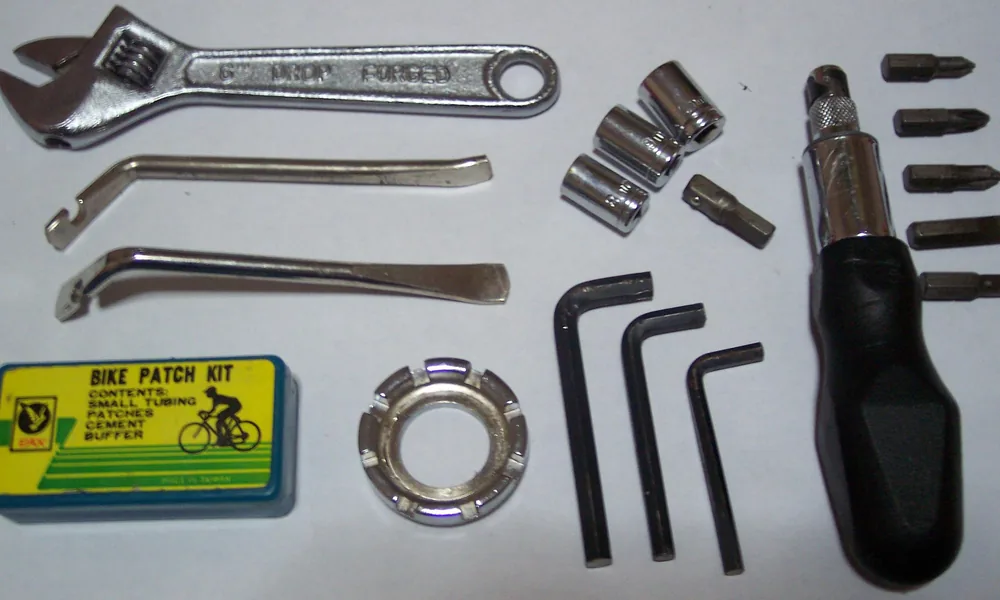
Not every bike tool deserves a place in a first kit. Bottom bracket tools, headset presses, hydraulic brake bleed kits and bearing presses are specialist tools for jobs most riders do once every few years, if ever. Leave these to a bike shop until you have a clear, repeated need for one.
The same goes for a full professional tool case. It looks impressive, but half its contents will gather dust in a home that services one or two bikes. Start with the essentials in this guide, add tools one at a time as real jobs demand them, and you will end up with a kit that matches the way you actually ride. Money saved on tools you never use can go towards the parts that wear out: tyres, chains, brake pads and cables.
Building your kit on a budget
A solid home bike tool kit does not need to cost a fortune. The essentials, a chain tool, tyre levers, a hex key set, a spoke wrench and a basic torque wrench, can be bought for the price of two or three shop services, and they pay for themselves within a year if you ride regularly.
Quality matters more than quantity at this price level. A mid-range chain tool from a known bicycle tool maker will outlast three cheap ones and do a better job every time. Look for tools with replaceable wear parts, such as chain tool pins, and for brands that sell spares, because a tool you can repair is a tool you keep. Storage matters too: a small toolbox keeps everything in one place and makes a missing tool obvious. A good lock is what keeps the bike yours, as our guide to the best bike locks explains.
Checklist: setting up your bike tool kit
- Start with a chain tool, tyre levers and a hardened hex key set in sizes 2 to 10 mm.
- Add a torque wrench covering 2 to 24 Nm before you adjust anything made of carbon.
- Match the spoke wrench to your nipple size and check the fit before you turn anything.
- Keep a roadside kit on the bike at all times.
- Store tools clean, dry and in one place so a missing tool is obvious at a glance.
- Replace worn parts before they damage a bolt.
Frequently asked questions
What bike tools do I need as a beginner?
A chain tool, three tyre levers, a hex key set from 2 to 10 mm and a mini pump handle nearly every beginner job: punctures, chain sizing, saddle and handlebar adjustments, and fitting accessories.
Are bike tools different from normal tools?
Yes. Bike tools are sized and shaped for bicycle parts: narrow chain links, small Allen bolts, spoke nipples and cassette splines. Household tools are usually too large and can damage parts.
Do I need a torque wrench for a bike?
You need one if your bike has carbon parts. Carbon cracks under over-tightening, and the correct torque for a stem or seatpost bolt is far lower than most people guess. A torque wrench costs less than one cracked carbon part.
Can I use a multitool instead of bike tools at home?
For roadside repairs, yes, and that is what a multitool is for. At home, dedicated tools are better: longer leverage, better fit, more accurate torque and a chain tool that works properly.
How often should I replace my chain tool?
The tool itself can last for years, but the pin is a wear part. Replace it when it starts to bend, mushroom or push off-centre. A worn pin damages chains, so replacing it promptly is cheaper than replacing a chain.
What is the most common home mechanic mistake?
Over-tightening bolts, especially on carbon parts, followed closely by using the wrong size hex key and rounding a bolt head.
The bottom line
The best bike tools are the ones that fit your bike, survive real use and get used often enough to pay for themselves. Start with a chain tool, tyre levers and good hex keys, add a torque wrench and a spoke wrench as your confidence grows, and skip the specialist tools until a real job demands them.