
How to Choose a Charcuterie Board for Effortless Hosting in 2026
A good charcuterie board does more work than almost anything else you own for entertaining. It is the centrepiece, the conversation starter and the dinner itself on the nights when cooking a full meal feels like too much. The right charcuterie board makes a handful of cheeses, cured meats and crackers look generous and considered, while the wrong one leaves food crowded, sliding off the edges and looking smaller than it is. Choosing well is not about spending the most money. It is about matching the board to the way you actually host, the size of your table and the food you like to serve.
Key takeaways
- Size matters more than material: a board that is too small is the single most common hosting mistake.
- Wood is the most forgiving everyday choice, while marble and slate suit cheese-led spreads and cooler rooms.
- Round boards suit small tables and grazing; long rectangular boards suit buffets and larger groups.
- A board with a handle is easier to carry from kitchen to table, but a handle eats into serving space.
- Buy for the largest gathering you host regularly, not the smallest, and keep a second small board for two.
Start with how many people you feed
Before looking at wood grain or marble veining, count heads. A board that serves four comfortably will look sparse and stingy for ten, and a board built for twelve will dominate a table set for two. The most useful rule is simple: allow roughly 15 to 20 centimetres of board edge per guest for a grazing spread, and more if the board is the whole meal rather than a starter. For a couple, a board around 30 centimetres across is plenty. For six to eight guests, look for something in the 45 to 60 centimetre range, or plan on two boards rather than one enormous one. Two medium boards are often better than one giant one, because you can place them at opposite ends of the table so nobody has to reach across a neighbour, and you can refill one while the other stays in play.

Wood, marble, slate or bamboo: what actually differs
Material changes how a board behaves, how it looks and how much care it needs. Wood is the classic for good reason. Hardwoods such as acacia, walnut and olive wood are dense enough to resist deep knife marks, warm to look at, and kind to cheese: they do not chill food the way stone does, and they feel right in a room full of people. Wood needs oiling now and then and should never go in the dishwasher, but a well-kept wooden board lasts for years and looks better with use. Bamboo is lighter and cheaper, and it is harder than many woods, which sounds like an advantage until you notice it can be tough on knife edges and sometimes feels less substantial in the hand. It is a fine choice for a second board or for outdoor use, where its lightness is a genuine plus.
Marble and slate bring a different mood. Marble stays cool, which keeps soft cheeses from slumping on a warm evening, and its pale surface makes colours pop in a way wood never quite does. The trade-off is weight and fragility: a marble board is heavy to carry when loaded, it can chip if knocked against a worktop edge, and acidic foods such as pickles and citrus can mark it over time. Slate is lighter than marble and its dark surface makes pale cheeses and crackers stand out beautifully, but it is usually smaller, it can be brittle at the edges, and chalk labels — charming in theory — rub off the moment someone sets a glass down. For most hosts, the honest answer is one good wooden board for everyday use and, if you love the look, a marble or slate board for cheese-led occasions. If you want to see how different serving surfaces behave once food is actually on them, our guide to serving platters that make hosting easier is a useful companion read.
Shape and edges: round, rectangular or paddle
Shape is not just style. A round board has no corners for food to get stranded in, and it suits a round table or a small group gathered close. The drawback is that a round board wastes the corners of a rectangular table, and it is harder to arrange food in neat rows. A rectangular board is the most practical shape for a crowd: it lines up with the table, it holds rows of sliced meat and cheese efficiently, and it is easy to carry with two hands. Paddle boards — rectangular or round boards with a handle — are the easiest to move from kitchen to table and look wonderful leaning against a kitchen wall between uses. The handle costs you serving area, though, and a long handle can make the board awkward on a crowded table.
What to look for in the build
Thickness is a quiet quality signal. A board thinner than about two centimetres can warp over time and feels flimsy when carried loaded, while one between two and four centimetres feels solid and sits flat. Check that it does not rock when you press opposite corners, and look for feet or rubber pads that stop it sliding. Handles should be part of the board rather than screwed on, since screws loosen with washing and heat.
How to arrange food so the board does the work
A good board earns its keep in the arrangement. Start with the largest items first: place cheeses at different points around the board, then add the meats, folding salami into ribbons and prosciutto into loose rosettes so they take up air rather than lying flat. Next come the bowls — olives, honey, mustard — because they anchor the layout, then fill the gaps with crackers, bread, nuts and dried fruit, and finish with fresh fruit and herbs for colour. Leave a little breathing room between groups so guests can see what things are and reach them without dismantling the display.
Colour and texture do more for the look than any garnish trick: add something dark, something red and something green, and leave breathing room between groups so guests can reach everything without dismantling the display. Choosing the cheeses is half the arrangement, and our roundup of the best and worst cheeses of 2026 will help you pick a spread with something for every taste.
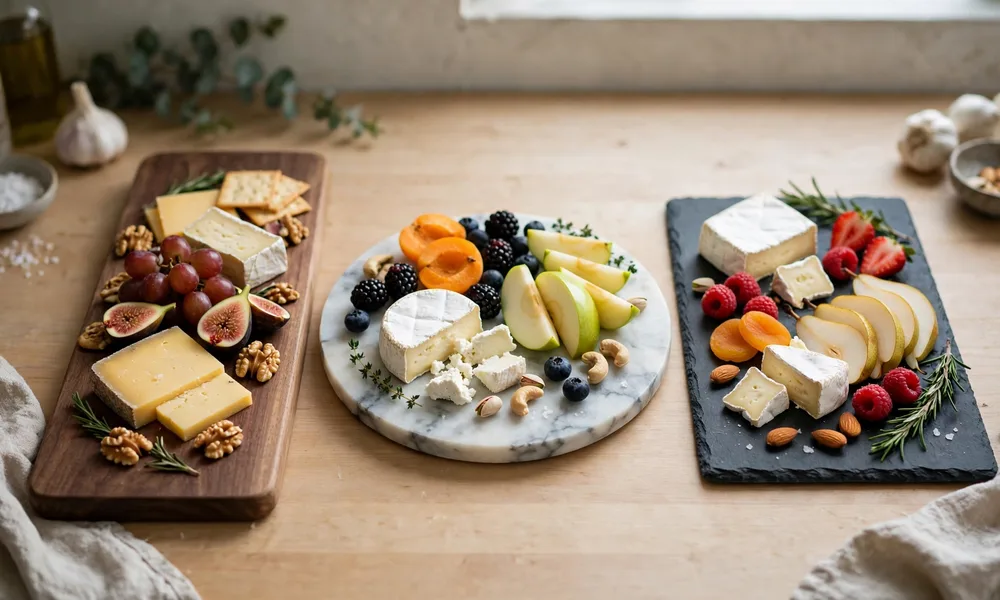
Comparing the main board types
| Board type | Best for | Watch out for | Care |
|---|---|---|---|
| Acacia or walnut wood | Everyday hosting, mixed spreads | Needs oiling; no dishwasher | Hand wash, oil monthly |
| Bamboo | Outdoor use, second board | Hard on knives; can feel light | Hand wash, oil occasionally |
| Marble | Cheese-led boards, warm rooms | Heavy; chips; stains from acid | Wipe clean, seal yearly |
| Slate | Striking presentation, small groups | Brittle edges; small sizes | Hand wash, oil to deepen colour |
| Paddle board with handle | Carrying to the table, display | Handle eats serving space | As per material |
| Round board | Small tables, grazing for two to four | Less efficient on rectangular tables | As per material |
Care, cleaning and storage
A board that is cared for will outlast several sets of plates. Wash wooden boards by hand with warm soapy water, dry them standing on edge, and never soak them or put them in the dishwasher: soaking swells the fibres and dishwashers crack them. Once a month, rub in a food-safe mineral oil or board butter and leave it overnight. That single habit is the difference between a board that looks tired after a year and one that looks better after five. Marble and slate need less fuss — a wipe with warm soapy water and a dry cloth — but marble benefits from a yearly seal, and slate looks richer with an occasional rub of food-safe oil.
Store boards upright, like books on a shelf, rather than stacked flat under a pile of pans, and keep them away from radiators and sunny windowsills, since heat dries wood unevenly and can cause cracking. A good cutting board is a different tool from a serving board, so do not use your charcuterie board as a chopping block — deep knife cuts are where bacteria and stains settle in.
Common mistakes to avoid
The first mistake is buying too small, and the second is buying for a fantasy: a board built for a banquet you host once a year will sit in a cupboard, while one matched to your ordinary Friday night gets used constantly. The third is forgetting the table itself — a dark slate surface can be hard to see in a dim room, and pale marble shows every drop of red wine. The fourth is overfilling: leave gaps, and keep extra food in the kitchen to refill as the evening goes on.
Charcuterie board checklist
- Measure your table and count your usual guests before choosing a size.
- Pick hardwood for everyday use; add marble or slate only if you love the look.
- Check the board sits flat, feels solid, and is comfortable to carry with two hands.
- Choose a shape that fits your table: round for small tables, rectangular for crowds.
- Look for a food-safe finish, smooth edges and a handle that is part of the board.
- Plan the arrangement: cheeses first, then meats, bowls, fillers and fresh colour last.

Frequently asked questions
What size charcuterie board do I need for eight people?
For eight guests, a board around 50 to 60 centimetres long, or two medium boards placed at opposite ends of the table, works best. One board that size can hold a full spread, but two boards are easier for guests to reach and simpler to refill during the evening.
Is wood or marble better for a charcuterie board?
Wood is better for everyday hosting: it is lighter, warmer, kinder to knives and easier to live with. Marble is better for cheese-led spreads in warm rooms because it stays cool and keeps soft cheeses firm. Many hosts end up with one of each and use the wooden board most often.
Can I put a wooden charcuterie board in the dishwasher?
No. Dishwashers and soaking crack and warp wood. Wash by hand with warm soapy water, dry the board standing on its edge, and oil it monthly with a food-safe oil to keep it in good condition.
How much food should I put on a charcuterie board?
As a rough guide, allow about 60 to 90 grams of cheese and 60 grams of cured meat per person when the board is a starter, and roughly double that when it is the main food. Fill the remaining space with crackers, bread, fruit, nuts and something pickled for contrast.
Do I need a board with a juice groove?
It helps if you serve runny cheeses, olives in oil or anything with honey, because it stops liquids reaching the tablecloth. On a small board it steals useful space, so it is worth having on a large board and easy to skip on a compact one.
How do I stop a charcuterie board sliding on the table?
Place a damp tea towel or a piece of non-slip shelf liner underneath, or choose a board with small rubber feet. Both are cheap fixes, and they also protect the table from scratches when the board is moved.
The bottom line
The best charcuterie board for effortless hosting in 2026 is the one that fits your table, your guest list and your habits — usually a solid hardwood board, sized for the largest group you host regularly, with enough room for food to breathe. Buy for real evenings rather than imaginary banquets, keep a second small board for quiet nights, and look after the wood. Do that, and the board will do the hosting for you: set it down, step back, and let your guests gather round it.


