
Best Kitchen Sinks 2026
A kitchen sink is the hardest-working fixture in the house. It washes the vegetables, soaks the roasting tin, rinses the muddy boots, and holds the washing-up while dinner is still on the table. A good one makes all of that feel easy, and a bad one makes every meal end with a splash on the floor and a puddle under the cupboard.
Get the sink right, though, and the whole kitchen works better: the tap sits where your hands naturally fall, the bowls are deep enough for the largest pan, and the worktop stays dry. These are the best kitchen sinks of 2026, chosen for size, material, depth, and how well they stand up to daily use.
Key Takeaways
- Buy the sink for the largest pan you own, because a bowl that swallows a roasting tin saves more time than any other feature.
- Depth matters as much as width, since a bowl at least 20 centimetres deep keeps splashes inside instead of on the worktop.
- Stainless steel suits busy family kitchens, while ceramic and granite composite suit quieter kitchens where looks matter most.
- Check the cabinet underneath before you buy, because the sink, the waste, and the tap all need room to fit together.
- Match the tap to the sink, not the other way round, since a tap that is too short or too tall will fight you every day.
Kitchen Sinks 2026 at a Glance
| Best for | Sink type | Bowl depth | Standout strength |
|---|---|---|---|
| Best overall | Single-bowl stainless steel undermount | 22 cm | Deep, quiet, and easy to wipe clean |
| Best for small kitchens | Compact single-bowl inset | 18 cm | Fits a 45 cm cabinet and still holds a pan |
| Best for large families | Double-bowl stainless steel | 20 cm | One bowl to wash, one to rinse or stack |
| Best for looks | Ceramic farmhouse sink | 22 cm | A wide apron front that anchors the room |
| Best for hard water | Granite composite sink | 21 cm | Hides limescale and shrugs off scratches |
| Best for a busy cook | Single bowl with drainer | 20 cm | A draining board built into the worktop space |
What a Kitchen Sink Is Really For
A kitchen sink does three jobs at once. First, it holds water for washing, soaking, and rinsing, from salad leaves to baking trays. Second, it catches the mess of cooking, so the worktop stays clear while you work. Third, it sets the height and the reach of the tap, which decides how comfortable the sink feels to use for ten minutes at a time.
It helps to think of the sink and the tap as one unit. The tap decides how the water lands in the bowl, and a tap that is too short forces you to hold pans at an angle, while a tap that is too tall sprays the worktop. Our guide to the best kitchen faucets of 2026 covers spout height, pull-out sprays, and finishes in detail, so you can match the two together.
Getting the Size Right
Size is where most kitchen sink purchases go wrong. Measure the cabinet underneath, the worktop cut-out, and the largest pan you own, then buy the sink that fits those numbers. A standard base cabinet is 60 centimetres wide, which takes a sink around 50 to 55 centimetres wide, while a 45-centimetre cabinet needs a compact sink of about 40 centimetres.
Depth follows the same logic. A bowl 18 centimetres deep is the minimum for a kitchen that cooks most days, and 20 to 23 centimetres is better if you wash large pans by hand. Deeper bowls hide the washing-up and keep splashes inside, but they also mean bending further down, so anyone with a bad back should try the depth in a showroom before committing.
The Main Types of Kitchen Sink
The single-bowl sink is the safest choice for most homes: one deep bowl with no divider, so the largest pan fits flat on the bottom. Its strength is space, and its weakness is organisation, since everything goes into the same bowl and the clean and the dirty share the water.
The double-bowl sink splits the space into two bowls, often one large and one small. The large bowl takes the washing-up and the small bowl takes rinsing, draining, or the food waste. It is the best choice for a household that washes up by hand every day, but the divider is a real limit, so measure your largest pan against the larger bowl before you buy.
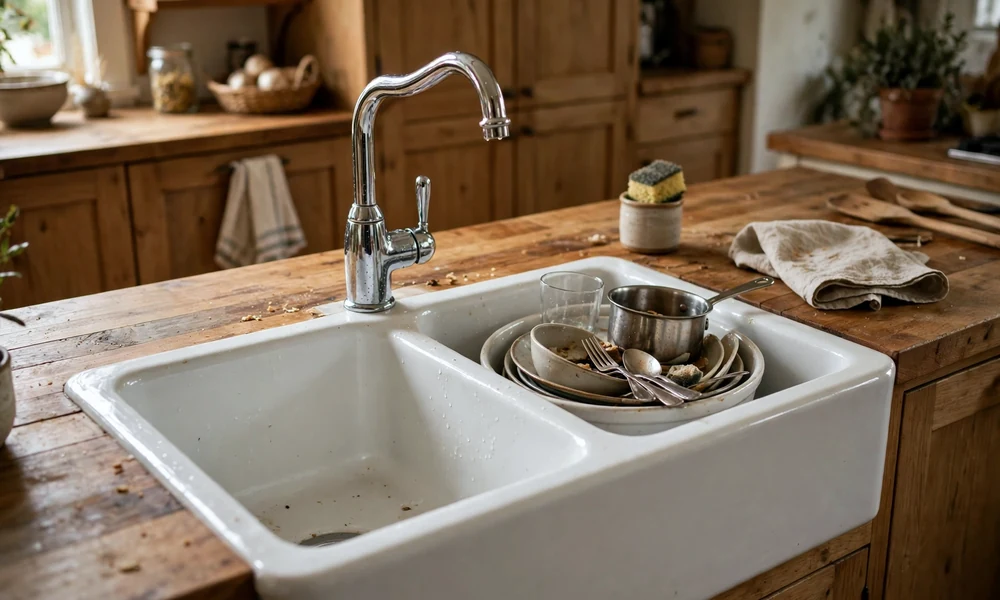
The farmhouse sink, also called an apron-front sink, has a deep bowl and a front panel that sits proud of the cabinet. It looks wonderful in a country kitchen and the deep bowl swallows tall stockpots, but it needs a special cabinet with the front cut away, so it is a job for a new kitchen rather than a simple replacement.
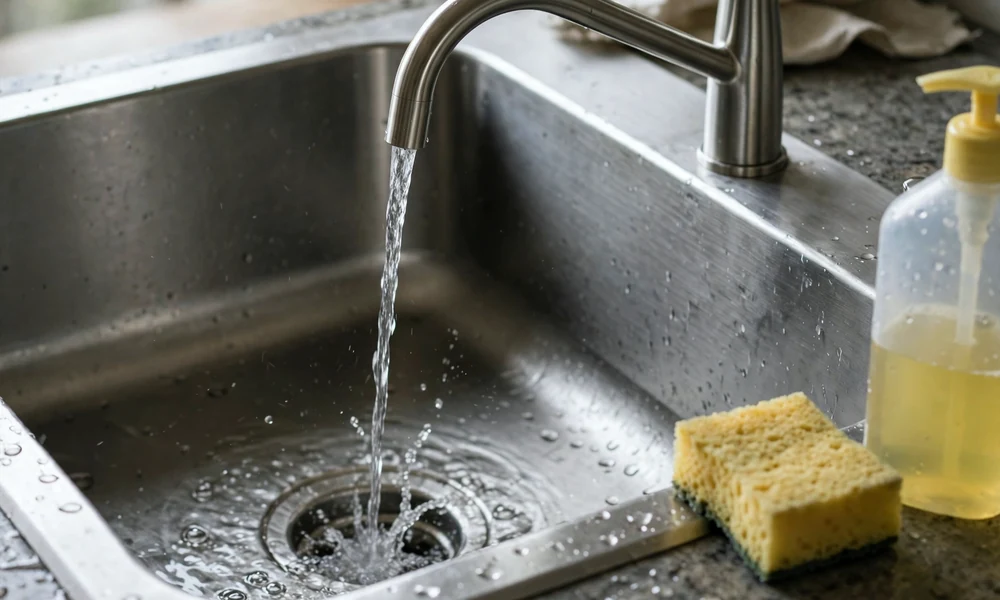
The sink with a drainer adds a grooved draining area beside the bowl, either built into the sink or as part of the worktop. It is the best choice when there is no dishwasher and the washing-up air-dries on the side. If you would rather keep the worktop clear and dry dishes over the sink itself, our guide to the best dish racks for a small kitchen in 2026 covers over-sink racks that free the counter completely.
Materials and Build Quality
Stainless steel is the classic choice, and it earns its place. A good steel sink is 18-gauge or thicker, feels solid under the hand, and resists stains, heat, and dents. Thinner steel, sometimes called 20-gauge or 22-gauge, is cheaper and noisier, and it flexes when a heavy pan lands in it. Look for sound-dampening pads underneath and a brushed finish, which hides water marks far better than a mirror polish.
Ceramic sinks, usually fireclay, are heavy, hard, and beautiful, with a smooth white surface that suits a farmhouse kitchen. They resist stains and heat, but a dropped cast-iron pan can chip the glaze, and the weight means the cabinet needs extra support. Granite composite, a mix of stone and resin, is the toughest of the three: it hides limescale, shrugs off scratches, and stays quiet, though dark colours can show water marks in hard-water areas.
Installation: Undermount, Inset, and Flush
How the sink sits in the worktop matters as much as the sink itself. An undermount sink is fixed beneath the worktop, so crumbs wipe straight into the bowl and there is no rim to trap dirt. It needs a solid worktop, such as stone or solid wood, and a strong cabinet, because the sink hangs from the underside.
An inset sink, also called top-mount, drops into a cut-out from above and sits on a rim around the edge. It fits almost any worktop, including laminate, and it is the easiest to replace, since the new sink can use the same hole. The rim is the trade-off: it traps crumbs and water, and it needs resealing every few years. A flush-mount sink sits level with the worktop for a clean look, but it needs a precise cut-out and a skilled fitter.
Drainage, Strainers, and Accessories
A sink is only as good as its drainage. Check the waste fitting before you buy: a standard 90-millimetre waste takes a basket strainer, which catches food and lifts out for emptying, while a smaller waste clogs faster and is harder to clean. A basket strainer is worth having in every kitchen, and a second one for the smaller bowl of a double sink saves fishing food out of the drain.

Cleaning and Everyday Care
Stainless steel needs little more than a wipe after use. Rinse the bowl, wipe it dry with a cloth, and the water marks stay away. Avoid wire wool and chlorine bleach, which scratch and stain the surface, and use bicarbonate of soda for the marks that do appear. Ceramic is just as simple: a soft cloth and washing-up liquid, with a paste of bicarbonate for tea and coffee stains.
The tap area needs attention too. Wipe the base of the tap and the soap dispenser once a week, since water pools there and leaves marks on the worktop. A pump dispenser that sits in a hole in the sink or the worktop keeps the bottle off the side, and our guide to soap dispensers that pump cleanly every time in 2026 covers the models that do not clog or drip.
Common Mistakes to Avoid
The most common mistake is buying the sink before measuring the cabinet: people remember the worktop width and forget the cabinet underneath, then discover the bowl is wider than the unit it must sit in. The second is choosing a double bowl without measuring the largest pan against the bigger bowl. The third is picking a thin steel sink that drums every time a plate lands in it. The fourth is forgetting the waste and the tap holes, which must match the sink and the worktop. The fifth is ignoring the depth, especially in a household that washes large pans by hand. Finally, do not buy a farmhouse sink for a standard cabinet, since the front panel needs a cabinet built to take it.
Before You Buy: A Short Checklist
- Measure the cabinet width and the worktop cut-out, and buy a sink that fits both with room for the waste.
- Measure the largest pan against the bowl, and check the depth against your back and your reach.
- Check the steel gauge or the composite thickness, and look for sound-dampening pads underneath.
- Count the tap holes and the waste size, and confirm they match the tap and the plumbing.
Frequently Asked Questions
What size kitchen sink do I need for a 60 cm cabinet? A 60-centimetre cabinet takes a sink around 50 to 55 centimetres wide, with a bowl about 45 centimetres across. A wider sink will not fit the cabinet, however good it looks in the showroom.
Is a single bowl or a double bowl better? A single bowl is better if you wash large trays and pans by hand, since nothing blocks the space. A double bowl is better if you wash up by hand every day and want one bowl for washing and one for rinsing or stacking.
How deep should a kitchen sink be? At least 18 centimetres for a kitchen that cooks most days, and 20 to 23 centimetres if you wash large pans by hand. Deeper bowls keep splashes inside but mean bending further down, so try the depth before you buy.
The Bottom Line
The best kitchen sink of 2026 is the one that fits your cabinet, your largest pan, and the way you actually wash up, and then quietly does its job for years. It is deep enough to hide the washing-up, wide enough for the roasting tin, quiet when a plate lands in it, and easy to wipe clean at the end of the day.
Start with the tape measure, not the catalogue. Measure the cabinet, the cut-out, and the biggest pan, count the tap holes, and then choose the type that fits: a deep single bowl for a busy cook, a double bowl for a household that washes by hand, a farmhouse sink for a new country kitchen, or a granite composite bowl if hard water is your daily battle.


