A Guide to Santoku Knives for Everyday Prep in 2026
A good santoku knife can quietly change the way you cook. Shorter, lighter and flatter than a classic chef knife, the santoku is built for the everyday prep most home cooks actually do: slicing vegetables, dicing onions, mincing garlic and cutting fish into neat, even pieces. If your chef knife feels too long or too heavy, a santoku knife for everyday prep in 2026 might be the single best upgrade you make to your kitchen.
The santoku comes from Japan, where its name means roughly “three virtues” — it handles meat, fish and vegetables with equal ease. This guide explains what makes one different, how to choose it, and which models are worth your money in 2026.
Key Takeaways
- A santoku is shorter and flatter than a chef knife, with a sheepfoot tip that suits straight push cuts rather than rocking.
- Most home cooks are happiest with a 16 to 18 cm blade: long enough for large vegetables, short enough to control precisely.
- Granton dimples help thin slices of potato, cucumber and fish release from the blade instead of sticking.
- Harder Japanese steel stays sharper longer but needs gentler handling, while softer stainless steel is tougher and easier to sharpen at home.
- A santoku pairs best with a good board and regular honing, and should never be used on bones, frozen food or very hard squash.
What Makes a Santoku Different From a Chef Knife
Hold a santoku next to a chef knife and the differences are obvious. The santoku blade is shorter, usually 16 to 18 cm against the chef knife’s 20 cm, and its edge is much flatter, with almost no curve toward the tip. The tip curves down in a gentle sheepfoot shape, so there is no sharp point to catch on the board — and that flat edge meets the board along its full length, so every part of the blade cuts with one straight downward push.
A chef knife, by contrast, is built to rock: its curved edge lets you pivot the tip and slice with a rolling motion. The santoku trades that for clean, straight cuts, and if you chop by lifting the blade and pressing down, it will feel natural within minutes. It is also lighter, usually 150 to 200 grams, so long prep tires your wrist far less. For the full comparison, our guide to the best chef knives of 2026 covers the classic 8-inch blades side by side.
The Sheepfoot Tip and the Flat Edge
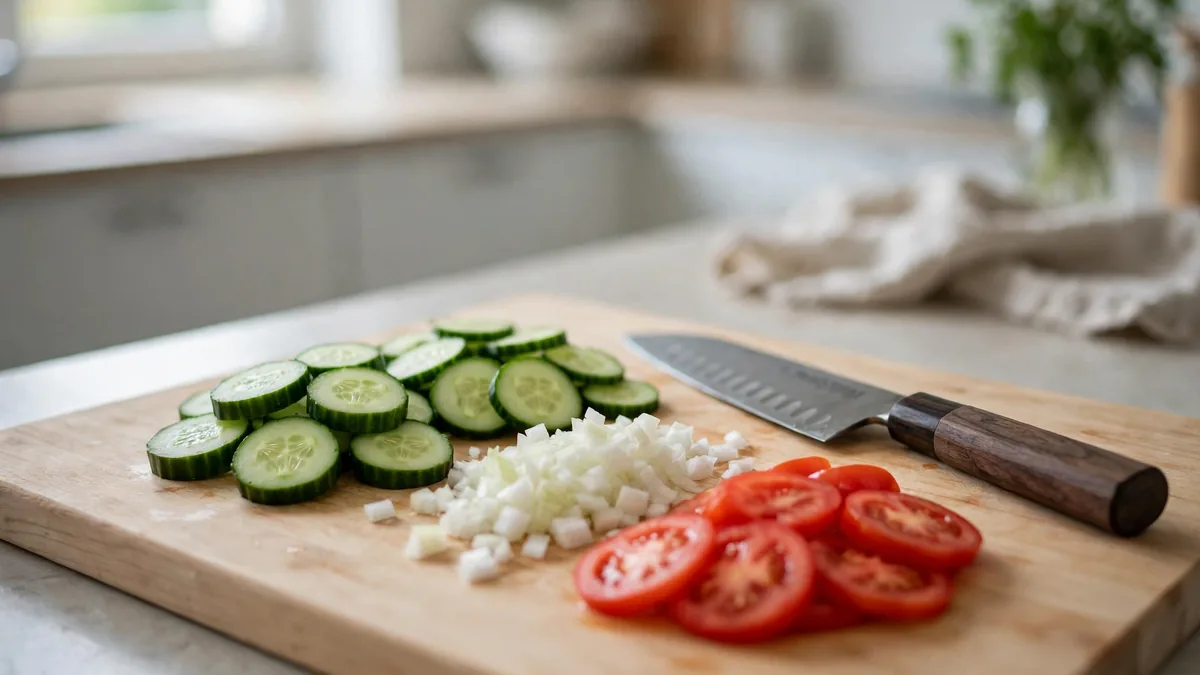
The sheepfoot tip is not just a style choice: because the spine curves down to meet the edge, the point is blunt and safe, and the whole edge stays in contact with the board. That makes the santoku excellent for thin, even slices — cucumber rounds come out uniform, potatoes slice without wedging, and fish fillets cut in one smooth draw — and the wide blade scoops chopped food off the board like a bench scraper.
The trade-off is that a santoku is poor at piercing: it will not start a cut in a large squash or score a roast, so keep a small paring knife nearby.
Granton Dimples: Do They Actually Help?
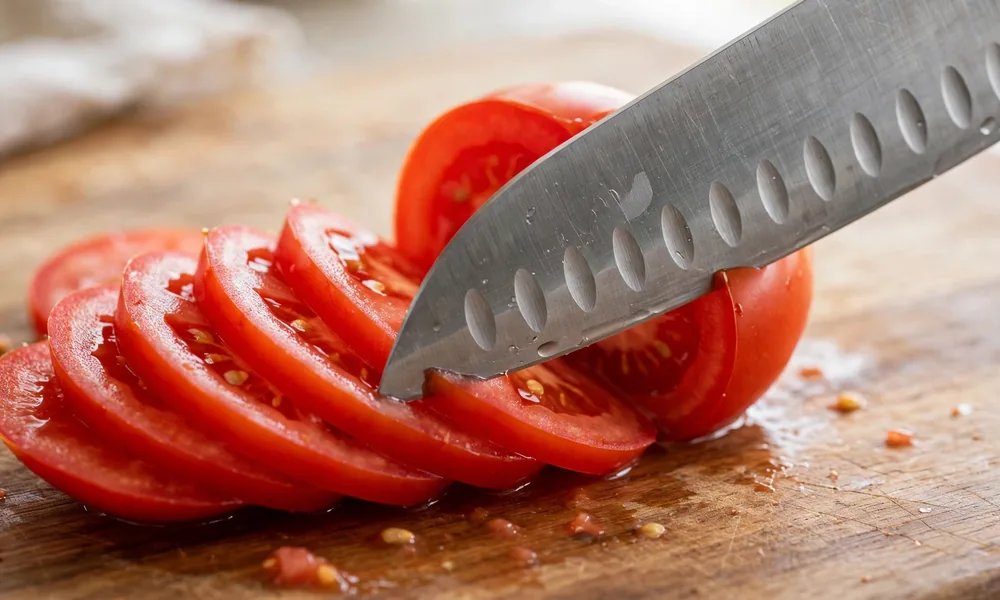
Many santoku blades carry a row of shallow oval dimples along each side, known as a granton edge. These pockets create tiny air gaps between blade and food, reducing the suction that makes thin slices stick. With wet foods like cucumber, potato and raw fish, the difference is real: slices fall away instead of clinging to the steel.
Granton dimples are not magic: they help most with thin, wet slices and least with dry foods, and a sharp plain blade still beats a dull granton one. On an otherwise good knife they are a genuine bonus.
The Best Santoku Knives of 2026 at a Glance
| Knife | Steel | Blade | Weight | Best For |
|---|---|---|---|---|
| Shun Classic Santoku 7-Inch | VG-MAX Damascus | 18 cm | 185 g | Overall excellence |
| Global G-48 Santoku 7-Inch | Chromium stainless | 18 cm | 175 g | Light, fast prep |
| Victorinox Fibrox Pro Santoku 7-Inch | High-carbon stainless | 17 cm | 170 g | Best value |
| MAC Superior Santoku 6.5-Inch | High-carbon stainless | 16.5 cm | 150 g | Precision and control |
| Wüsthof Classic Santoku 7-Inch | High-carbon stainless | 18 cm | 230 g | Heft and durability |
Best Santoku Overall: Shun Classic Santoku 7-Inch
The Shun Classic santoku is the benchmark for this shape, and it shows from the first cut. Its VG-MAX core, clad in layers of Damascus steel, takes an edge so fine that tomatoes slice under their own weight and herbs come out cleanly cut rather than bruised. and the granton dimples work exactly as intended.
At 185 grams it feels substantial without being heavy, and the D-shaped pakkawood handle fits the hand beautifully. It is a premium knife, but the one most likely to still be your favourite in ten years — treat it kindly and it rewards you with extraordinary sharpness.
Best Lightweight Santoku: Global G-48 Santoku 7-Inch
The Global G-48 is the santoku for cooks who prep for an hour and want their wrist to feel fresh at the end. At 175 grams with one-piece stainless construction, it is fast and nimble, and the thin blade glides through vegetables with almost no resistance. The dimpled steel handle is easy to grip even when wet.
The handle divides opinion, so try one in a shop if you can; if the grip suits you, this is one of the most enjoyable everyday knives you will ever use.
Best Value Santoku: Victorinox Fibrox Pro Santoku 7-Inch
The Victorinox Fibrox Pro is the quiet overachiever of this list. It costs a fraction of the premium Japanese knives, yet professional kitchens rely on it every day. The blade arrives very sharp, the textured handle stays grippy when wet, and the knife is light and easy to manoeuvre.
It will not hold an edge as long as a Shun, but a quick hone brings it straight back, and for a first santoku nothing else comes close for the money.

Best Precision Santoku: MAC Superior Santoku 6.5-Inch
The MAC Superior is the choice for cooks who value control above all else. Its 16.5 cm blade is the shortest here, and at 150 grams it feels like an extension of your hand. Fine work is where it shines: paper-thin garlic, chiffonade basil, brunoise shallots and delicate fish slicing all come out beautifully even.
The shorter blade also suits smaller boards and hands. The handle is simple, but for pure cutting precision at a fair price, the MAC earns its place.
Best Heavyweight Santoku: Wüsthof Classic Santoku 7-Inch
If you like heft, the Wüsthof Classic santoku delivers it. Forged from a single piece of high-carbon stainless steel with a full tang and a comfortable riveted handle, it weighs 230 grams and lets its own weight do much of the cutting work. Dense vegetables like carrots and sweet potato feel effortless under it, and the edge is tough enough for daily family cooking.
It is the most forgiving knife here: the softer German steel sharpens easily at home and resists chipping, and cooks moving from a heavy chef knife will feel at home immediately.
How to Use a Santoku Properly
Technique matters more with a santoku than with a chef knife, because the flat edge rewards a straight push cut. Grip firmly, curl the fingers of your guiding hand into a claw, and lift the blade clear of the board before each cut. Press straight down and slightly forward, letting the whole edge meet the food at once, then lift and repeat — the rhythm is up and down rather than rocking, and once it clicks you will find it faster and more accurate for most vegetables.
Use the wide blade to your advantage: slide the flat under chopped food and scoop it into the pan, and keep the edge off the board between cuts, since dragging it sideways dulls it quickly. A hard glass or stone board will destroy any fine edge in days; our guide to the best cutting boards of 2026 explains which surfaces protect your knives.
What to Avoid When Buying a Santoku
Skip santoku knives sold mainly on looks: coloured blades, gimmicky coatings and celebrity branding rarely cut better than plain, well-made steel, and coatings can flake into food. Avoid very cheap sets that promise a santoku alongside ten other knives for the price of one good blade — the steel is usually soft and dulls within weeks.
Also beware of blades too long or too heavy for your hand: a santoku longer than 18 cm starts to lose the control that makes the shape special, and a blade over 250 grams defeats the purpose of a light, nimble knife.
Keeping Your Santoku Sharp
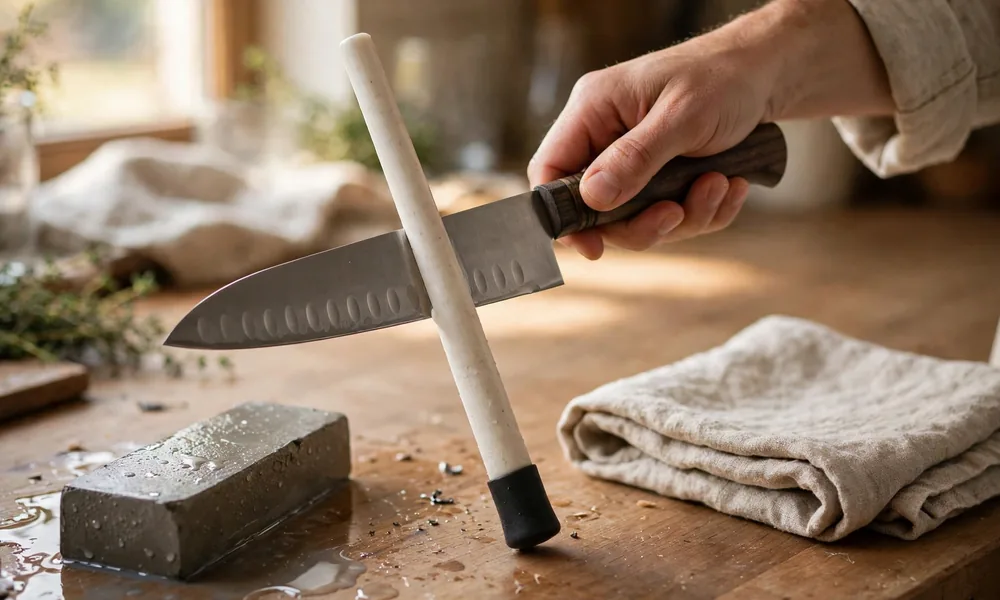
A santoku is only as good as its edge, and the flat blade makes dullness obvious: instead of biting into a tomato, it slides across the skin. Hone the edge with a ceramic rod before or after each heavy session, a few light strokes per side at roughly 15 degrees — ceramic suits hard Japanese steel better than a grooved steel rod.
Sharpen properly once or twice a year, on a whetstone or with a professional service. Never put a good santoku in the dishwasher, where heat, detergent and rattling dull and chip the edge. Hand wash, dry immediately and store it on a magnetic strip or in a blade guard. If you need a sharpener, our guide to knife sharpeners that bring a dull edge back in 2026 covers the options that actually work.
Buying Checklist
- Choose a 16 to 18 cm blade, and hold the knife before you buy if you possibly can.
- Pick high-carbon stainless steel for the best balance of sharpness, edge retention and easy care.
- Look for granton dimples if you slice a lot of wet vegetables or fish.
- Check the balance at the bolster: the knife should feel steady, not heavy at the tip or the handle.
- Make sure the handle feels secure when wet, with no sharp edges or loose rivets.
- Budget for a ceramic honing rod and a whetstone or sharpening service — a sharp santoku is a safe santoku.
Frequently Asked Questions
Is a santoku better than a chef knife?
Neither is better overall. A santoku suits straight push cuts, thin vegetable slices and cooks who prefer a shorter, lighter blade; a chef knife suits rocking cuts, piercing and larger items. Many cooks own both.
What size santoku should I buy?
Most home cooks are happiest with a 16 to 18 cm blade: long enough for large vegetables, short enough to control. Smaller hands may prefer 16 cm.
Can I use a santoku on meat?
Yes, for boneless meat and fish: a santoku slices roasts, chicken breasts and fish fillets beautifully. Do not use it on bones, joints or frozen meat, which can chip the thin, hard edge.
Do granton dimples really work?
Yes, for thin, wet slices like cucumber, potato and raw fish, where they reduce suction and help slices release. They help less with dry foods and never make up for a dull edge.
How do I sharpen a santoku knife?
Hone it regularly with a ceramic rod at about 15 degrees, and sharpen it once or twice a year on a whetstone or professionally. Use light pressure and avoid coarse powered sharpeners.
Can a santoku go in the dishwasher?
No. Dishwasher heat and detergent dull the edge, and rattling against plates chips it. Hand wash, dry immediately and store it on a magnetic strip or in a blade guard.
Bottom Line
The best santoku for everyday prep in 2026 for most cooks is the Shun Classic 7-Inch: razor sharp, beautifully balanced and built to last. For the best value, the Victorinox Fibrox Pro is unbeatable, and for a light, fast blade, the Global G-48 is a joy to use. Buy one great santoku, keep it sharp, and everyday prep gets faster, safer and far more enjoyable.