Buying swim shorts for a child looks simple until you are standing in a shop with a wriggling four-year-old, a rack of bright prints and no idea which pair will survive the summer. The best kids swim shorts of 2026 are not the loudest or the cheapest. They are the ones with a waistband that stays put, a lining that does not chafe, fabric that dries before the car ride home and seams that hold up to slides, sand and endless cannonballs. Get those four things right and the shorts disappear into the background of a good day at the pool. Get them wrong and you will hear about it every single time.

What Makes a Great Pair of Kids Swim Shorts
A child does not care about fabric technology. A child cares about comfort, and comfort comes from fit first. The waistband is the single most important part of the shorts. It should sit flat against the waist without digging in, and it should stay there through running, jumping and climbing out of the pool. The best kids swim shorts use a soft elastic waist with a drawstring, which gives two ways to adjust the fit and lets the shorts grow a little with the child across a summer.
The lining matters just as much, and it is the part parents most often overlook. A mesh liner stops fabric from clinging and protects against chafing during a long afternoon in the water, but a rough or oversized liner does the opposite and becomes the thing a child complains about. Look for a soft, lightweight mesh that ends above the knee and sits smoothly. If your child has ever refused to wear a pair after one swim, the liner is usually the reason.
Length is the third piece of the puzzle. Shorts that end well above the knee suit confident swimmers and toddlers, because they dry faster and never tangle around little legs. Longer board-short styles, reaching the knee, suit children who spend more time running around on sand or playing on slides, because they protect the tops of the knees from grazes. There is no single right length. There is the right length for what your child actually does at the water.
Fit First: Waistbands, Length and Liners
Sizing children’s swimwear is harder than sizing a T-shirt because wet fabric behaves differently from dry fabric. A pair that fits perfectly in the shop can feel tight once it is soaked, and a pair that feels roomy dry can slip once a child is climbing out of the pool. The safest rule is to buy for the waist first and the length second. If the waistband stays in place when you gently tug the shorts down, the fit is right, even if the legs look a little long.
Drawstrings deserve a closer look than they usually get. A working drawstring with a cord lock lets you tighten the waist properly, and it is the difference between shorts that survive a whole summer and shorts that need replacing after a month of growth. Avoid drawstrings that are purely decorative, stitched flat into the waistband with no way to adjust them. They look the same on the hanger and behave very differently in the water.
For younger children, especially toddlers and preschoolers, a snugger fit is better than a loose one. Small children move constantly, and loose shorts ride up, twist and fill with water. A closer cut with a soft elastic waist keeps everything in place without feeling restrictive. For older children who are swimming properly, a slightly looser board-short cut gives freedom of movement for kicking and diving, and the drawstring does the work of keeping the waist secure.
Fabric, Sun Protection and Quick Drying
Most kids swim shorts are made from polyester or a polyester blend, and that is a good thing. Polyester holds its shape when wet, dries quickly and resists chlorine far better than cotton or nylon. A small amount of elastane, usually between five and fifteen percent, adds stretch for comfort without making the shorts baggy when wet. Check the label for a chlorine-resistant claim if your child swims in a pool every week, because standard polyester will fade and loosen over a season of heavy pool use.
Sun protection is the quiet bonus of a good pair of swim shorts. Many 2026 styles carry a UPF 50+ rating, which blocks almost all ultraviolet light through the fabric. That matters because the backs of the legs and the waistband area are easy to miss with sunscreen and hard for a child to reach on their own. UPF-rated shorts are not a replacement for sunscreen, and they never should be treated as one, but they close a gap that sunscreen alone often leaves open. If you swim outdoors a lot, choose UPF 50+ as a baseline rather than a luxury.
Drying speed is the feature parents notice most after the first beach day. Shorts that are still damp at lunchtime make a child cold, uncomfortable and reluctant to get back in the water. The fastest-drying shorts use a thin, smooth polyester with a light mesh liner and no heavy pockets full of water. Hold the shorts up to the light: if you can see a little light through the fabric, it will usually dry quickly. Heavy, thick fabric that looks premium on the hanger is often the slowest to dry.
Prints, Pockets and Practical Details
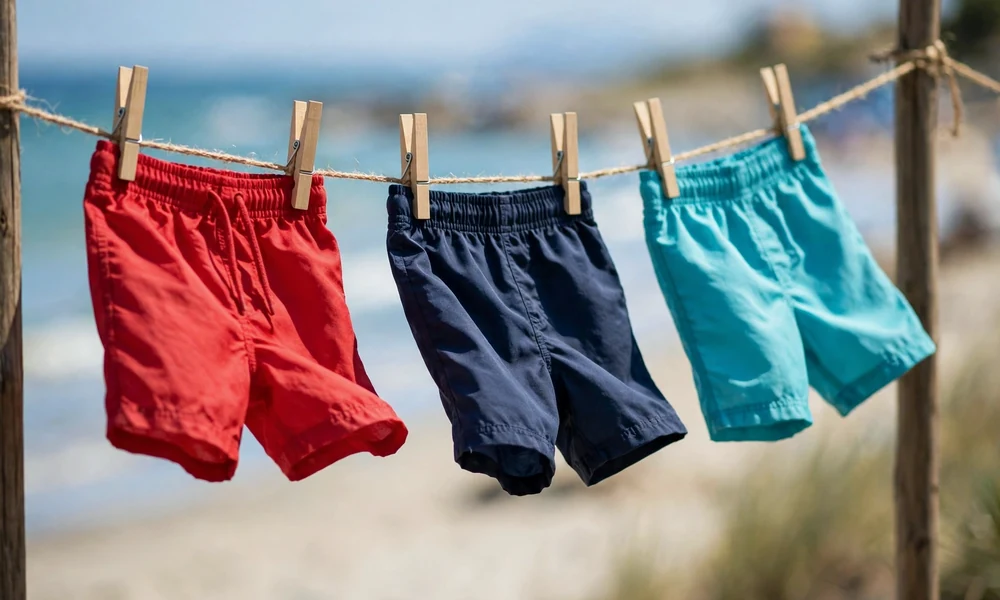
Children choose prints, and letting them choose is the easiest way to make sure the shorts actually get worn. Bright colours and bold patterns have a practical advantage too: they are easier to spot in a crowded pool or on a busy beach. Dark navy and black shorts look smart but disappear in a crowd, while a bright coral, turquoise or yellow pair is visible from across the water. If you buy two pairs for the summer, make one of them bright.
Pockets are a mixed blessing. A small side pocket is handy for a shell or a locker key, but deep pockets fill with water and sand, and they slow drying. The best kids swim shorts either skip pockets entirely or use a single small mesh pocket that drains. Check the stitching around the pocket and the waistband before you buy, because that is where cheap shorts fail first. Neat, tight stitching with no loose threads is a better sign of quality than any brand name on the label.
Sizing by Age and Activity
Age sizing is a rough guide at best, because children of the same age vary enormously in height and build. Measure the waist and the inside leg before you order, and compare against the brand’s own size chart rather than guessing from age alone. If your child sits between two sizes, size up for a toddler who will grow all summer, and size down for an older child who swims competitively, because a snugger fit stays put during proper swimming.
Think about what the shorts will be used for. Pool swimming rewards a short, light pair with a soft liner and a UPF rating. Beach days reward a slightly longer board-short style that protects knees on the sand and dries fast between swims. Swimming lessons reward a simple, comfortable pair with no fussy pockets and a waistband that does not need adjusting halfway through the lesson. One pair rarely does all three perfectly, which is why most families end up with two: a pool pair and a beach pair.

Care That Keeps Them Going All Summer
Swim shorts last far longer when they are rinsed in fresh water after every swim. Chlorine and salt both attack elastic and fade colours, and the damage happens while the shorts sit damp in a bag. A quick rinse under a tap, a gentle squeeze and hanging them in the shade takes two minutes and can double the life of a pair. Never leave wet swim shorts rolled up in a beach bag overnight, because that is when mildew starts and elastic begins to weaken.
Washing is simple: a cool, gentle machine wash with no fabric softener, then air dry. Fabric softener coats the fibres and slows drying, and tumble drying damages elastic faster than anything else. If a pair has a drawstring, tie a loose knot in it before washing so it does not disappear inside the waistband. It is a small habit, but anyone who has fished a drawstring out of a waistband with a safety pin knows it is worth doing.
Sun cream stains are the other enemy of bright prints. Rinse sunscreen off the shorts as soon as you can, especially around the waistband where cream collects, because some formulas stain light colours if they are left to dry in the sun. A quick rinse at the beach showers is usually enough.
How to Choose in Five Minutes
Start with the waist. Check for soft elastic plus a working drawstring, and tug the shorts gently to see whether the waistband stays put. Then check the liner: soft, smooth mesh that ends above the knee, with no rough seams. Then check the fabric label for a polyester blend with some elastane, a UPF 50+ rating and a chlorine-resistant claim if your child swims in a pool. If all three pass, the shorts are worth trying on.
Then let your child choose the colour. The best kids swim shorts are the ones a child wants to wear, and a child who picks a bright shark print or a bold stripe will reach for those shorts every time. Fit and fabric are the parent’s job; colour is the child’s. When both of you are happy, you have found the right pair, and the shorts will do their job quietly all summer while your child gets on with the swimming.
Finally, remember that the rest of the beach kit matters too. A good pair of swim shorts works best alongside the right sun protection, so read our guide to the best kids sunscreen for 2026 before your next trip. For the wider picture, our roundup of the best swimwear for 2026 covers the whole family, and if your child is still building water confidence, our guide to the best life jackets for 2026 is worth a read before you buy anything else.
Can kids swim shorts be worn all day at the beach? Yes, if they dry quickly and the liner is comfortable, but it is better to change into a dry pair after lunch, because sitting in damp shorts for hours can irritate skin. Pack a spare pair in the beach bag and the afternoon stays comfortable.
How many pairs of swim shorts does a child need for a holiday? Two is the practical answer. One pair on, one pair drying, and a rinse each evening keeps both fresh for a week. Three pairs is luxury, but it is worth it for a longer trip or a child who swims twice a day.
The best kids swim shorts are the ones you stop thinking about. Choose a secure waist, a soft liner, quick-drying fabric and a colour your child loves, and the shorts will simply do their job while the summer happens around them. Choose on price alone, and you will be choosing again before the holidays are over.