The worst festival experiences rarely start with one dramatic disaster. They build slowly, hour by hour, until the weekend you counted down to for months feels like an endurance test you paid too much to enter. The ticket was expensive, the travel was long, and the line-up looked perfect on the poster. Then the rain arrives and the band you came to see is a distant smudge you cannot hear.
Festivals sell a feeling: freedom, music, friends, and a few days outside ordinary life. When that feeling holds, few weekends can match it. When it breaks, the same ingredients turn against you. Crowds become crushing, food becomes overpriced and cold, and a campsite becomes a sleepless, soggy field. The worst festival experiences are not usually about bad music. They are about bad planning, bad infrastructure, and expectations that were never realistic.
This guide looks honestly at what goes wrong at festivals, from mud and queues to sound, safety, and camping, so you can spot the warning signs before you buy a ticket. It is not here to put you off live music. It is here to help you choose better, pack smarter, and walk away from the events most likely to waste your money and your weekend.
Key takeaways
- Mud, rain, and poor drainage ruin more festivals than any cancelled act, so check the site and the forecast before you book.
- Queues for entry, food, water, and toilets can eat half your day at badly run events.
- Sound, sightlines, and stage placement matter more than the line-up: a great band is wasted if you cannot see or hear them.
- Camping comfort decides whether you recover overnight or start each day colder, wetter, and more tired.
- The cheapest ticket is rarely the cheapest weekend once travel, food, water, and gear are added up.
Why Festivals Go Wrong So Often
A festival is a temporary city built in a field, and that is exactly why so many struggle. Roads, water, toilets, food, medical cover, security, and sound must all appear in a few days and work for tens of thousands of people at once. A permanent venue has years to fix its problems. A festival has one weekend, and if the drainage fails, there is no second chance.
Scale is the second problem. Organisers want a big line-up and a big crowd because both sell tickets. Yet every extra thousand people adds pressure to the same gates, paths, toilets, and water points.
The Hype Gap
Festival marketing makes every event look like the best weekend of your life. The photographs show golden sunsets and smiling crowds. Nobody photographs the mud, the overflowing bins, or the toilet queue at two in the morning. That gap between the pictures and the reality is where disappointment grows, and travel hype works the same way across travel: the promise is polished, while the practical details are left out.
The Mud, the Rain and the Ground Under Your Feet
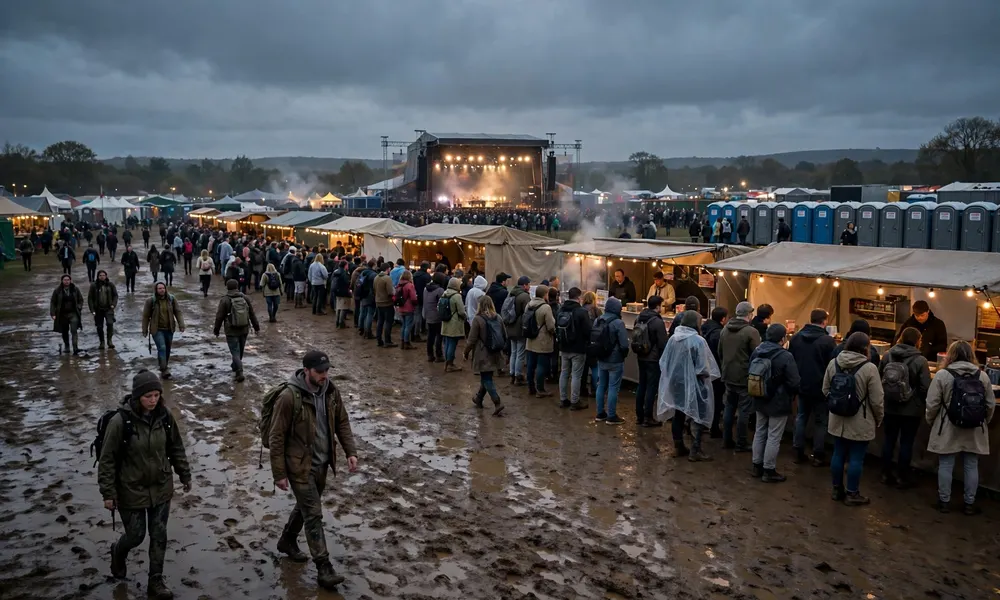
Rain is the most common reason a festival turns miserable. A light shower on dry grass is fine. A full day of rain on a field with no drainage turns paths into streams and campsites into bogs. Your shoes sink, your tent floor gets wet, and every walk becomes slow and slippery. By the second day, even cheerful people count the hours until they can leave.
Mud changes the whole mood of a site. Food areas get churned up, seating disappears, and the ground near stages becomes a sliding hazard. People fall, bags get soaked, and clothes meant to last the weekend are ruined on the first afternoon. Waterproof boots help, but they cannot fix a site never meant to hold that many people in wet weather.
Queues That Eat Your Whole Day
Queues are part of any big event, but at the worst festivals they become the main activity. Entry queues stretch for hours when wristband checks are slow. Food queues take forty-five minutes for a cold portion. Water queues form because there are too few taps. Added together, you can lose half a day standing still.
The knock-on effect is worse. A long entry queue means you miss the first act you wanted to see. A long food queue means you skip lunch and feel worse by evening. A long toilet queue means you drink less water and end up dehydrated. Queues do not just waste time; they wear you down and make every later problem feel bigger.
| Festival problem | Typical wait at a bad event | What it costs you |
|---|---|---|
| Entry and security | Two to four hours | Missed opening acts |
| Food stalls | Thirty to sixty minutes | Cold food and low energy |
| Drinking water | Twenty to forty minutes | Dehydration and headaches |
| Toilets | Twenty to fifty minutes | Discomfort and missed sets |
| Leaving the site | One to three hours | A miserable end to the weekend |
Sound, Stages and Seeing Nothing
You go to a festival for the music, so poor sound is a special disappointment. At the worst events, the sound is too quiet at the back, too harsh near the front, or drowned out by a neighbouring stage. You can stand in a huge crowd watching a famous band and still feel as if you are listening through a wall.
Clashes, Cancellations and Short Sets
Line-up clashes are normal, yet bad scheduling makes them worse. When two acts you love play at the same time on opposite sides of a huge site, you cannot enjoy either. Cancellations hurt more with no decent replacement and no clear announcement. A headliner who arrives late and plays for an hour can make an expensive ticket feel like poor value.
Food, Drink and Festival Prices
Festival food should be part of the fun, yet at the worst events it becomes a source of stress. Prices are high, portions are small, and quality is uneven. A meal that costs a fair price in a city can cost twice as much in a field and still arrive cold. When you are hungry, tired, and wet, a bad meal feels much worse than it would at home.
Camping at Festivals: Where Weekends Are Won or Lost
Camping is where many festival weekends quietly fall apart. A tent that leaks, a sleeping bag that is too thin, or a mattress that deflates will ruin your sleep, and poor sleep ruins the next day. Noise makes it worse: campsites stay loud late, with music, shouting, and people returning at all hours.
Gear That Fails When You Need It Most
Cheap camping gear is one of the most common festival mistakes. A tent never tested in rain, a mat with no insulation, or a bag too small for cold nights will all fail at the worst moment. Reading about camping gear that fails beginners before you pack is a far cheaper lesson than learning it in a flooded field at midnight. Pack for the worst weather, test your tent at home, and bring dry clothes in sealed bags.
Toilets, Hygiene and Staying Well
Festival toilets are rarely pleasant, but at the worst events they become genuinely awful. Too few units, infrequent cleaning, no toilet paper, and no handwashing turn a basic need into a dreaded chore. People avoid toilets, drink less, and eat less, which only makes them feel worse. Hygiene is not a luxury here; it is the difference between a fun weekend and a sick one.
Safety, Crowds and Getting Out
Crowd safety is the most serious festival issue of all. Dense crowds near stages, narrow exits, and poor stewarding can turn a fun moment into a frightening one. If you feel crushed or cannot breathe easily, move sideways toward the edge rather than pushing forward. No performance is worth staying in a crowd that feels unsafe.
Getting out can be as bad as getting in. Car parks turn into mud traps, shuttle buses run late, and taxi queues stretch for hours. Plan your exit before the weekend starts and keep your phone charged. Keep valuables close, lock your tent, and agree on a meeting point with friends in case phones die. The best festivals make safety feel organised; the worst leave you to work it out alone.
How to Spot a Bad Festival Before You Book
Research before you pay. Read reviews from ordinary visitors, not just press coverage. Look at photographs from previous years, especially in bad weather, and check how organisers respond to complaints. A festival that answers questions openly is far safer than one that deletes criticism.
Festival Checklist: Six Checks Before You Buy
- Read at least ten recent visitor reviews, including the negative ones, and look for repeated complaints about queues, mud, or toilets.
- Check the site map for water points, toilets, medical tents, exits, and the distance between stages and campsites.
- Look at photographs from a wet year, not just a sunny one, to see how the ground copes with rain.
- Add up the full cost: ticket, travel, food, water, gear, and transport home, before deciding it is good value.
- Confirm the refund, cancellation, and line-up change policy in writing, so a cancelled headliner does not leave you with nothing.
- Pack and test your camping gear at home, including a wet-weather plan, dry clothes, and a charged phone.
Frequently Asked Questions
What is the worst part of a festival?
For most people, it is not the music but the practical side: mud, queues, poor toilets, and bad sleep. Those problems last all weekend, while a disappointing set lasts an hour. A festival with good infrastructure can survive a weak line-up; one with bad infrastructure rarely recovers.
Are big festivals always worse than small ones?
No, but big festivals fail on a bigger scale when they go wrong. A large, well-run event can be excellent because it has the budget for proper sound, toilets, water, and staff. A small, badly run event can still be miserable. Size matters less than organisation.
How do I avoid mud at a festival?
You cannot avoid mud completely in wet weather, but you can reduce the damage. Wear waterproof boots, bring dry socks and clothes in sealed bags, choose a tent pitch on higher ground, and use main paths where possible. Arriving early helps, because the ground gets worse as thousands of feet churn it up.
Is festival camping worth it?
It can be, if you are prepared and the campsite is well managed. Camping keeps you close to the music, saves on hotels, and adds to the atmosphere. It is not worth it if your gear is untested, the site floods, or you need proper sleep. In that case, staying off-site is smarter.
Why are festivals so expensive?
Festivals carry huge temporary costs: staging, sound, security, medical cover, toilets, water, power, and staff, all for a few days. Ticket prices have risen as those costs have risen. Even so, some events charge far more than others, so compare the full weekend cost before you book.
Should I still go if the forecast looks bad?
Bad weather does not have to ruin a festival if the site is well drained and you are properly equipped. It does ruin festivals with poor drainage, few shelters, and long walks between stages. Check the site history in wet years, pack waterproof gear, and be honest about how much discomfort you will accept for the line-up.
The Bottom Line
The worst festival experiences share the same roots: too many people, too little infrastructure, and a line-up used to hide practical problems. Most of these problems are visible before you buy a ticket. Choose the event with the best-run site, not just the biggest names, pack for bad weather, and plan around rest, water, and realistic expectations. That is also why seasoned travellers learn to look beyond the poster, in the same way that tourist traps in Europe teach visitors to look beyond the famous view and check what the experience is really like once you arrive.