Every cook knows the sound: the avalanche. You reach for one frying pan and three others crash forward, lids sliding, handles tangling, and a heavy skillet landing exactly where your toes are. The best pan organizers in 2026 exist to end that small daily disaster. They turn a chaotic stack of cookware into a neat row where every pan has its own slot, every handle is reachable, and nothing has to be lifted out of the way to get to the pan underneath.
A pan organizer is a simple idea done well. Instead of stacking pans, which scratches nonstick coatings and hides the pan you want at the bottom, an organizer stands them upright or slides them out on a tray. The change is immediate. Cabinets that once held four pans in a wobbling tower can suddenly hold six or seven, each one visible at a glance and removable without disturbing the rest. For small kitchens, that extra capacity matters as much as the tidiness.
Key Takeaways
- Vertical divider racks are the best all-round choice for most kitchens, because they keep every pan visible and reachable without unstacking.
- Measure your cabinet height, depth and width before buying, and measure your largest pan too, because a rack that does not fit is useless.
- Steel and heavy-duty coated metal handle cast iron far better than plastic or thin wire, which bend and sag over time.
- Adjustable dividers are worth paying for, since pan collections change and fixed slots rarely match every pan you own.
- A good organizer protects nonstick coatings by stopping pans from sliding against each other, which can extend the life of your cookware.
What a Pan Organizer Actually Does
A pan organizer is any rack, tray or divider system designed to store frying pans, saucepans and skillets so they do not have to be stacked. Stacking is the default in most kitchens, and it is the root of nearly every pan-storage problem. The pan at the bottom bears the weight of everything above it, its coating gets scratched by the pan resting on it, and reaching it means lifting the whole pile. A single heavy skillet can weigh several kilos, so the daily lifting adds up.
Organizers solve this by giving each pan its own space. In a vertical rack, pans stand on their sides like books on a shelf, separated by dividers. In a pull-out tray, pans lie flat but on separate levels that slide out of the cabinet, so you can see and reach the bottom one without moving the rest. Over-door racks use the inside of a cabinet door, which is otherwise wasted space. Each approach trades space, capacity and convenience differently, and the right one depends on your cabinet layout as much as on your pans.
The Main Types of Pan Organizers
Vertical Divider Racks
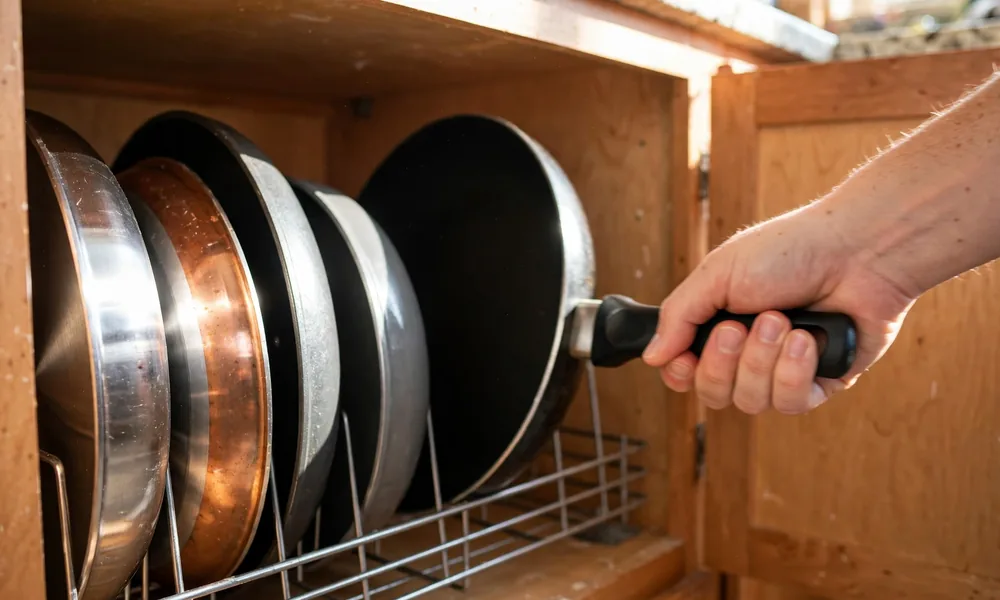
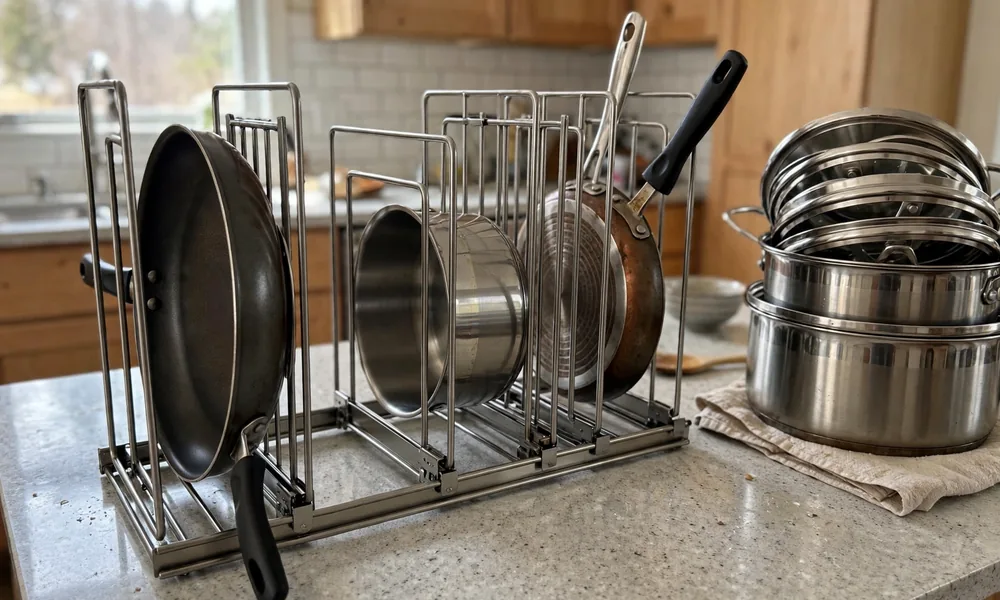
These are the most popular style for good reason. A low frame with upright dividers holds pans on their edges, handles pointing up or out, and each pan slides into its own slot. They work in deep base cabinets and on pantry shelves, they need no installation, and they cost less than most alternatives. The best versions have adjustable dividers, so you can widen a slot for a thick cast iron skillet and narrow another for a thin crepe pan. Their weakness is height: tall pans with long handles can be awkward in a short cabinet.
Pull-Out Cabinet Trays
A pull-out tray replaces the fixed shelf in a base cabinet with a sliding platform, sometimes with built-in dividers. You pull the whole tray towards you and every pan comes into view. This style is excellent for deep cabinets where pans at the back are otherwise unreachable, and it is the kindest option for heavy cast iron, since you never have to reach in and lift at arm’s length. The trade-off is installation: most pull-out systems need screws and a reasonably square cabinet, and they cost more than a simple rack.
Over-Door and Door-Mounted Racks
These hang on the inside of a cabinet door and hold one or two pans in shallow hooks or slots. They are a good answer when cabinet shelves are already full and the door is the only free surface. They suit lighter pans best, since a heavy skillet swinging on a door puts strain on hinges over time. Measure the clearance carefully, because a pan mounted on the door must clear the shelf edges when the door closes, and that clearance is smaller than most people expect.
Expandable and Adjustable Racks
Expandable racks stretch sideways to fit the width of your cabinet or shelf, with dividers you can slide along a rail. They are the most forgiving choice if you are unsure of your measurements or if your pan collection is still growing, because the rack grows with it. The mechanism adds moving parts, so look for a locking system that actually holds once set, and check the weight rating, since an expanded rack with a wide span is more likely to flex under heavy pans than a fixed frame.
How to Choose the Right Pan Organizer
Start by Measuring the Cabinet
Measure three things: the width of the shelf or cabinet floor, the depth from front to back, and the height from the shelf to the underside of the shelf above it. Write the numbers down, and subtract a couple of centimetres from each for clearance. A rack that fits exactly is a rack that scrapes, and a rack that is a centimetre too tall simply will not go in. Pay attention to the door opening too, because some cabinets have a narrower opening than the interior, and a wide rack may not pass through the door even if it would fit inside.
Measure Your Largest Pan
The diameter of your biggest frying pan sets the minimum slot spacing and the minimum height the rack must allow. A 30-centimetre skillet standing on its side needs roughly that much vertical clearance plus room for its handle, and a slot wide enough for its thickness. Cast iron pans are the thickest and heaviest, and they are the ones most often forgotten in this calculation. If your largest pan is cast iron, choose the rack for that pan first and let the lighter pans fit around it.
Match the Material to the Weight
Steel racks with a powder-coated or chrome finish are the safest default. They hold heavy pans without bending, they wipe clean, and they resist rust if the coating is intact. Stainless steel costs more but lasts longest in a damp kitchen. Plastic racks are light and cheap, but they flex under cast iron and can warp near a hot oven. Bamboo looks warm and natural, but it is not the best choice for the heaviest pans. Whatever the material, check the stated weight capacity and treat it as a maximum, not a target.
Look for Adjustable Dividers
Fixed dividers are a gamble. Your pans are all different thicknesses, and a fixed rack is designed around an average pan you may not own. Adjustable dividers let you set a wide slot for a deep saute pan and a narrow one for a flat griddle, and you can rearrange them when you buy a new pan. The adjustment mechanism should be simple and should stay put once set. If dividers slide around on their own, the rack will slowly collapse into a jumble, which defeats the purpose.
Think About How You Cook
If you reach for the same frying pan every morning, it should be the easiest pan to grab, not the one buried at the back. Put daily pans in the front slots and occasional ones at the back. A pan organizer also works best alongside other tidy storage: see our guides to pantry organizers, drawer organizers and kitchen carts.
Pan Organizer Comparison
| Type | Best For | Capacity | Installation | Price Range |
|---|---|---|---|---|
| Vertical divider rack | Most kitchens, everyday pans | 5 to 8 pans | None, sits on shelf | Low |
| Pull-out tray | Deep cabinets, heavy cast iron | 4 to 6 pans | Screws, moderate | Medium to high |
| Over-door rack | Small kitchens, light pans | 1 to 3 pans | Hooks or screws | Low |
| Expandable rack | Growing collections, odd cabinets | 5 to 10 pans | None | Low to medium |
Mistakes to Avoid
The most common mistake is buying before measuring, and it is also the most avoidable. A rack that is too tall for the shelf, too deep for the cabinet, or too narrow for the pans is a return trip waiting to happen. The second mistake is overloading. A rack rated for five pans will hold five pans, not eight, and squeezing extra pans in bends dividers, scratches coatings, and makes every pan harder to remove. The third is putting heavy cast iron on a light plastic rack, which sags slowly over weeks until the pans lean and slide.
Another quiet mistake is storing pans wet. A rack holds pans upright, which is good for drying, but if you put a wet pan straight into a closed cabinet, moisture sits in the slot and rust finds the uncoated edges. Dry pans properly before storing them, especially cast iron, and wipe the rack itself now and then. Finally, do not forget the handles. Long handles are the part that catches on the shelf above or pokes out of the cabinet door, so check handle clearance just as carefully as pan diameter.
Checklist: Before You Buy a Pan Organizer
- Measure cabinet width, depth and height, and subtract a couple of centimetres for clearance.
- Measure your largest pan, including its handle length and thickness.
- Check the rack’s weight rating against your heaviest pan, especially cast iron.
- Choose adjustable dividers so the rack can adapt when your collection changes.
- Confirm the material suits a kitchen, with a coating that resists rust and wipes clean.
- Test the door clearance, making sure handles do not stop the cabinet door from closing.
Frequently Asked Questions
Do pan organizers damage nonstick coatings?
No, a good organizer protects them. Damage comes from pans sliding and stacking against each other, which is exactly what an organizer prevents. Choose smooth, coated dividers and avoid bare rough metal edges.
Can a pan organizer hold cast iron pans?
Yes, provided the rack is made for the weight. Look for a steel frame with a weight rating that covers your heaviest skillet, place cast iron near the centre, and avoid plastic racks, which flex and sag under the load.
What size pan organizer do I need?
Measure the cabinet interior first, then the diameter and thickness of your biggest pan. The rack must fit the cabinet with a little clearance, and its slots must be wide enough for your thickest pan.
Are vertical racks or pull-out trays better?
Vertical racks suit most kitchens because they are cheap, need no installation, and keep every pan visible. Pull-out trays are better for deep cabinets and heavy pans, because the whole tray slides out to you.
Can I use a pan organizer in a small kitchen?
Yes, and small kitchens benefit the most. A vertical rack stores more pans in the same cabinet, and an over-door rack uses space that would otherwise be wasted. Measure carefully, since small cabinets leave less room for error.
How do I clean a pan organizer?
Most racks wipe clean with a damp cloth and a little washing-up liquid. Take the pans out once a month, wipe the frame and dividers, and check for rust spots. Dry the rack and the pans before putting them back.
The Bottom Line
The best pan organizer is the one that fits your cabinet, holds your heaviest pan without complaint, and lets you grab the pan you want without moving three others first. For most kitchens that means a steel vertical divider rack with adjustable slots, measured carefully before buying. Get the measurements right, load the heaviest pans in the middle, and the daily pan avalanche becomes a thing of the past.