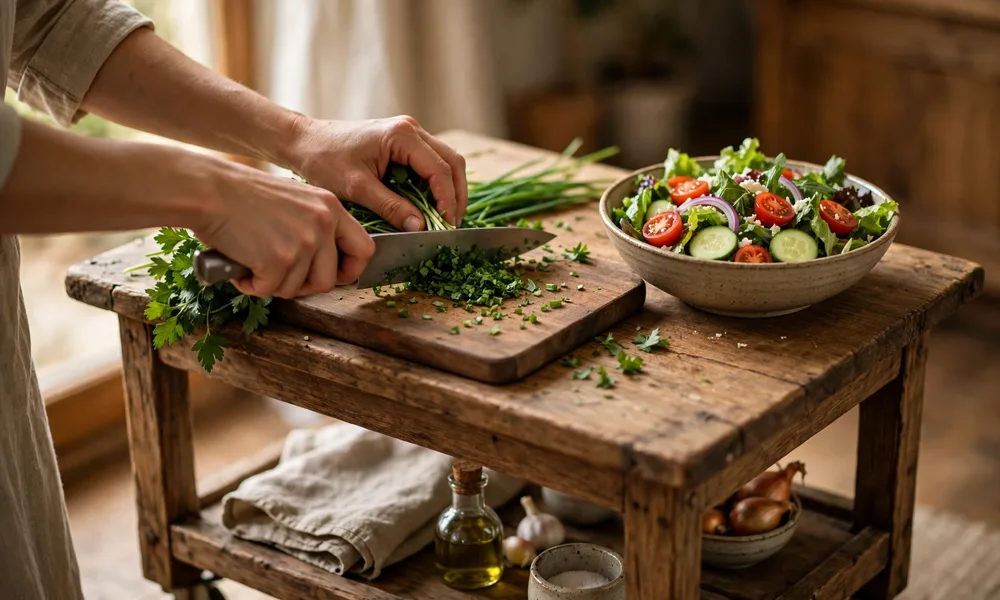
Kitchen Carts That Add Counter Space Anywhere in 2026
Kitchen carts add counter space anywhere in 2026, and that is the whole point of them. A kitchen cart is a freestanding piece of furniture on wheels or legs that gives you an extra work surface and extra storage in a kitchen that has run out of room. It rolls where you need it, parks where it fits, and costs a fraction of a fitted island. In a small kitchen, a good cart is the difference between cooking comfortably and cooking around a cluttered counter.
This guide covers the kitchen carts worth buying in 2026: the types that add usable counter space, how to measure a spot before you buy, and the mistakes that turn a useful cart into an obstacle. It is about kitchen carts, not bar carts. A bar cart holds bottles and glasses for entertaining; a kitchen cart holds chopping boards, pots and the food you are cooking. They look similar in a photo, but they do opposite jobs.
Key Takeaways
- A kitchen cart is worth buying when it adds at least 60 centimetres of work surface without blocking a walkway or a cupboard door.
- Butcher-block tops are the best all-round choice: they take knife work and can be sanded back when they get marked.
- Measure the parking spot, the route the cart will travel and the height of your existing counters before you buy anything.
- Lockable castors are not optional: a cart that rolls away while you chop is a hazard.
- Storage below the top matters: drawers and shelves keep the counter clear, which is why you bought the cart.
Why a Kitchen Cart Works
Most kitchens fail in the same place: there is nowhere to put things down. The chopping board sits on the recipe book, the mixing bowl balances on the edge of the sink, and the tray of vegetables waits on the hob. A kitchen cart fixes that by adding a surface exactly where the work happens: beside the cooker while you prep, at the table when dinner is ready, and against a spare wall when the cooking is done.
It also works because it is not a renovation. A fitted island needs a plumber, an electrician and a budget; a cart needs a delivery and ten minutes with an Allen key. For renters, it leaves no holes and no argument with a landlord, and it moves with you when the tenancy ends.

The Main Types of Kitchen Cart
Kitchen carts come in a handful of shapes, and the right one depends on your kitchen, your cooking and how much floor you can spare. Start with the top, the part you touch every day, then worry about the storage underneath.
Butcher-Block Carts
The butcher-block cart is the best kitchen cart for most homes in 2026, because the top is a real work surface rather than a shelf pretending to be one. A thick hardwood top, usually maple, beech or oak, takes direct knife work and can be oiled and sanded when marked. At around 90 centimetres long and 45 to 50 deep, it adds a proper prep station.
Look for a top at least 3 centimetres thick, joined rather than veneered, and screwed down at four points so it stays flat. The best versions have a towel rail on the side and a spice rack on the end.
Rolling Slim Carts
A rolling slim cart is built for the gap nobody else can use: the 20-centimetre slot between the fridge and the wall, or the strip beside the cooker in a galley kitchen. At around 40 centimetres long and only 20 to 25 deep, it slides into gaps that defeat any other cart.
The compromise is the size of the top: a slim cart holds a chopping board and a bowl, not a whole Sunday roast. Look for lockable castors and a low, wide wheelbase, because a tall, narrow cart can tip if pulled at an angle when loaded.
Cabinet-Style Carts
A cabinet-style cart looks like a small kitchen island, and in a larger kitchen it does the same job. It has a solid top, cupboard doors or drawers below, and a footprint of roughly 100 by 60 centimetres. Closed, it reads as furniture; open, it holds the pots, pans and small appliances that would otherwise crowd the worktops.
The cost is floor space and weight. A cabinet cart is heavy, often 30 kilograms or more, and once loaded it stays where it is put. It needs at least 90 centimetres clear in front for the doors to open. But if your kitchen has a dead corner and a shortage of cupboards, a cabinet cart adds both at once.
Drop-Leaf and Folding Carts
A drop-leaf cart is for kitchens that are small some of the time and busy the rest of the time. The top folds out to double its size when you are cooking for guests, then drops back to a narrow console when the meal is over. Folded, it is barely 30 centimetres deep; open, it holds a full prep spread.
Check the hinge before you buy, because the hinge is the cart: it should lock firmly open with no wobble, and the folded leaf should sit flush. Avoid the cheapest folding carts: a leaf that sags under a casserole dish is worse than no leaf at all.
Stainless Steel Utility Carts
A stainless steel utility cart is the workhorse of the list. It has a steel top, open shelves below and a frame that wipes clean in seconds, which matters where raw meat and flour share a surface.
The trade-off is warmth and noise: steel looks clinical in a cosy kitchen and rings when you set a pan down hard. A wooden chopping board on top solves both. Look for a raised edge, so nothing slides off when the cart moves, and shelves that adjust in height.
Kitchen Cart Comparison
| Type | Best for | Top size | Storage |
|---|---|---|---|
| Butcher-block cart | Daily prep and chopping | 90 x 50 cm | Shelves and drawers |
| Rolling slim cart | Narrow gaps, small kitchens | 40 x 25 cm | Two or three tiers |
| Cabinet-style cart | Extra cupboards and worktop | 100 x 60 cm | Cupboards and drawers |
| Drop-leaf cart | Occasional extra space | 60 to 120 cm open | Small drawer |
| Stainless steel cart | Heavy use, easy cleaning | 85 x 45 cm | Open shelves |
How to Measure Before You Buy
Measure the parking spot in centimetres, at the floor and at counter height, because skirting boards and uneven walls eat into the space. Then measure the route: the cart must pass the fridge, the bin and the open dishwasher door.
Height matters as much as width. A cart top should sit at the same height as your counters, roughly 90 centimetres, so a chopping board slides across without lifting. If the cart is going beside the sink, our guide to the best kitchen sinks of 2026 covers the sink depths and tap clearances that decide whether a cart fits alongside it.
What to Put on a Kitchen Cart
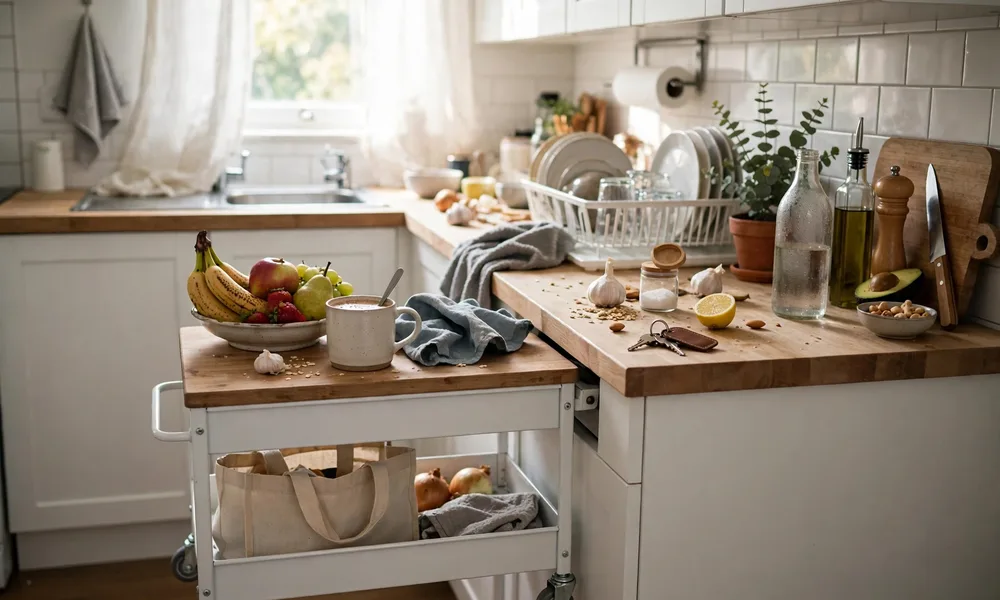
The cart earns its place by holding the things you use every day. The top should carry the chopping board, the knife block and the bowl you are working with, and nothing else. The shelf below is for the pots and pans you reach for most. Everything else belongs in a cupboard.
Think about weight as well as use. Heavy things go low, on the bottom shelf, where they keep the cart stable. A cart with a cast-iron pan on the top shelf and tea towels below will tip the first time someone pulls it at an angle.
What to Avoid
Skip carts with no stated weight rating: a rating is the manufacturer telling you what the cart can hold, and a cart without one is a guess. Skip carts whose castors do not lock, because a cart that rolls while you chop is dangerous, and skip tops thinner than 2 centimetres if you plan to chop on them, because a thin top will bow under a heavy pot.
Also beware of buying for the photo rather than the kitchen. A beautiful wooden cart too wide for your corner will live in the middle of the floor, and a cheap cart that looks fine empty will wobble and fall apart within months. And if the cart is going near the cooker, keep it clear of the hob: a wooden cart and an open flame need distance.
Kitchen Cart Buying Checklist
- Measure the parking spot and the route, and leave 90 centimetres clear in front for someone to stand and work.
- Match the top height to your existing counters, around 90 centimetres, so boards and bowls slide across without lifting.
- Check every castor locks, and test the cart loaded: it should roll smoothly and stop dead with the brakes on.
- Choose a top you can work on directly: butcher block for chopping, steel for heavy use.
- Count the storage honestly: drawers and shelves below keep the work surface clear.
- Check the weight rating and load heavy items low, so the cart stays stable when it is pulled out and pushed back.
Frequently Asked Questions
How much counter space does a kitchen cart really add?
A typical cart adds 0.3 to 0.6 square metres of work surface, roughly a large chopping board and a mixing bowl. In a kitchen where the counter is always full, that is the difference between having somewhere to work and not having one.
Can a kitchen cart replace a kitchen island?
For prep space and storage, yes, in most kitchens. A cabinet-style cart gives you a worktop and cupboards without the plumbing or the building work. It cannot replace an island with a sink or a hob, but for most homes it does the same daily job at a fraction of the cost. If you are planning a full refit, our guide to the best kitchen faucets of 2026 covers the taps and fittings that decide whether a fixed island is worth it.
What is the best top material for a kitchen cart?
Butcher block is the best all-round top: it takes knife work, can be sanded back when marked and looks better with age. Stainless steel is better for heavy, messy cooking and wipes clean fastest. Avoid glass tops for prep work: they show every mark and cannot take a knife.
Are kitchen carts safe with children in the house?
Yes, if the castors lock and heavy items are stored low. Lock the wheels whenever the cart is in use, keep knives in a drawer rather than on the top, and never let a child climb the shelves.
How do I keep a butcher-block cart top in good condition?
Oil it monthly with food-safe mineral oil, wipe up water and acidic spills straight away, and sand out knife marks when they build up. Never soak the top, and never put a hot pan directly on the wood.
Where should a kitchen cart live when it is not being used?
Against the longest spare stretch of wall, or in the gap it was measured for. The worst place is the middle of the floor, where it blocks the walkway. If the cart is freeing up cupboard space, our guide to pantry organizers that end the clutter in 2026 covers what to do with the shelves you have just emptied.
The Bottom Line
The best kitchen cart for most homes in 2026 is a butcher-block cart on lockable castors, roughly 90 centimetres long and 50 deep, with shelves or drawers below the top: it adds a real prep surface, holds the pots you use every day, and rolls out of the way when dinner is done. Small kitchens should look at a rolling slim cart that fits the gap they have, and larger kitchens at a cabinet-style cart that adds cupboards too. Measure the spot, match the height, lock the wheels, and buy the cart that fits your kitchen.