
A lacrosse stick looks like a simple shaft with a netted pocket at the end, and that is exactly the problem. It looks so simple that anyone can sell a bad one, and so many do. A bad stick is too heavy, too stiff, or strung so badly that the ball falls out every time you run. It ruins your first catch, it makes passing feel like throwing with a broken arm, and it breaks when you need it most. The worst lacrosse sticks of 2026 are the ones that make good players look clumsy, hurt young players’ wrists, and fall apart in the middle of a season, and they are still on sale.

What Makes a Lacrosse Stick Bad
The first problem is the head. A good head is stiff enough to hold its shape under pressure, with an evenly strung pocket and a smooth, true scoop. A bad head is soft and flexible, so it bends when you catch a hard pass and throws the ball off line. Or it is brittle, cracking at the sidewall the first time it meets a hard check. Either way, the head fails at its one job: catching the ball cleanly and throwing it where you want it.
The second problem is the pocket. The pocket is the netting that holds the ball, and it is the hardest part of a lacrosse stick to get right. A good pocket has a clear channel down the middle, even tension, and a depth that holds the ball without hiding it. A bad pocket is strung too deep, so the ball sits too low to throw, or too shallow, so the ball falls out every time you run. A pocket with uneven tension throws the ball sideways, and a pocket with a bag in the middle makes every pass unpredictable.
The third problem is the shaft. A good shaft is light, strong, and shaped to fit the hands, with a grip that stays put when the hands sweat. A bad shaft is heavy, which slows the hands down, or thin and weak, which bends and breaks under a check. Cheap metal shafts dent easily, and once dented a shaft is weaker at that spot and will break there sooner or later. Cheap composite shafts can feel dead, with no spring, so the ball comes off with no pace.
The Main Types of Lacrosse Stick, and Where They Go Wrong
Cheap complete sticks are the most common trap. A complete stick comes with the head already strung and attached to the shaft, and the cheapest ones are built to a price, not a standard. The head is soft plastic that warps in the sun, the pocket is machine-strung with no attention to tension, and the shaft is thin metal that dents on the first check. They are often sold to beginners at a price that seems too good to refuse, and it is: the stick is heavy, the pocket is a bag, and the ball falls out every time the player runs.
Poorly strung heads are the more expensive trap. A good head can be ruined by bad stringing. The usual fault is a pocket with no channel, so the ball has nowhere to sit and rolls around the head. The other fault is a pocket strung too tight at the top and too loose at the bottom, which throws the ball high and wide. Stringing looks simple and is not: a pocket strung in a hurry will cost its owner goals all season.
Junior sticks are where bad manufacturing does the most damage. A junior stick should be light, well-balanced, and sized for a child’s hands. Bad junior sticks are simply adult sticks cut short, leaving them heavy at the head and impossible to control. A child with a head-heavy stick cannot catch cleanly, cannot get the stick up in time, and learns to cradle with a stiff wrist instead of a soft one. Worse, the weight strains young wrists, and the child decides lacrosse is not for them.
Then there are the novelty and gift sticks, the ones sold in toy shops and tourist stores. They look like lacrosse sticks, with a net and a coloured shaft, but they are not lacrosse sticks at all. The head is soft plastic, the pocket is loose mesh, and the whole thing breaks on the first hard pass. They are bought as presents and broken within a week.
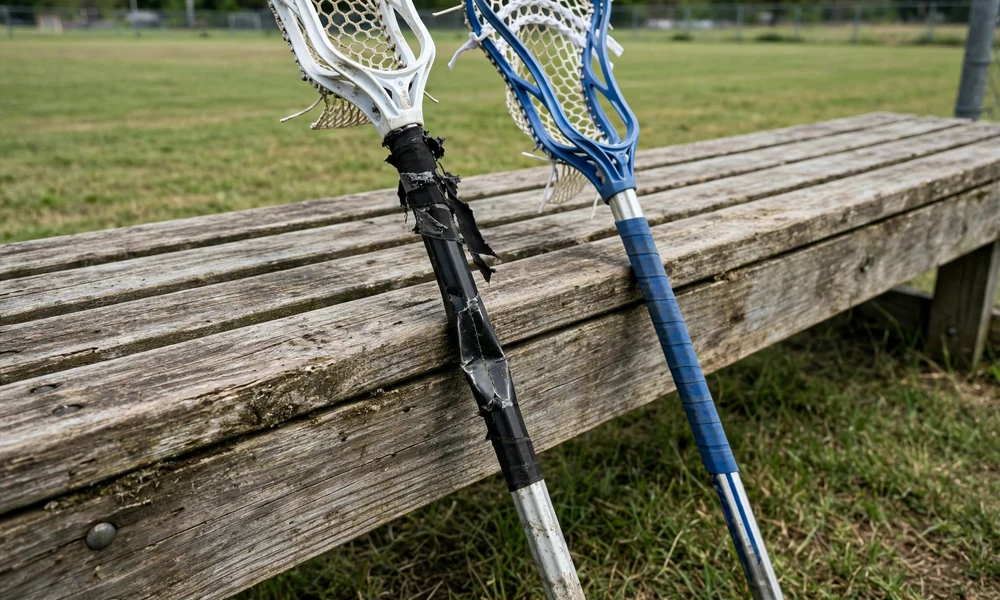
How to Spot a Bad Stick Before You Buy
The head tells the truth first. Hold the stick up and look at the head in good light. It should be straight, with no warps, no twists, and no cracks at the sidewalls. Squeeze the head gently from the sides: it should feel firm and spring back, not soft and floppy. Look at the scoop, the top edge of the head. It should be smooth and even, with no rough spots and no flat patches. A rough or uneven scoop will snag the ground on every pickup, and a pickup that snags is one that fails.
Next, check the pocket. Put a ball in the pocket and hold the stick flat: the ball should sit in a clear channel down the middle, with the top just visible above the sidewalls. Tip the stick slowly. The ball should stay put until the stick is well past level, then roll out smoothly. If the ball falls out at the slightest tilt, the pocket is too shallow. If it sits so deep you cannot see it, the pocket is too deep. If it rolls sideways, the pocket is strung unevenly.
Finally, check the shaft and the grip. Look along the shaft for dents, cracks, or places where the surface has bubbled or peeled. Squeeze it: it should feel solid all the way down, with no soft spots and no give. Hold the stick by the handle and let it hang: it should feel light and easy, not heavy at the head. A stick that is too heavy will slow your hands down, and slow hands are the difference between catching the ball and missing it.
The Most Common Faults, One by One
A baggy pocket is the fault players notice first. The ball sits in a loose sag in the middle of the pocket, and every throw comes out differently: one pass goes high, the next goes wide, and the next drops at the player’s feet. The cause is almost always bad stringing, or a mesh that has stretched out of shape. A pocket strung badly will only get worse with use, because the mesh stretches more every time the ball sits in it. A stick that makes you guess where the ball is going is one to avoid.
Breakage comes second, and it usually starts at the head. A head with weak sidewalls cracks the first time it meets a hard check, and once a head cracks, the crack spreads. Cheap shafts break too, because the shaft is thinnest and takes the most punishment from checks and from hitting the ground. A stick that needs replacing after a month is a stick that was never worth buying.
Poor balance is the third fault, and it is the one that does the most damage to technique. A head-heavy stick makes the player late, and a late player drops catches, misses passes, or gets beaten to the ball. A handle-heavy stick feels dead and makes the player push at the ball instead of catching it. Both faults teach the player to compensate, and compensation becomes habit. Months later, the player is still dropping catches, long after the stick is gone.
A bad shaft is the last fault, and it is the most dangerous. A shaft that dents sends shock straight into the hands with every check, which stings and, over time, hurts the wrists. A shaft that breaks mid-game leaves the player holding half a stick, dangerous for everyone on the field. If the shaft is dented, the grip slips, or the head wobbles on the shaft, the stick is not safe to use.
Who Gets Hurt Most by a Bad Stick
Young players suffer first. A child with a heavy, badly strung stick cannot learn the game properly, because the stick fights them on every catch. They learn to cradle with a stiff wrist, drop passes, and lose the ball the same way every time. Many give up, and the tragedy is that the stick was the problem, not the child. A good junior stick is light, balanced, and sized properly, and it is the single most important piece of kit a young player owns.
Club players suffer differently. They buy a stick, play with it for a season, and watch their form fall without knowing why. The pocket is baggy, the head is cracking, or the shaft is dented, and each fault costs them possession in a different way. They spend the winter working on their technique when the real problem was in their hands all season. A bad stick costs games before it costs money.
Occasional players suffer last: they buy the cheapest stick on the shelf and play three games a year. The stick sits in a garage, the mesh dries out, the pocket sags, and when they do play, it feels terrible. They decide lacrosse is a hard game, when they never gave themselves a fair chance with a decent stick.

What to Buy Instead
The fix is not to buy the most expensive stick, but to buy one with a stiff head, an even pocket, and a light shaft, and to check all three before you pay. Look for a head that is firm and true, a pocket with a clear channel and even tension, and a shaft that feels light. Hold it, cradle a ball in it, and trust what your hands tell you. A stick that feels right in the shop usually plays right, and one that feels wrong never improves.
Weight matters more than most people think. A stick should be as light as you can control, because a lighter stick means faster hands and better catching. The old advice to buy the heaviest stick you can lift is wrong: buy the stick you can move late and still control, and your game will improve. If you play other stick sports, the same rule applies: the stick should feel like an extension of your hands, not a weight you drag around. Our guide to the best baseball bats of 2026 makes the same point about weight and balance, and is worth reading before you buy any stick.
The Bottom Line
The worst lacrosse sticks of 2026 share the same faults: soft heads, baggy pockets, weak shafts, and bad balance. They are easy to spot once you know what to look for, and easy to avoid. Check the head, the pocket, and the shaft, and trust your hands. Spend a little more on a stick with a firm head, an even pocket, and a light shaft, and it will last longer, catch better, and make the game more fun. The same care applies to any stick or racket sport: our guides to the best badminton rackets of 2026 and the best golf clubs of 2026 start with the same advice, check the balance and the build, and never trust a stick you have not held.


