Every home has a corner that nothing fits into: the floor beside it is too narrow for a bookcase and the wall too awkward for a normal shelf, so the corner sits empty. Corner shelves are the fix — a dead angle becomes display space, a plant stand or a tidy home for small things, without taking a single centimetre of floor.
The best corner shelves in 2026 come as floating triangles, tiered sets, leaning ladder shelves, freestanding corner units and glass shelves for bathrooms, each suiting a different corner and job. Choosing well means matching the shelf to the corner you actually have: measuring both walls and being honest about how much weight it will carry. This guide covers the types worth buying, the sizes that work, and how to fix and style them.
Key Takeaways
- A corner shelf should solve a real problem — a dead corner or a spot where nothing else fits — not just fill a wall.
- Measure both walls, not one: a shelf that overhangs one wall looks wrong from every angle.
- Floating corner shelves hold far less than they look like they should, typically 3 to 5 kilograms, so check the fixings first.
- Triangular shelves suit tight angles, curved shelves suit soft rooms, and ladder shelves suit renters who cannot drill.
- Leave a third of every shelf empty: the empty space makes the full part look intentional.
Corner Shelves 2026 at a Glance
| Shelf type | Best for | Typical load | Fixing |
|---|---|---|---|
| Floating corner shelf | Living rooms, display | 3 to 5 kg | Hidden brackets, two walls |
| Tiered corner shelves | Small rooms, plants | 2 to 4 kg per tier | Hidden brackets, stacked |
| Ladder corner shelf | Renters, bathrooms | 5 to 10 kg total | Leans, no drilling |
| Freestanding corner unit | Books, heavy display | 10 to 20 kg total | Stands on the floor |
| Glass corner shelf | Bathrooms, showers | 2 to 3 kg | Suction or screws |
What a Corner Shelf Actually Is
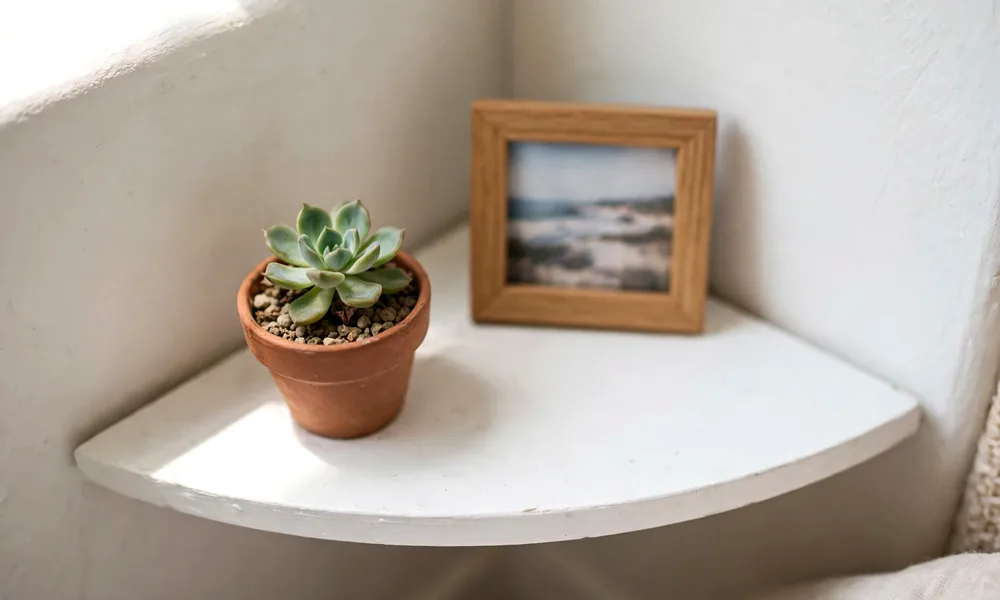
A corner shelf is a shelf shaped to fit where two walls meet. The classic form is a triangle, with two straight edges against the walls and the long edge facing into the room, but modern versions also come as curved quarter-circles, L-shaped pairs, and tiered sets. The point is always the same: use space that no other furniture can use. A corner shelf needs only the angle itself, which is why it suits small rooms better than any other shelf. Our guide to the best floating shelves for living rooms covers the straight-wall version of the same idea, and the corner version adds one extra problem: every fixing has to land in two walls, not one.
The corner itself is the hard part. Two walls rarely meet at a perfect right angle, and plasterboard corners are often the weakest part of the wall, with a hollow behind the angle that fixings cannot bite into. Measure the angle with a square, check both walls with a stud finder, and accept a small gap at the back: walls are rarely square.
The Main Types of Corner Shelf Compared
Floating Corner Shelves
The floating corner shelf is the simplest type: one triangular board, or two short boards meeting at the corner, held by hidden brackets. It suits living rooms and bedrooms, where the shelf is there to be looked at, and it holds a plant, a few books and a photo in space that was otherwise wasted. The limit is the load, at 3 to 5 kilograms, and the fixing, which needs solid anchors in both walls. Keep it light and short, and never put a heavy vase on a shelf built for photographs. Plan for two: a pair reads as a deliberate display.
Tiered Corner Shelves
Tiered corner shelves stack three or four small triangles up the wall, each smaller than the one below. They suit plants best: a trailing plant on top, small pots in the middle, a watering can or a book at the bottom. They also suit small kitchens, where spice jars and mugs can climb a corner a cabinet could never fill. Check the spacing first: tiers 25 centimetres apart suit small pots, while 35 apart suit taller plants and books. Too tight and nothing fits; too loose and the set looks sparse.
Ladder Corner Shelves
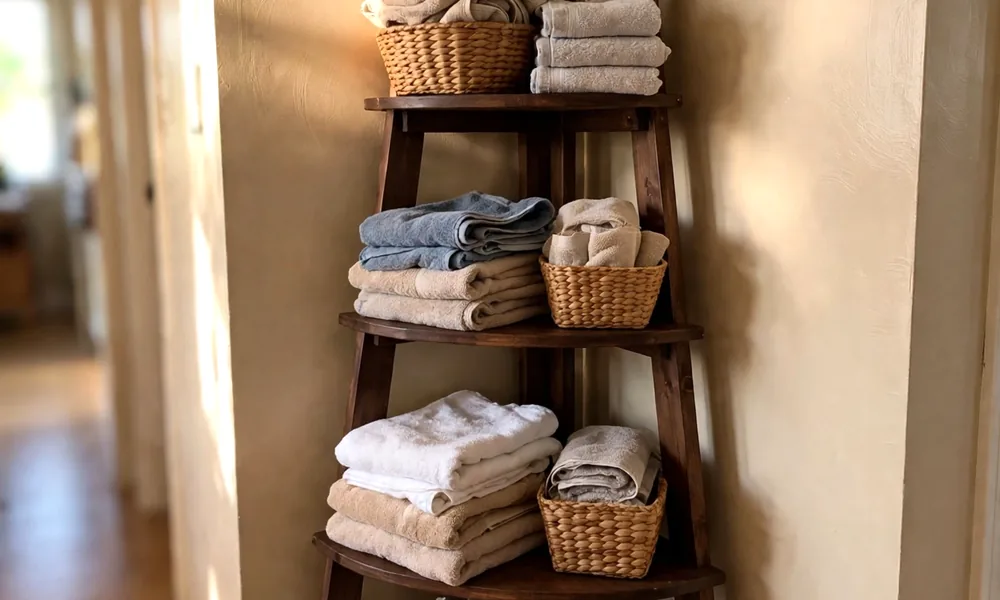
A ladder corner shelf leans against the corner, with shelves that get deeper towards the floor. It is the best choice for renters, because it needs no drilling, and for bathrooms, where it holds towels and toiletries beside the bath. The trade-off is floor space: the bottom shelf sticks out further than a floating shelf, so measure at floor level and make sure the ladder does not block a door swing or a walkway.
Freestanding Corner Units
A freestanding corner unit is a small triangular bookcase that stands on the floor and fills the corner to waist height or the ceiling. It is the only corner shelf that holds real weight — 10 to 20 kilograms across its shelves — so it suits books, board games and heavier display pieces no floating shelf could carry. The cost is the floor space it takes, which defeats the purpose in a very small room. Our guide to the best bathroom shelves for small bathrooms shows the same trade-off in a wet room: a freestanding unit holds more, but only a wall-mounted shelf keeps the floor clear.
Glass Corner Shelves
Glass corner shelves are made for bathrooms and showers, where a small triangular shelf above the bath holds shampoo and soap exactly where they are used. Tempered glass wipes clean, never rusts, and suits a steamy room better than wood or painted MDF, but it holds the least weight of any type, at 2 to 3 kilograms, and shows every water mark. Suction-cup shelves suit renters and smooth tiles but fall off textured tiles; screwed shelves hold better, so drill if the landlord allows it.
Getting the Size Right
Size matters more with a corner shelf than with any other shelf, because it has to fit two walls at once. Measure each wall from the corner outwards, at the height where the shelf will sit, and buy shorter than the shorter measurement: a shelf that overhangs one wall looks wrong from every seat in the room. A triangular shelf with 30 to 40 centimetre sides suits most corners, while 50 centimetre sides suit a large room and look oversized in a small one. Depth is decided by the corner: a triangle with 30 centimetre sides reaches about 21 centimetres into the room, enough for a plant pot or paperbacks but not for a large vase.
Height matters too. A single corner shelf should sit at eye level, around 150 to 160 centimetres from the floor, and a tiered set should start at about 120 centimetres and climb to 180. Measure the corner at three heights before you order, because walls lean: a corner that measures 30 centimetres at waist height can measure 28 at the ceiling.
Fixing Them So They Stay Up
Fixing is where most corner shelves fail, and it is the easiest part to get right if you take it slowly. A corner shelf needs solid fixings in two walls, and the corner is often the weakest part of the plasterboard, so find the studs first and mark the bracket positions with a spirit level, not by eye. Use fixings that match your wall, not the ones in the box: plasterboard anchors for hollow walls, masonry plugs for brick, wood screws where a stud sits behind the plaster. Load the shelf slowly, lightest things first, and check it after a day before trusting it with anything breakable. Our guide to the best desk shelves for home offices covers the same rules for a straight wall, and every one applies twice in a corner.
The commonest mistake is fixing one side well and the other badly, so the shelf slowly twists out of level. Check both sides with the spirit level after the first bracket is in. If one wall is solid and the other is hollow, put the heavier end over the solid side. If neither wall will take a fixing, use a ladder shelf or a freestanding unit instead.
Styling a Corner Shelf Without the Clutter
A corner shelf earns its place by what sits on it, and the rule is the same as for any display shelf: leave a third of it empty. A triangular shelf holds three or four objects at most — a plant, a book stack, a candle, a photo — and anything more turns it into a ledge of things you forgot you owned. Put the tallest object at the back, against the corner itself, and the smallest at the front edge. A trailing plant softens the hard angle better than anything else, because the leaves spill over the front edge and break up the triangle. Match the shelf to the room: light wood suits a bright living room, black metal suits a modern bedroom, and glass suits a bathroom.
Colour matters because a corner is already a shadow, so pale shelves and pale objects read better than dark ones. Avoid a mirror on a corner shelf — it reflects the two walls back at each other. A picture, a ceramic vase or a small clock all work better. Keep the top of a tiered set lighter than the bottom, with the heaviest objects low.

Corner Shelf Checklist
- Measure both walls from the corner at shelf height, and buy shorter than the shorter wall.
- Check the corner angle with a square and both walls with a stud finder before you drill anything.
- Choose the type for the job: floating for display, tiered for plants, ladder for renters, freestanding for books, glass for bathrooms.
- Use fixings that match your wall type, and load slowly, lightest things first.
- Style with three or four objects per shelf and leave a third of it empty.
- Keep the heaviest objects low on tiered and ladder shelves so the set stays stable.
Frequently Asked Questions
Are corner shelves hard to install?
They are slightly harder than straight floating shelves because every fixing has to land in two walls. A stud finder, a spirit level and the right anchors make the job straightforward, and a ladder shelf needs no drilling.
How much weight can a corner shelf hold?
A floating corner shelf typically holds 3 to 5 kilograms, a tiered set holds 2 to 4 kilograms per tier, a ladder shelf holds 5 to 10 kilograms in total, and a freestanding corner unit holds 10 to 20 kilograms.
Do corner shelves work in small rooms?
They work better in small rooms than any other shelf, because they use space no other furniture can use and take no floor at all. A pair above a sofa or a desk adds display space without crowding the room.
What should I put on a corner shelf?
Three or four objects at most: a plant, a stack of books, a candle or a photo. A trailing plant suits a corner best, because it softens the hard angle.
Are corner shelves good for bathrooms?
Yes, if you choose glass or another moisture-proof material. A small glass shelf above the bath holds shampoo and soap where they are used, and a ladder shelf beside the bath holds towels. Wood swells and warps in a steamy bathroom.
Can renters use corner shelves?
Yes. A ladder corner shelf leans against the corner and needs no drilling, and some glass shelves fix with suction cups on smooth tiles. Adhesive strips can hold a very light shelf, but never trust adhesive with anything breakable.
The Bottom Line
Corner shelves are the simplest way to make a dead corner useful: a triangular or tiered shelf turns wasted angle into display, storage or a home for plants, without taking any floor. Measure both walls, pick the type for the job, fix it into both walls properly, and style it lightly.