
Best Adhesive Hooks for Renters Who Can’t Drill in 2026
A good adhesive hook holds your keys by the door, a towel in the bathroom or a row of utensils in the kitchen, all without a drill, a screw or a hole in the wall. A bad one slides off the tile by morning or peels paint away when you pull it off. Here is which hooks stay up, how much weight they carry, and where they should never be trusted.
Key Takeaways
- Most hold 0.5 to 3 kilograms on a smooth, clean wall at room temperature.
- Smooth painted plaster, glass and glazed tile grip well; textured wallpaper, rough plaster, brick and dusty paint do not.
- Clean the surface, press firmly for thirty seconds, and wait an hour before hanging anything on it.
- They suit light items like keys, hand towels, utensils and cables, not heavy coats or full bath towels.
- Pull the tab slowly straight down the wall, never outwards, or warm the pad gently if there is no tab.

What an Adhesive Hook Really Is
An adhesive hook sticks to the wall instead of screwing into it. The hook can be plastic or stainless steel, but the part that does the work is the pad behind it: foam tape, a clear nano-tape gel, or a stretch-release strip. The pad grips hard under a steady downward pull, the load a hanging towel or a set of keys creates.
That explains the two ways they fail: a swinging load, like a coat grabbed off a hook ten times a day, works the pad loose, and a surface the pad cannot fully touch, like textured wallpaper, gives the adhesive only a fraction of its grip. For pictures, our guide to command strips that hold without holes covers the flat pads made for frames and mirrors.
The Main Types of Adhesive Hook
Almost every adhesive hook falls into one of five types, and the type matters more than the brand.
Foam-Tape Plastic Hooks
The classic is a small white or clear plastic hook on a foam-tape pad, sold in packs of ten or twenty. It holds keys, lanyards, cables and a hand towel, usually up to about one kilogram. It is cheap and the right default for most rooms, but heat is its weakness: a foam pad above a radiator or in a sunny window softens and creeps down.
Clear Nano-Tape Hooks
Clear hooks use a thick gel tape that looks almost invisible on tile and glass, and many can be washed and reused. They grip smooth surfaces better than foam tape, but a single grout line under the pad cuts the grip sharply, and on painted walls the gel can pull paint off.
Metal Adhesive Hooks
Metal hooks pair a stainless steel or brushed brass hook with a strong adhesive pad, and they look like proper hardware rather than a temporary fix. They suit hallways and kitchens, and they usually carry two to three kilograms. Check the pad: a good one uses a wide pad with a stretch-release tab.
Suction Hooks
Suction hooks are a different tool: they grip with a vacuum cup instead of glue. On a mirror, a glazed tile or a glass shower screen they hold well and move in seconds, handy for a razor or a sponge. On any surface with the slightest texture, or on painted plaster, they fall off within days.
Adhesive Rails and Rows
A rail is several hooks on one adhesive strip, made for a row of coats or towels in a shared space. It spreads the load across a wider pad, so it can carry more than a single hook, but it needs a long, flat, smooth stretch of wall, and if one end of the pad fails the whole rail tilts.
| Type | Best for | Typical load | Watch out for |
|---|---|---|---|
| Foam-tape plastic | Keys, cables, light decor | Up to 1 kg | Softens in heat |
| Clear nano-tape | Tile and glass | Up to 2 kg | Pulls paint off walls |
| Metal adhesive | Hallways and kitchens | 2 to 3 kg | Pad matters more than hook |
| Suction | Mirrors and shower screens | Up to 1 kg | Falls off textured surfaces |
| Adhesive rail | Shared hallways | 3 to 5 kg total | Needs a long flat wall |
Matching the Hook to the Weight
Most failures are simply a hook asked to carry too much. A set of keys weighs under half a kilogram. A hand towel is light when dry but twice as heavy when damp. A full bath towel can weigh over a kilogram when wet, so it belongs on a rail or a screwed hook. A wet winter coat weighs three to four kilograms and swings every time the door opens. For a heavy coat, our guide to the best wall hook for heavy coats explains why a screwed hook into a stud is the only reliable answer.
Packet ratings are measured in ideal conditions: a smooth, clean wall at room temperature, with the pad pressed on properly and left to bond. Treat the rating as a ceiling and leave a margin. A hook rated for two kilograms will hold a one-kilogram towel for years, but loaded to its full rating on a warm wall it may last only months.
The Wall Decides More Than the Hook
Smooth painted plasterboard is the best surface: the pad makes full contact and bonds evenly. Glazed tile and glass are just as good, which is why adhesive hooks feel so secure in bathrooms and kitchens. Fresh paint is a trap: the hook bonds to paint that has not yet hardened, so wait at least a month after painting.
Textured wallpaper, rough plaster, brick and bare wood are poor surfaces, because the pad only touches the high points. Dust is just as bad: a wall that looks clean may carry a fine layer that stops the pad bonding, so wipe the spot with a damp cloth and let it dry fully first. Damp is the third enemy: a hook in a steamy bathroom loosens as moisture works under the pad.
Where Adhesive Hooks Work Best
In the Bathroom
The bathroom is the best room for adhesive hooks, because the walls are smooth tile and glass and the items are light. A hook beside the basin takes a hand towel, a hook on the shower screen holds a sponge or a razor, and a hook on the door takes a robe. Keep the loads light: a damp hand towel is fine, but a heavy wet bath towel will pull the pad down. Our guide to towel hooks that actually dry your towels covers the fittings that suit a steamy bathroom.
In the Kitchen
The kitchen suits adhesive hooks for the same reason: smooth tiles and light items. A row of hooks under a cabinet holds measuring cups, scissors and tea towels, and a hook on the fridge keeps an oven glove where you can grab it. Keep hooks away from the hob, where heat softens the adhesive, and from the sink splash zone.
In the Entryway
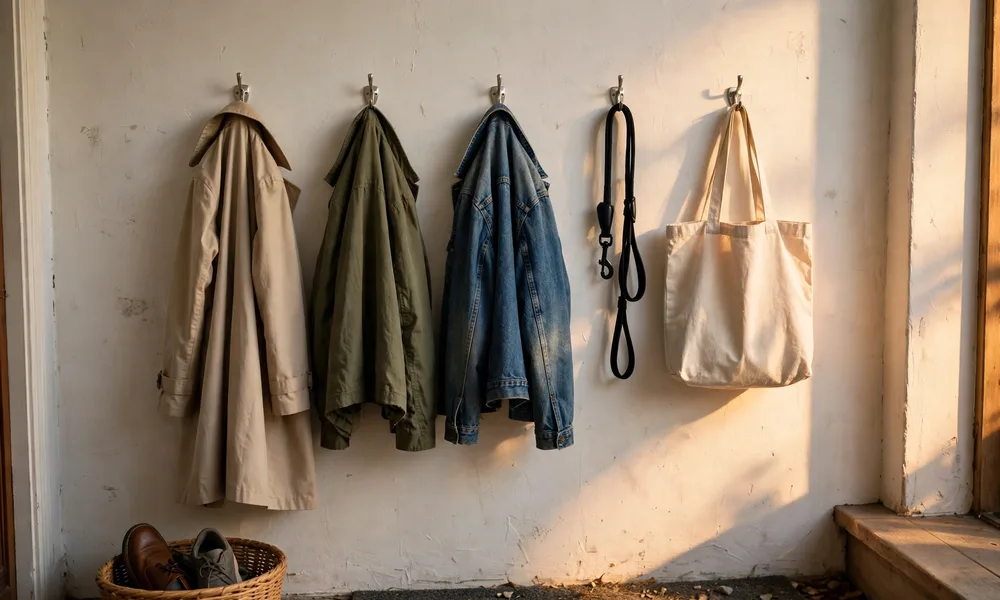
The entryway is where adhesive hooks earn their keep in a rental. A row of hooks by the door holds keys, a dog lead, a tote bag and a light jacket, and the whole setup comes down without a trace when you move out. The weight limit matters most here, so stick to keys, leads and bags and keep coats on a screwed rail.

Where Adhesive Hooks Fail
The failures are predictable. Heavy coats are the classic example: a wet coat weighs several kilograms and swings every time the door opens, and no adhesive pad is meant to carry that repeated, moving load. Heat is another: a hook above a radiator or in a sunny window softens, creeps a millimetre a day, and ends up on the floor. Steam does the same in a bathroom with no ventilation.
How to Fit One So It Stays Up
Fitting one properly takes two minutes, and skipping a step is the most common reason a good hook fails. Wipe the spot with a damp cloth, then let it dry completely. Peel the backing off without touching the adhesive, because the oil on your fingers weakens the bond. Press the hook against the wall and hold it firmly for thirty seconds, pushing across the whole pad.
Then wait: most makers ask for a full hour before you hang anything on the hook. A hook loaded five minutes after fitting has only a fraction of its rated strength. If the room is cold, warm the wall gently with a hairdryer first, because adhesive bonds poorly below about fifteen degrees.
How to Remove One Without Damage
Removal is where adhesive hooks earn their reputation with renters. If the hook has a stretch-release tab, pull it slowly straight down along the wall, keeping it close to the surface: stretching the tab draws the adhesive into a long thin line that lets go gradually. Never pull the tab outwards away from the wall, which peels the paint off in a patch.
If there is no tab, warm the pad gently with a hairdryer for about thirty seconds, then peel the hook away slowly from one corner. Any residue usually rolls off with a fingertip or a dab of washing-up liquid.
Checklist: Before You Stick Anything Up
- Weigh the item and pick a hook rated for at least twice that weight.
- Check the wall is smooth, clean, dry and fully cured if freshly painted.
- Keep the hook away from radiators, hobs, sunny windows and constant steam.
- Wipe the spot, press the pad firmly for thirty seconds, and wait an hour before loading it.
- Space hooks at least twenty centimetres apart so items hang without bunching.
- Test removal on a hidden spot first.
Frequently Asked Questions
How much weight can an adhesive hook really hold?
Most hold 0.5 to 3 kilograms, and rails hold 3 to 5 kilograms in total. The packet rating assumes a smooth, clean wall at room temperature, so treat it as a ceiling: a hook rated for two kilograms will hold a one-kilogram towel for years, but loaded to its full rating on a warm wall it may last only months.
Will adhesive hooks damage the paint when removed?
A good hook with a stretch-release tab comes off cleanly if you pull the tab slowly straight down along the wall. Damage usually happens when the paint is fresh, dusty or already loose, or the tab is pulled outwards.
Do adhesive hooks work in bathrooms?
Yes, on smooth glazed tile, glass and mirrors, where they are at their best. Pick a hook rated for humid rooms, fit it when the room is dry, and keep the loads light.
Can I reuse an adhesive hook after removing it?
Foam-tape hooks cannot be reused, because the pad is spent once stretched. Clear nano-tape hooks often can: wash the gel pad with warm soapy water, let it dry, and it grips again. Metal hooks can be reused with a fresh pad.
Why did my adhesive hook fall off overnight?
The usual causes are a dusty or damp wall, loading the hook before the adhesive had an hour to bond, a textured surface, or heat softening the pad.
Are adhesive hooks or screwed hooks better?
Adhesive hooks are better for light items in rented homes, where holes are forbidden and the hook must come off cleanly. Screwed hooks are better for anything heavy, anything that swings, and anything used many times a day, like a wet winter coat.
The Bottom Line
The best adhesive hook is the one matched to the weight, the wall and the room: a foam-tape hook for keys and cables, a clear hook for tile and glass, a metal hook where it will always be seen, and a rail where a shared space needs order. Fit it on a clean, smooth, dry wall, press it for thirty seconds, wait an hour before loading it, and pull the tab straight down when it comes off.


