Towel Hooks That Actually Dry Your Towels in 2026
Towel hooks are the smallest fitting in the bathroom, and the one you touch most often. A good towel hook holds a damp towel where air can reach it, keeps it off the floor and the back of a chair, and stays solid after years of daily tugs. This guide covers the shapes worth buying, the materials that survive steam, and the spacing that keeps towels fresh.
Key Takeaways
- Hang towels by their loop on a hook with a deep curve and an upturned tip, so the towel stays put and hangs open enough for air to reach both sides.
- Give each towel its own hook and leave at least 20 centimetres between hooks, because towels bunched together stay damp and start to smell.
- Stainless steel and solid brass survive a steamy bathroom far better than thin chrome or plastic, which spot, peel or bend within a year.
- Screw hooks into a stud or a proper wall anchor on plasterboard; adhesive hooks suit light hand towels on smooth tile, not heavy wet bath towels.
- Hooks suit hand towels and daily bath towels, but a bath towel dries fastest spread flat on a rail or rack.
What a Towel Hook Is, and What It Is Not
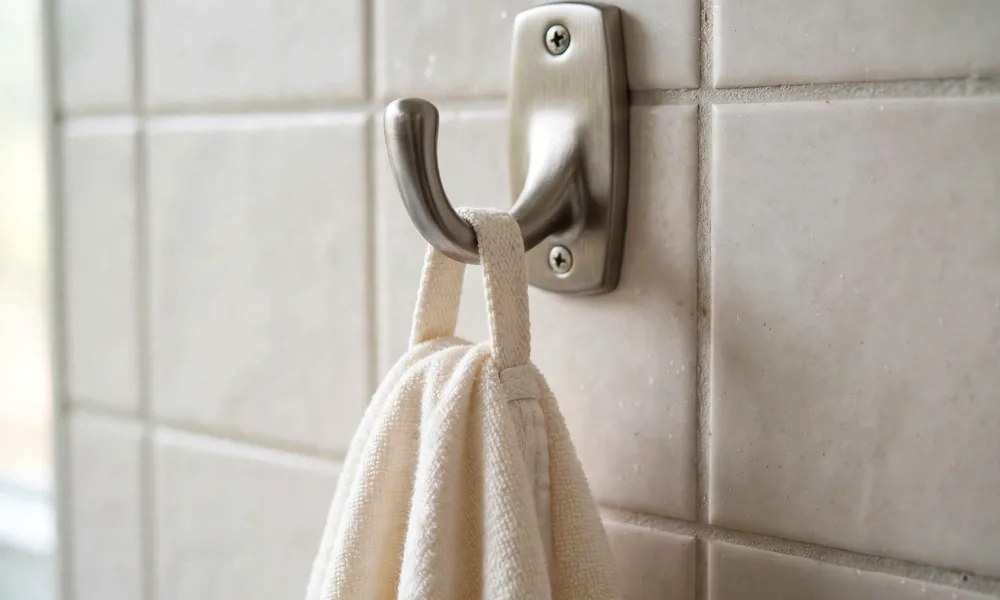
A towel hook is an open, curved prong on a small wall plate. You hang the towel by its loop, or fold it over the curve, and gravity does the rest. It is a different tool from the other towel fittings in the room, and mixing them up is how people end up with towels that never dry. A towel ring is a closed loop you thread the towel through, and it suits a hand towel at the basin, where the towel is used lightly and dries between washes. A towel bar or rail holds a bath towel spread flat, which is the fastest way to dry a large towel. A towel hook sits between the two: quicker to use than a ring, and far less wall-hungry than a bar.
That middle position is why hooks are so popular in small bathrooms, cloakrooms and kitchens. A single hook beside the basin takes the hand towel. A pair of hooks on the bathroom door takes the towels nobody wants to fold. The trade-off is drying speed. A towel hanging from a hook folds in on itself, so the middle layers dry slowly, and a thick bath towel hung from a hook can still be damp the next morning. The rest of this guide is about closing that gap.
The Main Types of Towel Hook
Almost every towel hook is one of five shapes, each suiting a different towel, wall and household.
Single hooks
A single hook is one curved prong on a round or square base, and it is the tidiest option when one person uses one hook for one towel. Look for a deep curve with an upturned tip, because a shallow hook lets a thick towel loop slide off the moment you brush past it. Two singles spaced 25 to 30 centimetres apart give a couple each their own hook.
Double and triple hooks
A double hook has two prongs on one base, and a triple has three. Doubles are the workhorse of family bathrooms: one prong for the bath towel, one for the hand towel, with air between them so both dry. Triples suit shared bathrooms, but check the prong spacing: prongs closer than 8 centimetres crush thick towels.
Adhesive hooks
Adhesive hooks stick to smooth tile, glass or painted wood with a foam or gel pad, and they need no drilling. Their honest limit is weight: most are rated for 2 to 3 kilograms, assuming a clean, dry, perfectly smooth surface. A light hand towel is well inside that limit, but a heavy wet bath towel sits right at it, so use adhesive hooks for light towels and screwed hooks for anything heavier. Textured tile defeats adhesive, so test one hook first.
Over-door hooks
Over-door hooks hang from the top of a door and need no fixing at all. The catch is the door itself: a hook that is too thick stops the door closing, one that is too thin wobbles and scratches the paint, and a row of hooks loaded with wet towels pulls on the hinges. Keep the total load light, with the heaviest towel nearest the hinges.
Hooks on a rail or board
A rail or board with several hooks fixed along it is the neatest answer for a family bathroom. It needs a clear stretch of wall, with nothing above it that the towels will brush against.
Materials and Finishes That Survive Steam
A towel hook lives in the dampest room in the house, and the finish decides whether it still looks good in two years. Stainless steel is the safest all-round choice: it resists rust, wipes clean, and suits almost any bathroom. Chrome looks bright and clean when new, but thin chrome over a cheap base can peel or spot once steam gets under it, so check that the coating feels thick and even. Matte black finishes look modern and hide water marks well, yet they can chip if knocked.
Where to Put Towel Hooks
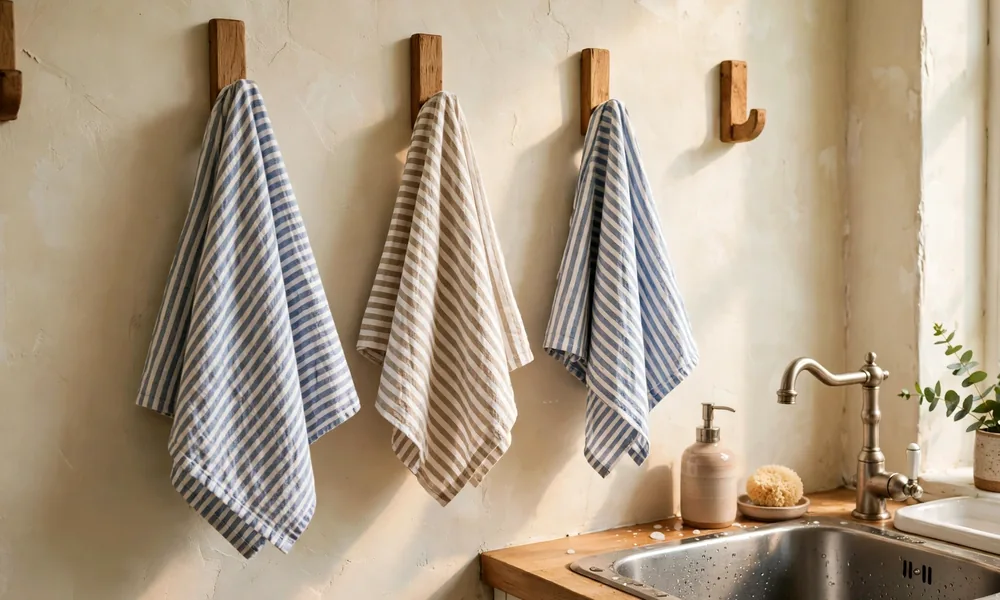
Placement matters more than price. A towel hook in the wrong place is ignored, and the towel ends up on the floor anyway. The hand towel hook belongs beside the basin, at hand height, roughly 120 to 140 centimetres from the floor, so you can reach it with wet hands without dripping across the room. In a kitchen, the tea towel hook belongs beside the sink, not above the cooker.
Hang bath towel hooks at about 150 to 165 centimetres, so the towel hangs clear of the floor even when it is long, and lower, around 120 centimetres, for children’s towels so small hands can reach them. Space hooks at least 20 centimetres apart, and 25 to 30 if the towels are thick, because towels that touch each other do not dry. Leave a gap of at least 5 centimetres between the hook and the wall, so air moves behind the towel.
How to Make Towels Dry Faster on Hooks
The honest truth is that hooks dry towels more slowly than a rail. A towel rack spreads a bath towel flat so air reaches both sides, and the same towel folded over a hook can stay damp in the middle until the next morning. Hang the towel by its loop and let it fall in a single layer, rather than folding it double over the hook. Spread the folds apart once it is hanging, so the fabric opens up instead of sitting in a tight bundle. And give each towel its own hook.
Ventilation does the rest. A bathroom with a working extractor fan, or a window opened for ten minutes after a shower, dries towels far faster than any hook design. In a windowless bathroom, leave the door ajar after showering so steam can escape. Wash towels regularly, and rotate them so each one gets a full dry between uses.
Towel Hooks Compared
| Type | Best for | Typical load | Watch out for |
|---|---|---|---|
| Single hook | One towel, one person | 3 to 5 kg | Shallow curves let loops slide off |
| Double hook | Bath towel plus hand towel | 5 to 8 kg | Prongs too close crush thick towels |
| Triple hook | Shared family bathrooms | 6 to 10 kg | Crowded prongs slow drying |
| Adhesive hook | Renters, smooth tile | 2 to 3 kg | Heavy wet towels pull them off |
| Over-door hook | No free wall, guest rooms | 2 to 4 kg | Wrong fit scratches the door |
| Hook rail or board | Family towel stations | 8 to 12 kg | Needs a clear stretch of wall |
Mistakes That Leave Towels on the Floor
Most towel hook failures are not about the hook at all. The first mistake is the fixing: a screw driven into bare plasterboard with no anchor works loose a little every time the towel is lifted off and hung back up, until one day the hook comes away in your hand. Always screw into a stud or use a proper wall anchor. The second mistake is the wrong hook for the towel. A small hook with a shallow curve cannot hold a thick bath towel by its loop, and a hook meant for a hand towel will slowly bend open under a heavy wet bath towel.
The third mistake is crowding. A row of hooks set 10 centimetres apart looks tidy in a photograph, but in daily use the towels press together, trap damp, and start to smell within days. And the sixth is mixing jobs: a hook that also holds a heavy dressing gown will be pulled loose far faster than one that holds towels only, because a wet robe weighs far more than a towel, and robe hooks are built for that heavier, steamier job.

Checklist: Before You Buy Towel Hooks
- Count the towels that need a hook, one per person plus a spare, and buy that many hooks, not fewer.
- Check the towel loops: every towel that will hang from a hook needs a strong loop, or a double hook to fold over.
- Measure the wall and the spacing: at least 20 centimetres between hooks, and room for the longest towel to hang clear of the floor.
- Match the fixing to the wall: stud or anchor for screwed hooks, smooth clean tile only for adhesive hooks.
- Pick one finish for the whole bathroom and match it to the taps, the rail and the other fittings.
- Test one hook with a damp towel for a week before fitting a row.
Frequently Asked Questions
How many towel hooks do I need in a bathroom?
One per person, plus one spare: a family of four needs five hooks, four for bath towels and one for the hand towel.
Are towel hooks better than towel rings?
For bath towels, yes: a hook takes the towel by its loop in one movement and holds thicker towels, while a ring suits a light hand towel at the basin. For a light hand towel, a ring is just as good.
Will adhesive towel hooks hold a wet bath towel?
Usually not for long. Most are rated for 2 to 3 kilograms, and a heavy wet bath towel sits right at that limit. Use adhesive hooks for hand towels and screwed hooks for bath towels.
How high should towel hooks be?
About 150 to 165 centimetres for bath towels, so the towel hangs clear of the floor, and 120 to 140 centimetres for hand towels beside the basin. Children’s hooks should sit at about 100 to 120 centimetres.
Why do my towels smell musty on hooks?
Because they are not drying fully between uses. The usual causes are hooks too close together, towels folded double, or poor ventilation. Space the hooks out, spread the folds open, and air the room after showering.
Can I put towel hooks in the kitchen?
Yes, and they work well there. A hook beside the sink keeps the tea towel off the worktop. Keep hooks away from the cooker.
The Bottom Line
The best towel hook is a simple thing done well: a deep curve, a solid fixing, a finish that survives steam, and enough space around it for the towel to dry. Count the towels, give each one its own hook, space them at least 20 centimetres apart, and screw them into something solid. Do that, and your towels will be dry exactly where you left them.