How to Pick Robe Hooks That Hold Without Pulling Out in 2026
A good robe hook is a small piece of hardware with an unfair job. It has to hold a wet, heavy bathrobe every single day, in the dampest room in the house, without bending, rusting, or pulling out of the wall. The best robe hooks do that quietly for years. The worst ones sag within a month, drop your robe on a wet floor, and leave a torn hole in the plaster. This guide explains how to pick robe hooks that hold.
Key takeaways
- Weight capacity is decided by the fixing, not the hook: a strong hook on a weak fixing will still pull out under a wet robe.
- A dry terry robe weighs about 800 grams; soaked after a shower it can weigh close to 2 kilograms, so buy a hook rated well above what you think you need.
- Solid brass, stainless steel, and zinc alloy hold up in a steamy bathroom far better than hollow metal or plastic, which bend and rust.
- Double hooks share the load and keep a robe and a towel apart, so both dry faster and nothing ends up on the floor.
- Screw a hook into a stud or use a proper wall anchor; adhesive pads suit light robes on smooth tile, but not heavy terry robes.
Why robe hooks fail
Most robe hooks fail for the same three reasons, and none of them is the hook snapping in half. The first is the fixing: a screw driven into bare plasterboard with no anchor works loose a little every time the robe is lifted off and hung back up. The second is rust, as cheap chrome spots orange within a few months of steam. The third is the wrong hook for the weight, as a small hook with a shallow curve lets a thick robe loop slide off, or slowly bends open until the robe slips to the floor.
None of this is hard to avoid. A robe hook is not a coat hook, even though the two look alike. Wall hooks for heavy coats are built for entryways and heavy wool, and they assume a solid wall and a thick coat loop. A robe hook lives in a bathroom or bedroom, holds a soft fabric loop, and fights steam every day.
The four kinds of robe hook
Every robe hook on the market is one of four shapes. Each suits a different robe, a different wall, and a different household.
Single hooks
A single hook is one curved prong on a round or square base. It is the tidiest option and the right one when one person uses one hook for one robe. Look for a deep curve with an upturned tip, because a shallow hook lets a thick robe loop slide off the moment you brush past it. A single hook rated for 5 kilograms is plenty for any robe, provided the fixing behind it is sound. Two singles spaced 25 to 30 centimetres apart give a couple each their own hook.
Double and triple hooks
A double hook has two prongs on one base, and a triple has three. Doubles are the workhorse of family bathrooms: one prong for the robe, one for a towel, with air between them so both dry. The load spreads across two fixing screws instead of one. Triples suit shared bathrooms, but prongs closer than 8 centimetres apart crush a thick robe against its neighbour and slow drying to a crawl.

Adhesive hooks
Adhesive hooks stick to smooth tile, glass, or painted wood with a foam or gel pad, and they need no drilling. They are the right choice for renters and for anyone who does not want holes in a tiled wall. Their honest limit is weight: most are rated for 2 to 3 kilograms, assuming a clean, dry, perfectly smooth surface. A heavy wet terry robe is right at that limit, so use adhesive hooks for light waffle or cotton robes. Textured tile defeats adhesive, so screw the hook in instead. Suction hooks are the weakest option: a vacuum cup and lever that steam loosens over time, so treat them as temporary, not as the permanent home for a heavy robe.
What a wet robe really weighs
People underestimate robe weight by a lot, and that is why so many hooks fail. A light waffle-knit robe weighs around 400 grams dry. A mid-weight cotton robe is about 600 grams. A thick terry robe is 800 grams to 1 kilogram dry, and it can hold its own weight in water after a shower, so the hook carries close to 2 kilograms from one small loop, several times a day.
Buy with that number in mind. A hook rated for 3 kilograms is the minimum for a terry robe, and 5 kilograms is a comfortable margin. Treat the box rating as a best case: it assumes a perfect fixing in solid material.
Materials and finishes that survive a bathroom
A bathroom is the hardest room in the house for metal. Steam condenses on every surface, and a hook that stays damp grows rust spots, then pits, then weakens. Stainless steel is the safest all-round choice: it does not rust in normal bathroom use and it is strong for its size. Solid brass is the classic choice, heavy and naturally resistant to corrosion. Zinc alloy is fine when the plating is thick and even, but a thin coat chips and the metal underneath corrodes fast. Avoid hollow tubular hooks and plastic hooks for anything heavier than a light robe: they bend and snap without warning.
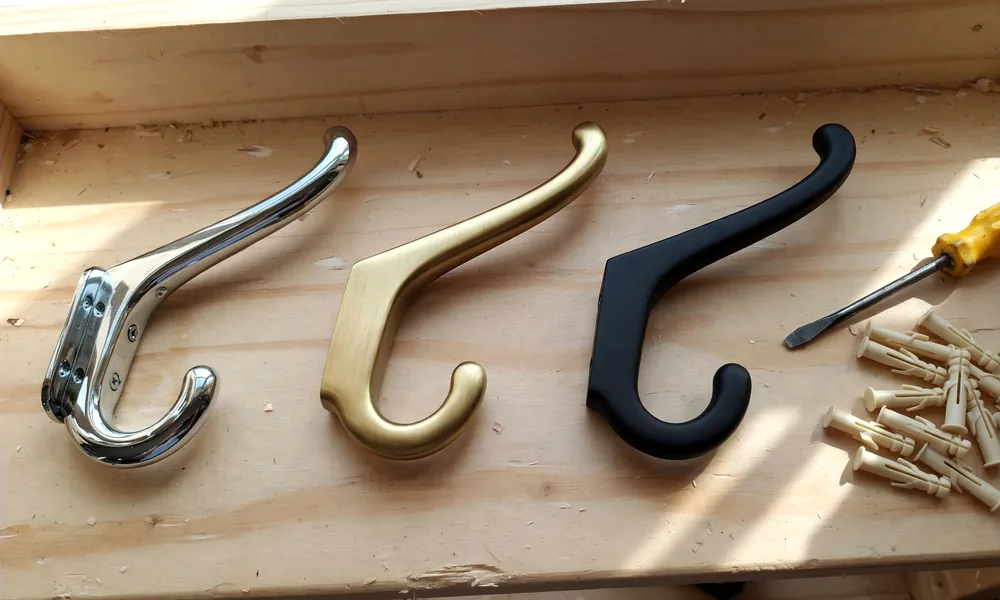
Polished chrome is bright and easy to clean but shows water spots. Brushed nickel hides spots and fingerprints, the most forgiving finish in a family bathroom. Matte black shows limescale, so it needs a weekly wipe.
Where to put robe hooks
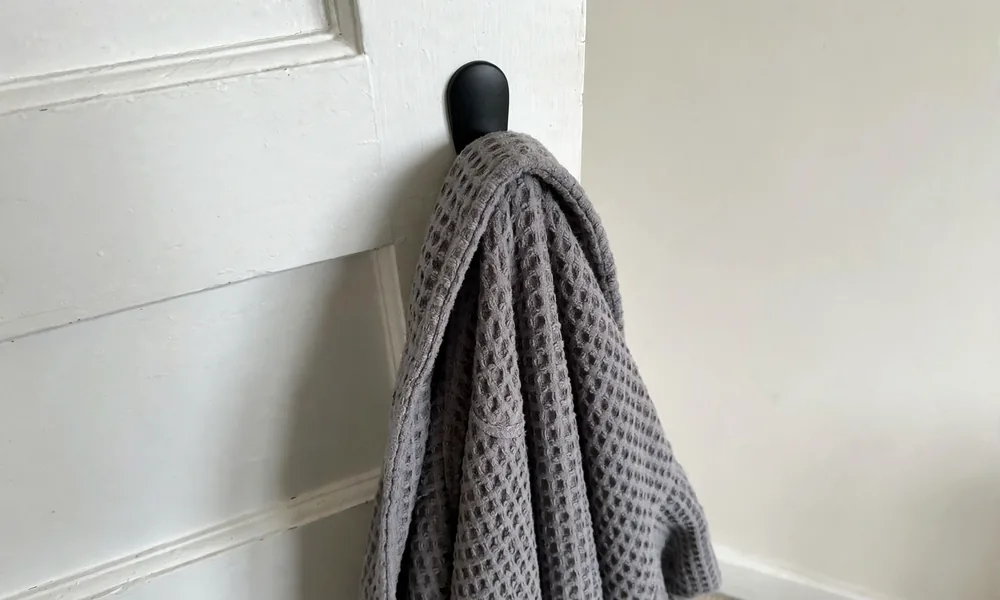
Placement decides whether a robe hook gets used or ignored. The right height is 150 to 165 centimetres from the floor: low enough to reach without stretching, high enough that a long robe does not drag on the floor. In a bathroom, put the hook on the wall beside the shower or bath, within one step of the shower. A hook on the far wall means a robe draped over a towel rail instead.
On a door, the back of the bathroom or bedroom door is the classic spot, and it works well when the hook is screwed in. Over-door hooks are a different product: a rack that hangs over the top of the door and holds several items at once. A fixed robe hook is better when one robe needs one solid anchor, while an over-door rack wins when a whole family shares one door. Give each hook breathing room: a robe needs about 30 centimetres of clear wall on each side, or it stays damp and smells musty.
Robe hook types compared
| Type | Best for | Typical load | Needs drilling | Renter friendly |
|---|---|---|---|---|
| Single screw-fixed | One robe, one person | 5 kg | Yes | No |
| Double or triple | Family bathrooms | 7 to 10 kg | Yes | No |
| Adhesive | Light robes, smooth tile | 2 to 3 kg | No | Yes |
| Suction | Temporary or travel use | 1 to 2 kg | No | Yes |
| Over-door rack | Shared doors, many items | 5 to 8 kg | No | Yes |
How to fit a screw-fixed hook so it stays put
Fitting a robe hook properly takes ten minutes. Mark the height with a pencil, 150 to 165 centimetres from the floor, and check the spot is clear of pipes and cables. Drill a pilot hole, then fit the right anchor for the wall: a plasterboard anchor for hollow walls, a masonry plug for brick or block, and a tile drill bit for ceramic tile so the tile does not crack. Push the anchor in flush, drive the screw through the hook base, and tighten until the base sits flat with no wobble. Test it before you trust it: hang a full kettle from it for an hour. If the hook moves or the screw turns, refit it with a bigger anchor rather than a longer screw.
Renter-friendly options that actually hold
Renters do not have to live with a robe on the floor. Adhesive hooks from a reputable maker hold a light robe on smooth tile for months, provided the tile is cleaned with alcohol first and the pad cures for 24 hours before use. Removable strips are a good middle ground: they hold 2 to 3 kilograms and peel off without damage when you move out. Test one hook with a towel for a week first: textured tile and grout defeat adhesive pads.
Choosing by robe type
Match the hook to the robe. A light waffle robe suits any hook, including adhesive. A cotton robe needs a screw-fixed single or double with a 3-kilogram rating. A heavy terry robe needs a screw-fixed double or a sturdy single rated for 5 kilograms, in stainless steel or brass. A bulky hooded fleece robe needs a deep curve and wide spacing more than raw strength. Kids’ robes are light, but children yank robes off hooks, so fit kids’ hooks lower, at 120 centimetres, and screw them in properly. Sew a small loop at the back of the neck if your robe has none. Our guide to bathrobes explains which weights and fabrics suit different mornings.
Checklist: before you buy robe hooks
- Assume 2 kilograms for a thick terry robe wet, and buy a hook rated at least double that.
- Choose stainless steel or solid brass for a steamy bathroom, and check the plating is thick and even.
- Pick a deep curve with an upturned tip so a thick robe loop cannot slide off.
- Match the fixing to the wall: plasterboard anchor, masonry plug, or tile bit, never a bare screw in plasterboard.
- Measure the height at 150 to 165 centimetres and leave 30 centimetres of clear wall on each side.
- Count one hook per person, and give heavy robes a screw-fixed hook rather than an adhesive one.
Frequently asked questions
How much weight should a robe hook hold?
At least 3 kilograms for a light robe and 5 kilograms for a heavy terry robe, because a wet terry robe can weigh close to 2 kilograms.
Are adhesive robe hooks strong enough?
Yes for light waffle or cotton robes on clean, smooth tile, where most adhesive hooks hold 2 to 3 kilograms. They are not right for a heavy wet terry robe, and they fail on textured tile, grout, or rough paint.
Why does my robe hook keep pulling out of the wall?
Almost always because the screw has no anchor, or the wrong anchor for the wall. A screw in bare plasterboard works loose a little every time the robe is lifted off. Refit it with a plasterboard anchor or a masonry plug.
What is the best height for a robe hook?
Between 150 and 165 centimetres from the floor for adults, and about 120 centimetres for children.
Do robe hooks rust in the bathroom?
Cheap chrome over mild steel will rust within months of daily steam, but stainless steel and solid brass do not rust in normal bathroom use.
Single or double robe hook: which should I choose?
A single hook is tidiest for one person and one robe. A double hook is better for a family bathroom, because one prong holds the robe and the other holds a towel, with air between them so both dry.
The bottom line
The best robe hook is not the prettiest in the shop. It is a solid stainless steel or brass hook with a deep curve, screwed into a proper anchor, with room around it for the robe to dry. Get the fixing right and a modest hook will hold a wet robe for years.
BestXWorst verdict: 10 out of 10. A well-chosen robe hook is one of the cheapest upgrades in the house, and it is the one you touch every single day.